Monday Myth: Standardisation Kills Innovation
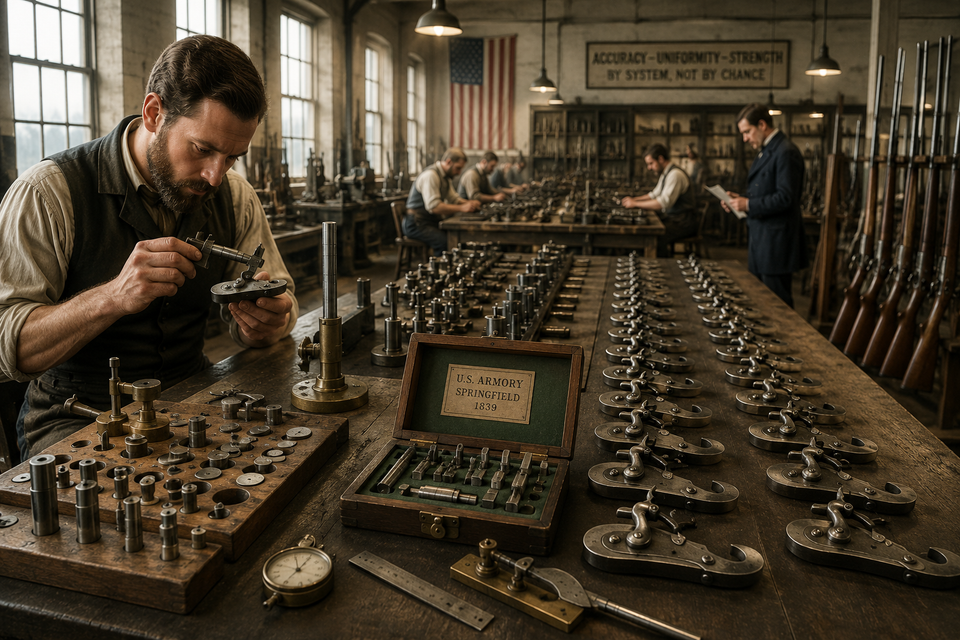
The Armoury That Changed Industry
At the beginning of the nineteenth century, firearms remained as much the product of individual craftsmen as of organised industry. Every musket represented hundreds of hours of skilled labour. Gunsmiths filed, adjusted and fitted each component by hand until it matched its neighbouring parts. Two rifles leaving the same workshop might appear identical, yet exchanging the lock mechanism or trigger assembly between them often proved impossible. Every weapon carried the invisible signature of the craftsman who had built it.
This model rewarded remarkable expertise, but it also imposed severe limitations. Repairing a damaged rifle required another skilled gunsmith capable of recreating the same delicate adjustments. Armies could manufacture thousands of weapons, yet maintaining them in the field remained painfully slow because replacement parts rarely replaced anything. Every repair became another exercise in craftsmanship rather than a straightforward act of maintenance.
The transformation that emerged from the Springfield Armory fundamentally changed this relationship between engineering and production. The objective was not merely to manufacture more rifles. It was to manufacture them differently. Components would no longer depend upon the judgement of individual craftsmen but upon carefully defined tolerances, gauges and repeatable processes. A trigger produced on one machine had to fit a rifle assembled days later by another team without additional filing or adjustment. Precision ceased to be an individual accomplishment and became a property of the manufacturing system itself.
The resistance proved entirely understandable. Skilled craftsmen viewed the movement towards interchangeable parts with considerable scepticism. Their expertise had always distinguished exceptional work from ordinary work. Standardisation appeared to reduce engineering to mechanical repetition, threatening the very craftsmanship upon which quality had depended for generations. Many believed that replacing individual judgement with predefined tolerances would inevitably produce inferior products.
History delivered a rather different verdict.
Interchangeable parts did not eliminate craftsmanship. They relocated it. Instead of applying extraordinary skill to every individual rifle, engineers invested that skill in designing manufacturing systems capable of producing extraordinary rifles repeatedly. Precision migrated from the hands of individual craftsmen into the production process itself. Quality became something the system generated rather than something heroic individuals rescued.
That distinction quietly transformed the economics of engineering. Every successful improvement no longer benefited a single product before disappearing into memory. It became part of the production system available to every product manufactured thereafter. Knowledge ceased to reside exclusively inside experienced craftsmen and began accumulating inside the organisation itself. Every refinement strengthened the factory rather than merely showcasing the ability of the individual.
Industrial history would repeat that lesson with remarkable consistency over the next two centuries.
When Innovation Became Infrastructure
The Springfield Armory did not simply improve manufacturing efficiency. It altered the way innovation spread.
Before interchangeable parts, every improvement remained closely attached to the people who discovered it. Expertise travelled slowly because it depended upon observation, apprenticeship and repetition. Skilled engineers created remarkable results, yet those results often remained localised. Each workshop solved many of the same problems independently because successful solutions rarely became permanent organisational capability.
Standardisation changed that equation completely.
Once manufacturing methods became repeatable, engineers no longer devoted their attention to rediscovering yesterday's solutions. They inherited them. Every established process became another foundation upon which further improvements could be built. Innovation stopped beginning from the same starting point every generation because each generation inherited a larger body of reliable engineering practice.
Standardisation therefore functions less as a constraint than as infrastructure. Like roads, railways or electrical grids, it rarely attracts admiration once established because its greatest achievement lies in becoming invisible. Nobody praises the railway gauge every time a train reaches its destination. Nobody celebrates electrical standards before switching on a light. Infrastructure succeeds precisely because attention shifts away from the foundations towards what those foundations make possible.
Engineering follows exactly the same pattern.
When deployment pipelines become predictable, engineers spend less time debating how software reaches production and more time improving the product itself. When authentication mechanisms become reusable, teams stop solving identical security problems repeatedly. When observability follows common principles, failures become easier to understand instead of requiring entirely new investigations every time a service behaves unexpectedly.
Innovation resembles a river far more than an explosion.
A river reaches remarkable distances not because water spreads freely in every direction, but because its banks provide direction. Remove those banks and the river becomes a floodplain. Water still exists, but movement slows, energy disperses and progress gradually disappears into the surrounding landscape.
Standards perform much the same function inside engineering organisations. They channel creativity rather than restricting it. They reduce the effort required to solve familiar problems so that engineers can devote increasing amounts of attention to unfamiliar ones. The objective has never been uniformity for its own sake. The objective has always been preserving scarce engineering capacity for the problems that genuinely require imagination.
The pattern appears repeatedly throughout industrial history. Henry Ford did not become revolutionary because every engineer designed a different assembly line. Toyota did not transform manufacturing through endless variation in production methods. Container shipping did not reshape global trade because every port invented its own dimensions. Each breakthrough depended upon a growing body of shared practices that allowed innovation to accumulate rather than restart.
Perhaps this explains why history's most innovative industries often appear remarkably standardised. Their standards do not compete with innovation. They allow innovation to compound. Every improvement immediately becomes available to everything that follows instead of remaining trapped inside isolated teams, projects or individuals.
The irony is difficult to ignore.
Many technology organisations proudly describe themselves as modern while unknowingly recreating an operating model nineteenth-century manufacturers worked tirelessly to leave behind.
They encourage every team to choose its own frameworks, deployment models, authentication mechanisms, observability platforms and development practices in the name of autonomy. Variation becomes synonymous with creativity even as engineering effort increasingly disappears into solving the same structural problems again and again.
The workshop has returned.
Only now it runs in the cloud.
The Cost Nobody Budgets
The return of the workshop does not simply influence engineering practice. It quietly reshapes the economics of the organisation.
Every deviation from a common approach appears perfectly rational when viewed in isolation. One team prefers a different deployment pipeline because it better suits their product. Another adopts an alternative logging framework after encountering limitations in the existing platform. A third selects a new authentication mechanism because it promises greater flexibility. None of these decisions appears significant on its own, and each can usually be justified with convincing technical arguments.
The cumulative effect tells a very different story.
Every additional deployment model requires documentation, maintenance, support and specialist knowledge. Every observability platform introduces another operational discipline to master. Every authentication framework expands the organisation's security surface. Recruitment becomes more difficult because expertise fragments across competing technologies. Engineers move between teams only to discover entirely different ways of solving identical problems. Knowledge no longer accumulates. It scatters.
Variation behaves remarkably like compound interest. The first exception costs almost nothing. The hundredth begins to consume measurable engineering capacity. Eventually, organisations devote increasing amounts of time to preserving uniqueness rather than creating new capability. The very autonomy intended to accelerate innovation gradually becomes the mechanism that slows it.
Economists distinguish between fixed costs and marginal costs. Standardisation quietly reduces both. A shared deployment platform lowers the marginal cost of launching another service. Common engineering practices reduce the fixed cost of onboarding the next engineer. Reusable infrastructure shortens every future project because each new initiative begins with a larger body of established capability instead of another collection of decisions waiting to be made.
This explains why mature engineering organisations often appear deceptively conservative. They understand that the greatest return rarely comes from solving the same problem in increasingly creative ways. It comes from solving it once, solving it exceptionally well and allowing every future engineer to inherit the result.
The investment appears once. The dividend compounds indefinitely.
From Discovery to Capability
Every engineering discipline eventually discovers that invention represents only the beginning of innovation.
Ideas emerge through experimentation. Some fail immediately. Others survive long enough to demonstrate genuine value. Only a small number prove sufficiently reliable to deserve standardisation. Once standardised, they become teachable. Once teachable, they become repeatable. Once repeatable, they gradually disappear into the background, no longer recognised as innovation because they have become part of everyday engineering practice.
This progression matters far more than the original breakthrough.
The organisations that scale most effectively do not necessarily generate more ideas than their competitors. They simply convert successful discoveries into organisational capability more quickly. Individual insight becomes shared practice. Shared practice becomes infrastructure. Infrastructure becomes the starting point for the next generation of innovation.
Industrial history repeatedly follows this pattern.
The organisations that transformed manufacturing, logistics, aviation and telecommunications did not merely invent remarkable technologies. They developed extraordinary mechanisms for ensuring those inventions became permanent organisational assets rather than isolated moments of brilliance. Every successful discovery shortened the distance to the next one because nothing valuable needed to be rediscovered.
Many technology organisations unknowingly reverse that journey.
Knowledge remains attached to teams instead of platforms. Successful experiments remain local instead of becoming organisational standards. Engineers repeatedly solve problems their colleagues have already solved elsewhere because no reliable mechanism exists for transforming discovery into shared capability.
Experience accumulates. Capability does not.
The Great Misunderstanding
Perhaps this explains one of the most curious characteristics of many modern organisations.
They devote enormous effort to standardising coordination while leaving production increasingly fragmented.
Roadmaps follow common templates. Governance frameworks become meticulously documented. Steering committees operate with impressive consistency. Reporting structures grow ever more sophisticated. Meetings acquire carefully designed agendas, approval processes and decision forums.
Meanwhile, the engineering system beneath that administrative consistency becomes progressively more diverse. Different deployment models, incompatible operational practices, competing architectural approaches and isolated technical ecosystems quietly multiply until collaboration depends less upon shared capability than upon individual familiarity with local conventions.
Industrial history consistently moved in the opposite direction.
Successful industries standardised production so that coordination became easier. Modern organisations frequently standardise coordination because production remains difficult.
The timetable becomes beautifully organised. The railway quietly grows more complicated every year.
That distinction reveals the real misunderstanding. The debate has never been about standards versus innovation. It has always been about deciding where standardisation creates the greatest value.
History suggests an answer that remains surprisingly consistent. Standardise the work that should never require reinvention. Protect the work that still demands imagination.
Conclusion
The engineers who transformed manufacturing through interchangeable parts did far more than produce better rifles. They changed the relationship between knowledge and time. Every standard they established ensured that tomorrow's engineers no longer needed to solve yesterday's problems before attempting something new. Innovation ceased to be a sequence of isolated achievements and became an accumulating system.
Industrial history repeated that lesson with remarkable consistency. Roman roads allowed commerce to build upon previous generations rather than beginning anew. Railway gauges enabled networks instead of isolated lines. Electrical standards transformed individual inventions into entire industries. Containerisation reshaped global trade because movement became predictable rather than bespoke. Each revolution appeared different on the surface, yet every one reached the same conclusion. Progress accelerates when successful ideas stop belonging to individuals and begin belonging to the system itself.
Perhaps that explains why truly mature engineering organisations rarely appear obsessed with innovation. They spend surprisingly little time talking about it. Instead, they invest patiently in the foundations that allow innovation to spread, accumulate and quietly disappear into everyday practice. Their greatest breakthroughs often become invisible precisely because they have become ordinary.
Technology organisations frequently treat standards as reluctant compromises imposed after creativity has finished. Industrial history suggests something rather different. Standards are not the end of innovation. They are the mechanism by which innovation survives its creators.
Perhaps organisations have misunderstood standards because they mistake them for constraints.
They are something far more significant. They determine whether ideas remain trapped inside talented individuals or become part of the organisation itself.
The question, then, has never been whether standards limit innovation. The question is whether innovation that never becomes shared capability deserves to be called innovation at all.





Member discussion