Friday Fun: The Corporate Perpetual Motion Machine
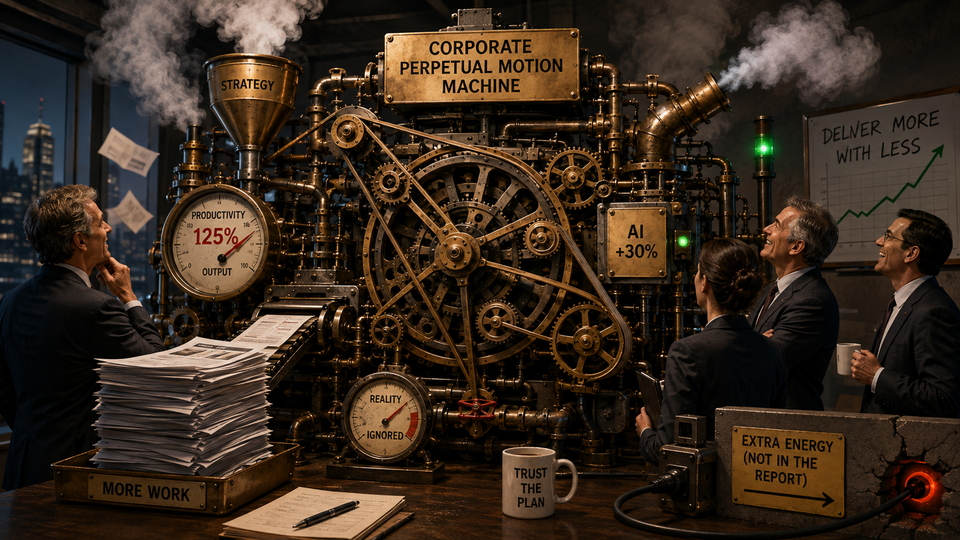
For several centuries, inventors have attempted to construct machines that physics stubbornly refuses to permit. The designs varied enormously. Some relied on wheels carrying articulated weights that supposedly remained permanently heavier on one side. Others used magnets arranged to pull an object forwards without requiring equivalent energy to reset the mechanism. Water wheels appeared surprisingly often, usually involving an ingenious arrangement through which the water powering the wheel would somehow return to the top afterwards.
Later designs became considerably more sophisticated, involving pumps, gears, fluids, buoyancy, electricity and increasingly elaborate explanations of why every previous perpetual-motion machine had failed while this particular one definitely would not.
None worked, which disappointed generations of inventors but eventually contributed to something considerably more useful: understanding why they could never work. Thermodynamics formalised an inconvenient property of reality. Energy cannot simply appear, and transformations cannot convert all available energy indefinitely into useful work without losses and degradation.
Engineering eventually accepted these limitations and built astonishing machines by respecting them. Corporate planning appears to have taken the opposite approach and interpreted the laws of thermodynamics as an unnecessarily conservative set of recommendations.
The First Law Problem
The first law of thermodynamics concerns conservation of energy. Energy may change form and move between systems, but a closed system cannot manufacture additional energy merely because somebody has placed an ambitious target beside it. This creates difficulties for perpetual-motion machines of the first kind because a machine producing work indefinitely without receiving equivalent energy would need to create energy from nothing. Mechanical engineers generally consider this a fundamental design flaw, although the modern engineering organisation has developed a more progressive interpretation.
At the beginning of the year, imagine an organisation containing 100 engineers. Finance subsequently announces a hiring freeze. Attrition reduces the organisation to 93. 7 engineers move onto a strategic transformation programme, several senior engineers spend increasing amounts of time interviewing replacements who cannot yet be hired, a new governance process introduces additional architecture reviews, Security adds mandatory controls, and Product expands the roadmap because 3 important enterprise customers have arrived. Management reviews these developments carefully and increases the annual delivery target by 25%. Somewhere, a 19th-century inventor looks up from his overbalanced wheel and wonders why history treated him so harshly.
The explanation usually involves efficiency. The organisation will work smarter. Teams will focus. Prioritisation will improve. Processes will become leaner. Dependencies will disappear. AI will increase developer productivity. Meetings will become shorter. Everybody will align around fewer priorities, of which there are now seventeen. None of these possibilities deserves automatic ridicule because productive systems genuinely improve efficiency. Better tooling matters, automation changes economics, and engineers have spent centuries extracting more useful work from the same resources by reducing losses and improving mechanisms. Efficiency, however, cannot rescue an equation whose inputs nobody has bothered to measure.
A steam engine can become more efficient, but it cannot become more efficient than the physical constraints governing the conversion of heat into work. A production line can eliminate waste, but it cannot produce indefinitely without material and energy entering somewhere. Software engineering can remove friction, automate repetitive tasks and improve feedback loops, but it cannot convert every nominal person-day into feature delivery. The interesting problem therefore begins not with the quantity of energy entering the organisational machine, but with what happens to that energy once it gets inside.
The Second Law Enters the Meeting
The first law tells us that energy must come from somewhere. The second law delivers worse news because even when sufficient energy exists, transformations do not preserve its ability to perform useful work perfectly. Real systems dissipate energy. Machines generate heat, fluids experience friction, electrical conductors have resistance, bearings warm, materials deform, and engines require cooling systems precisely because considerable quantities of the energy entering them never reach the wheels as useful mechanical output. Engineers do not regard this as evidence of insufficient commitment from the bearings. They design around it.
Organisations dissipate energy too. 20 engineers working together do not produce 20 times the useful output of one engineer because they communicate, coordinate interfaces, review one another's work, wait for decisions, resolve conflicting assumptions, maintain existing systems, investigate failures, support customers, explain architecture to newcomers, update dependencies and occasionally discover that the API documented three years ago does not quite behave as documented. They then attend the quarterly efficiency workshop, which consumes some additional energy in order to determine why so much energy disappears into activities other than delivery.
Capacity planning nevertheless has an interesting tendency to treat people as ideal thermodynamic devices. 10 engineers provide roughly 10 engineers of capacity, except that 1 mentors 2 juniors, another handles production incidents, 2 maintain the platform everybody else depends upon, 1 has become the unofficial expert on a service whose original authors left four years ago, and 1 another spends Tuesday afternoons in architecture governance. Everybody participates in planning, refinement, retrospectives, all-hands meetings, security training, performance reviews, hiring interviews and the newly introduced programme intended to reduce meetings. The spreadsheet still contains 10 rows, so 10 engineers exist and 10 engineers of productive capacity apparently remain available. The machine achieves remarkable efficiency once losses have been defined out of the model.
Organisational Waste Heat
Computers provide an instructive comparison because almost all the electrical energy they consume eventually leaves as heat. A busy server can therefore generate impressive quantities of warmth while accomplishing remarkably little useful computation. Nobody enters a data centre, feels the hot exhaust air and concludes that the software must have delivered enormous customer value. The heat proves that energy entered the system. It tells us considerably less about what useful work occurred before that energy dissipated.
Organisations have more difficulty making this distinction because they produce enormous quantities of organisational heat that resemble productive activity. Calendars fill, Slack accelerates, Jira tickets move, documents multiply, roadmaps acquire colours, programme managers create dependency maps, architects produce diagrams, dashboards refresh, and meetings generate actions requiring further meetings.
Status reports document progress on preparing material for steering committees that will determine whether projects can proceed to governance checkpoints whose purpose involves ensuring that work remains aligned with the strategy everybody stopped reading two quarters ago. The building feels extremely warm, and nobody can reasonably deny that an enormous quantity of human energy has entered the system.
This produces one of the more fascinating properties of troubled organisations: activity often increases precisely when productive output decreases. As uncertainty rises, coordination expands. As delivery becomes less predictable, reporting intensifies. As dependencies multiply, meetings proliferate. As confidence falls, management requests additional visibility. Each intervention consumes further capacity from the same system whose declining capacity triggered the intervention, creating a feedback loop in which attempts to understand lost productivity generate additional losses. The machine has not merely begun producing waste heat. It has started consuming useful energy in order to measure how much useful energy it no longer produces.
Corporate thermodynamics could therefore justify several modest amendments to the conventional laws. Centuries of experimental evidence from offices, engineering departments and transformation programmes suggest that the following formulations may describe large organisations rather more accurately than classical physics would prefer.
The Corporate First Law of Thermodynamics
Work can neither be created nor destroyed. It can only be reassigned until nobody remembers why it exists.
The conservation principle remains surprisingly robust. Projects rarely disappear merely because their original purpose disappeared. They change owners, move between quarters, acquire new sponsors and occasionally become strategic initiatives. Enough organisational energy can keep almost any historical commitment alive long after the conditions that created it have vanished.
The Corporate Second Law of Thermodynamics
The entropy of an organisation always increases, particularly after a transformation programme intended to simplify it.
This requires little experimental verification. Simplification creates workstreams. Workstreams require governance. Governance requires reporting, Reporting requires common definitions. Common definitions require alignment meetings. And eventually somebody creates a Transformation Office to coordinate the simplification programme. The organisation now contains everything it contained before, plus the machinery created to remove it.
The Corporate Third Law of Thermodynamics
As productive delivery approaches zero, the number of status meetings approaches infinity.
This final law may explain why troubled programmes generate such extraordinary calendar density. When reality becomes difficult to change, organisations increase the frequency with which they discuss reality. At sufficiently low delivery temperatures, almost all remaining organisational energy eventually converts into PowerPoint. Physics departments have so far declined to incorporate these findings into the standard curriculum, perhaps because their peer-review processes remain insufficiently agile.
The Efficiency Breakthrough
Fortunately, the perpetual-motion machine recently acquired a component capable of solving the energy problem once and for all. Someone attends a conference where a presentation suggests that AI-assisted development can increase engineering productivity by 30%. The number reaches the executive committee somewhat faster than the methodology, qualifications or measurement conditions that produced it, allowing the organisation to perform a remarkable calculation. 93 engineers, properly augmented, can now plan as though approximately 121 engineers existed.
Finance may then notice something even more interesting. If 93 engineers can produce the work of 121, perhaps 80 engineers equipped with AI can produce the work previously expected from 100. The productivity improvement becomes a headcount reduction before anybody has established whether the productivity improvement exists, after which the remaining 80 engineers inherit the original roadmap together with several new AI initiatives intended to modernise the company.
18th-century perpetual-motion inventors spent decades trying to obtain one quantity of free energy from their machines. Modern organisations have discovered how to spend the same hypothetical energy twice.
The underlying technological proposition remains perfectly plausible. AI can remove certain categories of work. Code generation can accelerate routine implementation, better search can reduce discovery time, automated analysis can shorten feedback loops, and tools have always shifted the productive frontier. The more interesting systems question concerns what happens to the capacity these improvements release, because organisations rarely leave available capacity unoccupied for long.
Faster coding creates more code requiring review. Faster prototyping creates more experiments requiring evaluation. Easier software creation lowers the cost of starting initiatives, which encourages organisations to start more initiatives. Additional output creates additional integration surfaces, operational responsibilities and maintenance obligations. A tool that reduces the cost of producing software may therefore increase the total amount of software the organisation chooses to produce, along with the coordination required to operate it. Efficiency does not necessarily reduce organisational entropy. Under certain conditions it merely allows the organisation to manufacture entropy at a higher throughput.
The Mysterious Additional Energy Source
There remains an inconvenient observation because corporate perpetual-motion machines occasionally appear to work. A team planned for 100 units of capacity somehow delivers 125. A programme absorbs unexpected scope without moving its deadline. A critical migration finishes despite losing several engineers, while production incidents continue and the roadmap somehow keeps moving. The quarterly review records extraordinary execution, which leaves only 2 plausible explanations: either management has finally overturned several centuries of physics, or somebody drew the system boundary in the wrong place.
Engineers encountering an apparently impossible energy balance usually investigate the boundary before rewriting thermodynamics. If more energy leaves a system than measurements show entering it, something probably crossed that boundary unnoticed. Organisations contain several such hidden energy sources. People work later, senior engineers quietly absorb coordination work, managers prepare documents at night, teams postpone maintenance, technical debt accumulates, testing narrows and operational risk increases. Someone handles the production incident during dinner rather than recording the interruption against project capacity, while another engineer spends Sunday understanding a failure because Monday's sprint commitment cannot move.
People also carry unresolved problems outside the formal system. They think about architecture while cooking, reconstruct conversations while driving, realise what caused the production bug while standing in the shower and return the next morning carrying solutions generated during hours that never appeared in the capacity model. None of this enters the spreadsheet, which allows the organisation to report 125 units of output from 100 units of input without falsifying any individual number. The perpetual-motion machine genuinely appears to work because the accounting system observes only part of the machine.
Engineering has several mechanisms capable of producing the same illusion. Batteries release stored chemical energy, flywheels release rotational energy, reservoirs release gravitational potential energy, and stressed materials can temporarily absorb loads whose consequences appear later. None creates free energy. Each moves energy through time or across a boundary, and every one eventually reaches a condition in which the stored resource must recover, recharge or fail.
Organisations can similarly convert future capacity into present delivery. Maintenance deferred today becomes tomorrow's failure. Technical debt exchanges future engineering effort for current speed. Sustained cognitive load gradually changes judgement and behaviour. Experienced people leave and carry accumulated system knowledge with them, forcing the remaining organisation to spend additional energy reconstructing what disappeared. The extraordinary quarter therefore may not represent an increase in efficiency at all. It may represent an organisation consuming reserves that its accounting system never recognised as assets.
The subsequent decline in output creates another intriguing possibility. Management can interpret it as evidence that the organisation has become inefficient and launch a transformation programme. The programme introduces new reporting, new governance, new roles, new ceremonies and new mechanisms for understanding why delivery has slowed. More of the remaining energy moves from productive work into coordination, the machine generates additional heat, and the declining ratio between visible activity and useful output creates pressure for still more intervention. A system originally consuming hidden reserves now consumes additional energy investigating the consequences of having consumed those reserves.
A Small Accounting Error
The history of perpetual motion contains a recurring pattern that makes these machines more interesting than simple fraud or foolishness. Many proposed machines really did move, and some ran for surprisingly long periods. Their inventors could therefore point at observable motion as evidence that established physics had finally encountered an exception. Closer inspection usually discovered an energy source somewhere: a hidden spring, air-pressure differences, temperature gradients, chemical reactions, external vibration or, in less scientifically ambitious demonstrations, a concealed mechanism supplying exactly the energy the machine supposedly created.
The important discovery did not concern the machine itself but the boundary around the explanation. Once the missing input entered the model, the miracle disappeared and ordinary physics returned. Nothing supernatural had occurred. The observer had simply measured one part of a larger system and mistaken the accounting boundary for the physical boundary.
Corporate perpetual motion depends upon much the same trick. The quarterly report can show 93 engineers, a hiring freeze, additional governance, seventeen priorities, an AI productivity target and 125% delivery against plan without containing a single false number. The result may look like a remarkable triumph of organisational efficiency, and perhaps some of it genuinely reflects better engineering, better tools or better decisions. But before rewriting the laws of thermodynamics, it might still prove useful to walk around the machine, examine where its apparent efficiency comes from, and check whether somebody has quietly run an extension cable through the wall.





Member discussion