Friday Fun: Another Successful Orbit Around the Sun
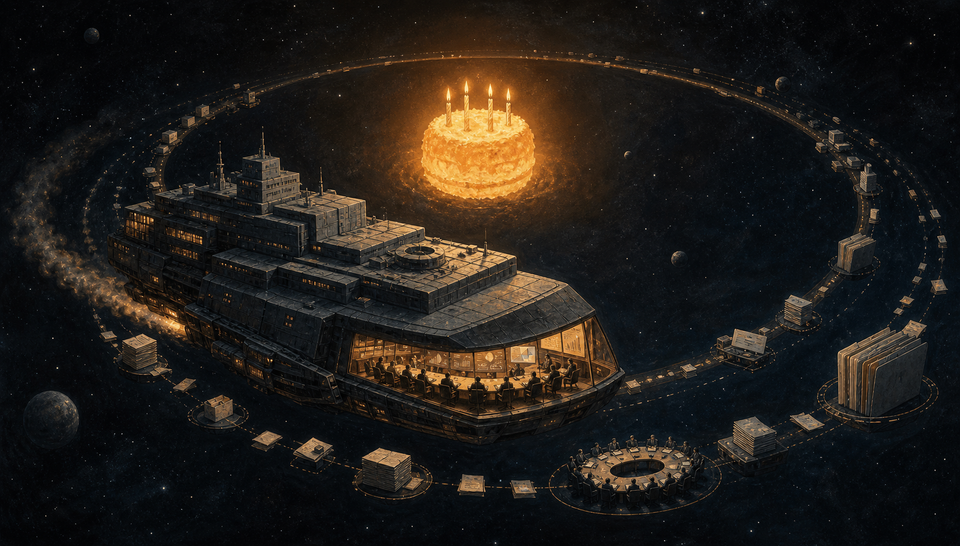
Nothing Happens at Midnight
At midnight, nothing happens.
The Earth does not complete its orbit at the same moment that a particular calendar reaches the end of a printed page. It does not pass a brass marker suspended in space, sound a bell or receive a certificate from the solar system recognising another year of satisfactory planetary performance. The planet continues along a path it has followed for roughly 4.5 billion years, moving at nearly thirty kilometres per second through a vacuum that offers neither applause nor performance feedback. Somewhere on its surface, however, candles are placed on cakes, annual reports are closed, objectives are renewed and people congratulate one another for having returned, with impressive punctuality, to an invented point on an imaginary circle.
An orbit looks simple only when drawn badly. The familiar classroom diagram shows a small Earth moving around a large Sun along a clean elliptical line. In reality, nothing traces that stationary path. The Sun travels through the Milky Way and the galaxy moves relative to neighbouring galaxies. The planets tug at one another while the Moon disturbs the Earth. And the Earth never returns to precisely the same place because there is no fixed place to which it could return. An orbit is not a railway track laid through space. It is a continuously negotiated fall.
Completing another orbit therefore proves something, but less than birthday cards imply. It proves that the underlying forces remained sufficiently balanced for the traveller to avoid both departure and collision. It says nothing about wisdom, improvement, purpose or deservingness. Asteroids complete orbits. Debris completes orbits. A satellite that stopped functioning years ago may continue circling the Earth with exemplary discipline. Orbital persistence does not require awareness of the journey, usefulness upon it or even evidence that anybody remains in control.
The Inconvenient Behaviour of Planets
Before Kepler, astronomers spent centuries constructing increasingly elaborate geometric machinery to preserve the perfection of circular motion. Planets, unfortunately, displayed little respect for philosophical elegance. Viewed from Earth, they sometimes appeared to slow, stop and travel backwards across the sky. The heavens seemed to contain senior stakeholders who had changed strategic direction without updating the presentation.
The Ptolemaic response was ingenious. If a planet would not follow one circle, it could travel around a smaller circle whose centre travelled around a larger one. These epicycles preserved the preferred model while accommodating inconvenient observations. As measurements improved, further adjustments followed. Each discrepancy required another circle, another calculation or another exquisitely reasoned explanation of why the model remained fundamentally correct despite the growing hostility of the sky.
Epicycles were not foolish. They predicted planetary positions reasonably well, and serious minds refined them over generations. Their weakness lay elsewhere: each correction protected an assumption that perhaps deserved abandonment. Complexity accumulated around the error until intellectual effort became difficult to distinguish from intellectual defence. The system grew more sophisticated precisely because reality refused to behave as the system required.
Kepler discarded the circle. Using Tycho Brahe’s observations, he found that planets followed ellipses, swept equal areas in equal times and moved faster when nearer the Sun. The orbit ceased to represent uniform movement around a perfect centre. It became an account of changing velocity, unequal distance and persistent gravitational constraint. Newton later supplied the deeper explanation. A planet travels forward while gravity continually bends its path towards the Sun. It remains in orbit because it falls perpetually and misses.
This is among the more beautiful arrangements in mechanics. Stability emerges not from the absence of failure but from failure maintained with extraordinary precision. The Earth never escapes in a straight line and never completes its fall into the Sun. Its apparent constancy consists of two tendencies failing to prevail over one another.
Many durable institutions have since achieved something similar.
The Administrative Discovery of the Year
Human beings possess a deep affection for cycles. Agricultural societies depended on them because seasons carried material consequences. Planting too early or harvesting too late could destroy a community. Calendars converted astronomical repetition into social memory. They coordinated festivals, debts, taxes, military campaigns and the distribution of food. The year became infrastructure: an agreed interval within which dispersed people could align their activities with changes occurring in the physical world.
The difficulty began when the interval escaped the phenomena it once described. The calendar, devised to represent cycles, acquired authority over processes that possessed no natural annual rhythm. Budgets received years. Strategies received years. Performance received years. Work begun in January acquired an artificial maturity in December, when accounts closed, ratings hardened and expenditure accelerated before an arbitrary boundary converted available money into evidence of poor forecasting.
Once the year became a unit of organisational thought, completing it began to resemble an achievement. Companies celebrated anniversaries, departments reported annual progress and transformation programmes survived into Phase Two. The language of endurance borrowed the prestige of accomplishment. Another twelve months of existence could be presented as another twelve months of development, although the two bear approximately the same relationship as orbit and exploration.
Corporate anniversaries make this confusion visible.
Longevity appears in the annual report as evidence of health, even when it merely demonstrates that customers remain trapped, creditors remain patient and nobody can identify the person authorised to turn the machinery off.
Survival may result from fitness. It may also result from institutional mass, contractual inertia or the discovery that dismantling the organisation would require a steering committee more expensive than continuing it.
Nine Hundred and Forty Million Kilometres of Progress
Enormous velocity can produce negligible displacement. The Earth travels approximately 940 million kilometres around the Sun each year. Its inhabitants experience this prodigious movement while sitting in chairs.
An organisation can perform a similar feat. It can conduct workshops, launch initiatives, revise governance, replace systems, restructure departments and hold several hundred thousand meetings, then arrive in December facing the same constraints it described in January. The distance travelled appears in calendars, timesheets and transformation updates. The displacement appears in consequences, where it proves considerably harder to locate.
This does not mean that the activity lacked effort. Orbital organisations work tremendously hard. Their people move quickly because constant adjustment keeps the system on its established path. Reports must feed committees, committees must commission reviews, reviews must recommend programmes and programmes must generate reports. Each activity supplies the gravitational force required by another. Remove one and the system may wobble dangerously, not because value disappears but because the next body in the sequence loses the object around which it revolves.
Productive work changes something outside the organisation. Coordinating work changes the organisation’s representation of what it believes it may eventually change outside itself. The distinction becomes difficult to preserve once the coordination system grows large enough to employ its own specialists, establish professional standards and assess its success using measures produced internally. At that point, the telescope turns around. The organisation studies itself with improving resolution while the external universe gradually disappears from view.
The Corporate Epicycle
Annual planning gives orbital movement a ceremonial structure. The process often begins with an examination of a future that everyone understands will be revised before it arrives. Assumptions enter models, models produce targets, targets descend through hierarchies and local managers translate them into numbers that remain both ambitious and survivable. The numbers then return upwards bearing the marks of consultation. Eventually, the organisation discovers the destination that its financial constraints had specified before the journey began.
The procedure resembles pre-Keplerian astronomy. When observed performance refuses to follow the approved circle, additional machinery preserves the system. A strategic initiative becomes a workstream. The workstream develops dependencies. Dependencies require governance. Governance identifies a need for enhanced coordination. Coordination requires a transformation office, which creates a dashboard showing that the organisation has become extremely advanced at representing its inability to move.
Every new epicycle improves the apparent fit between prediction and observation. None requires the centre to change.
The resulting complexity acquires moral force. A simple programme may look underdeveloped, whereas a programme with eleven workstreams, four governance forums, a dependency matrix and a colour-coded risk architecture has clearly encountered civilisation. It may not have altered reality, but it has produced sufficient administrative surface area to make any search for responsibility prohibitively expensive.
This is useful because failed work can damage careers, while well-governed work that has not yet succeeded remains rich with professional opportunity.
Failure closes programmes. Governance extends them.
Four Seasons of Temporary Divergence
The quarterly review adds another orbital layer. Twelve months may prove too long to wait for evidence that the annual plan bears little relationship to events, so the year is divided into four opportunities to explain why reality has temporarily diverged from expectation.
The first quarter remains too early to judge. The second contains timing effects. The third requires confidence in the recovery plan. The fourth becomes exceptional because closing actions distort the underlying trend. After this, a new year begins, mercifully restoring the possibility that the strategy remains sound ...
Forecast accuracy rarely survives this ritual, but the forecasting system does. Its purpose quietly changes. It no longer predicts events. It coordinates beliefs about events. The forecast tells each part of the organisation what the other parts have agreed to pretend will happen. This can prove useful. Navigation also depends on shared reference frames. Trouble begins only when agreement about the map receives more protection than observation of the territory.
The review meeting completes the conversion. Numbers that once represented physical or commercial events become characters in an administrative drama. Revenue disappoints. Costs remain stubborn. Headwinds appear. Opportunities soften. Timing moves. The figures acquire motives because attributing behaviour to numbers feels more comfortable than tracing behaviour through decisions.
By the end of the discussion, the organisation has not explained the variance so much as domesticated it. The deviation receives an owner, an action and a date. Reality can now be considered under management.
Choosing a Convenient Universe
Space engineers treat reference frames with care. A spacecraft’s position makes sense only relative to something else: the Earth, the Sun, a planet, a rotating body or an inertial frame selected for calculation. Movement measured relative to the launch site differs from movement measured relative to the solar system. A vehicle may appear stationary in one frame while travelling at extraordinary speed in another. Confusing those frames can produce ruinous errors.
Organisations choose reference frames too. A division can exceed its internal target while losing ground to competitors. A programme can remain on schedule while the need it addresses disappears. A service can improve against last year while customers abandon the category. The dashboard reports movement relative to the plan because the plan offers the most politically convenient stationary object.
Outside that frame, the entire system may be drifting.
This explains how internal success and external irrelevance coexist without immediate contradiction. The organisation measures itself against an orbit of its own construction. Each year’s objectives inherit the geometry of the previous year, adjusted enough to suggest ambition but not enough to threaten continuity. Targets become gravitational bodies. Careers settle around them. Resources follow predictable trajectories. People learn which deviations lead to discovery and which lead to impact.
The most sophisticated organisations can maintain several reference frames simultaneously. A project may prove strategically essential when requesting money, experimentally uncertain when questioned about results and operationally complete when reporting progress. It occupies whichever universe offers the least resistance at the time. Modern governance does not eliminate ambiguity. It gives ambiguity a controlled vocabulary.
Escape Velocity
In celestial mechanics, changing an orbit requires energy. A spacecraft cannot simply decide to visit another planet. It must alter its velocity at a particular point, escape an existing gravitational relationship and enter another. Small errors compound across vast distances. Engineers calculate burns carefully, exploiting planetary motion and gravity assists where possible. The manoeuvre consumes fuel and introduces risk. Remaining in orbit often costs less.
Organisational escape carries similar penalties. A genuine change of trajectory disrupts budgets, expertise, authority and professional identity. It may strand assets built for the former orbit. It may render years of accumulated knowledge less valuable. More dangerously, it changes the reference frame by which previous success was measured. The resistance requires neither cowardice nor conspiracy. The existing orbit supports lives, reputations and obligations. Gravity does not need a change-management strategy.
Transformation programmes frequently underestimate this. They describe a destination while leaving the old gravitational field intact. Incentives still reward the former behaviour. Investment rules still favour familiar assets. Governance still asks questions derived from yesterday’s risks. Reporting still measures progress against inherited categories. The organisation launches, consumes considerable fuel, produces a magnificent plume and settles into a slightly more expensive version of its previous orbit.
The launch nevertheless provides excellent photographs.
Technology accelerates the circulation. Automated dashboards shorten reporting cycles. Collaboration platforms multiply coordination. Artificial intelligence produces plans, summaries and forecasts faster than human beings can generate reasons to ignore them. None determines direction. A more powerful engine attached to an orbiting body creates faster orbiting unless something alters the trajectory. The organisation experiences unprecedented speed and calls the sensation transformation.
The Accumulation of Birthdays
Age accumulates within this motion. Not biological age, which leaves marks regardless of accounting policy, but institutional age: the residue of decisions that once responded to real conditions. A control introduced after a loss remains after the risk changes. A committee created during a crisis survives the crisis. A reporting requirement outlives the executive who requested it. Each completed orbit adds a layer.
Removal creates visible accountability. Continuation creates only dispersed cost. The layers therefore persist.
An old organisation resembles an ancient astronomical instrument: intricate, polished and surrounded by people who know how to operate its mechanisms but no longer remember which celestial problem it was built to solve. Its complexity testifies to generations of conscientious adjustment. Every wheel has a history. Every dial answers an objection. Every correction once made sense.
The organisation can sometimes date its own strata. One approval layer belongs to a scandal nobody remembers. Another descends from a regulatory interpretation superseded fourteen years ago. A monthly report exists because a former executive once asked a question during a difficult Tuesday. Nobody still reads it, but discontinuing it would require the approval of a committee that receives the report as evidence that reporting continues.
Such systems rarely collapse dramatically. They continue. Continuation represents their most developed capability. They absorb disappointment, reinterpret evidence and convert every failed prediction into demand for a more detailed prediction. Their survival gradually ceases to depend on producing the intended outcome because the work of maintaining the machinery has itself become the outcome.
Then the anniversary arrives. The numbers are prepared, the achievements assembled and the candles lit. Speeches celebrate resilience, longevity and another successful year. Nobody mentions that debris also completes orbits, or that a dead satellite can circle the planet for decades after it has ceased to transmit anything of value.
Outside, the Earth continues its vast, silent fall, covering nearly a billion kilometres without approaching a destination. Inside, everyone applauds the organisation for completing the same manoeuvre.





Member discussion