Friday Fun: The Locomotive Has Been Eliminated. Please Recruit More People to Maintain the Vacuum.
A railway without the engine
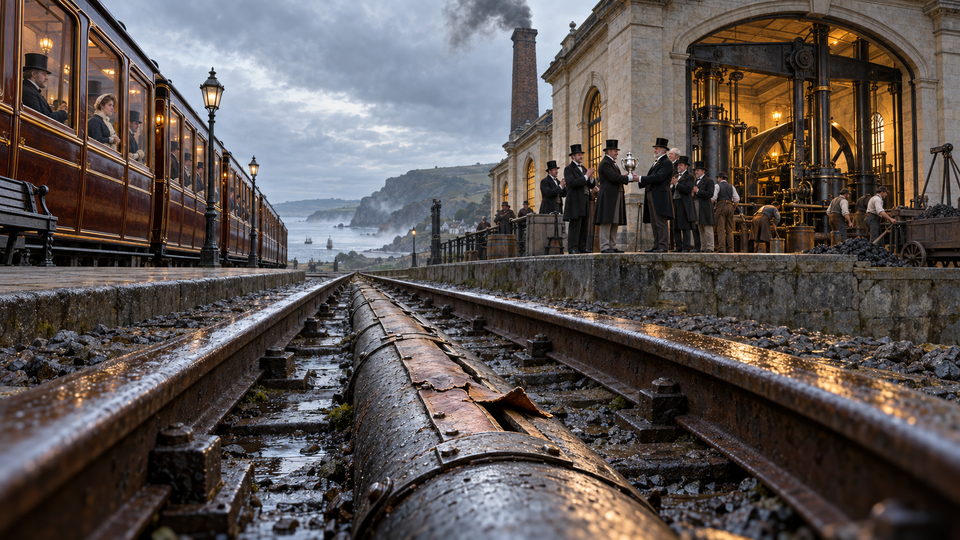
In September 1847, passengers on the South Devon Railway began travelling behind something conspicuously absent. Their train had no steam locomotive at its head. Between the rails ran a slotted iron pipe containing a piston connected to the carriage above. Stationary engines pumped air out of the pipe ahead of the piston, allowing atmospheric pressure behind it to propel the train. Brunel had adopted a railway in which the source of power stayed beside the track while the passengers moved along it. The arrangement worked. That detail matters, because the most interesting difficulties began after the invention had demonstrated that it could move a train.
The attraction went beyond novelty. A train relieved of its locomotive also shed the weight of a travelling boiler, fuel and machinery. Stationary engines promised advantages on difficult terrain, while passengers could enjoy a journey without a locomotive producing smoke immediately ahead of them. This represented a serious attempt to reorganise traction around the capabilities and limitations of contemporary engineering. It deserves better than the comfortable retrospective amusement reserved for an ambitious Victorian who should apparently have waited for someone else to invent better materials.
Yet the connection between piston and carriage posed an awkward problem. Its arm had to pass through the pipe, which meant the pipe could not simply remain closed. A longitudinal valve, incorporating leather, had to open as the connection passed and seal behind it. The railway therefore depended on a boundary that repeatedly interrupted its own airtightness. In an ordinary sealed vessel, the engineer tries to prevent openings. Here, opening formed part of normal operation. The machine had to admit its moving connection while excluding almost everything surrounding it.
The weather declined to participate
Consider what the valve had to accomplish. It needed enough flexibility to yield, enough consistency to close, and enough durability to repeat the performance along an outdoor railway. The passenger bought a journey between stations. Beneath the carriage, that journey depended on a succession of small mechanical reconciliations between movement and containment. No single reconciliation looked particularly grand. Together, they determined whether the grand idea worked.
The leather suffered under changing weather conditions, and leakage increased the burden on the pumping machinery. Maintenance and treatments could not make the problem economically sustainable. Atmospheric working ended in September 1848. Didcot Railway Centre records operating costs of three shillings and one penny per mile, against one shilling and fourpence for locomotive working. The absence of an engine at the front of the train had not produced the expected economy across the railway.
There lies the more interesting joke. The locomotive had disappeared from the passenger’s immediate surroundings, but the work of propulsion continued elsewhere. Boilers still required fuel. Engines still required attention. The pipe introduced its own demands. Something that looked simpler from a carriage window could demand more from the system supporting the carriage. The view had improved more decisively than the economics.
An imaginary publicity department could have celebrated the successful elimination of onboard steam machinery while the pumping accounts developed a less celebratory interpretation. Both descriptions could have remained factually correct. One counted what had vanished from the train. The other counted what the railway now needed to keep it moving. Their disagreement would not require dishonesty, merely different boundaries around the question.
The department responsible for keeping nothing inside
Imagine this railway receiving the benefit of contemporary corporate organisation. The passenger experience team would own the carriage. Infrastructure would own the pipe. A specialist propulsion function would operate the pumping stations. Valve maintenance would probably occupy an inconvenient position between two budgets, since leather looks insufficiently strategic for infrastructure and insufficiently powerful for propulsion. Someone would eventually propose a working group to clarify responsibility for the air.
The pumping stations could demonstrate impressive activity. Engines running, fuel consumed, staff occupied, capacity increased. Valve maintenance could report treatments completed and sections inspected. The carriage team could confirm readiness for departure. Every function might supply persuasive evidence of effort while the train waited for a pressure difference that none of those reports, individually, could establish. The passenger would remain regrettably attached to the old-fashioned measurement of arriving somewhere.
This imaginary railway would face a particular reporting difficulty. Its useful condition consisted partly of something missing. Maintaining a partial vacuum requires preventing unwanted air from undoing the work already performed. The supporting activity becomes visible when containment deteriorates, while successful containment can look like an unremarkable pipe doing nothing. A quiet maintenance operation might consequently appear less productive than a pumping operation heroically compensating for its absence.
There would, of course, be a recognition programme. The team that restored pressure after a disruption could explain its achievement with timestamps, graphs and a compelling narrative. The person who prevented the disruption by attending to a deteriorating valve would have a shorter story and no stranded passengers to authenticate its importance. Over time, the railway might acquire a remarkably energetic emergency culture, accompanied by an increasingly economical approach to prevention.
A small leak with an excellent business case
The same arrangement can develop inside software organisations without anyone laying an iron pipe between desks. A requirement passes from an initial conversation into a specification, from specification into implementation, from implementation into testing, and from testing into operation. At each boundary, some understanding must survive the transfer. The document travels easily. The reasoning behind it, including uncertainties and discarded alternatives, travels with considerably more difficulty.
The missing context rarely announces itself immediately. A plausible interpretation allows work to continue, which helps the next reporting cycle. The defect emerges later, perhaps during acceptance testing, perhaps after release, when someone explains that the implemented behaviour differs from what the business intended. By then, the organisation has accumulated enough activity around the interpretation to make correction expensive. The original gap may have occupied a sentence. Resolving its consequences can occupy several teams.
Now the pumps start. Additional meetings establish what earlier meetings failed to establish. A coordination role connects departments whose work already requires continuous connection. Another approval stage compensates for uncertainty that survives the existing stages. Each intervention can help locally, and each can acquire a reasonable business case. The difficult question concerns their combined effect. How much of the machinery advances the work, and how much keeps recovering understanding that the structure allows to escape?
The distinction becomes awkward when the recovery machinery also supplies evidence of organisational sophistication. A company with numerous escalation paths, dependency forums and delivery coordinators can describe an impressive capacity for handling complexity. Some of that capacity may support unavoidable complexity. Some may service complexity generated by its own divisions. From a distance, both produce busy calendars and reassuring diagrams. Only a closer inspection reveals what keeps the engines running.
The demonstration went extremely well
An atmospheric railway offers another useful discomfort. Moving one train proves that the mechanism can produce movement. It does not establish the cost of sustaining repeated journeys under changing conditions. The demonstration answers a real question, but a narrower one than the people funding a railway ultimately need answered. Commercial operation adds duration, variation and accumulated wear to a mechanism that may look convincing during an observed run.
A software demonstration often enjoys a similarly accommodating environment. Familiar data, available specialists and carefully selected paths give the system its opportunity to perform. Afterwards, ordinary users introduce incomplete information, contradictory expectations and inconvenient timing. Support staff begin supplying the flexibility that the demonstration never needed. The product continues to function because people bridge its gaps, although the organisation may still attribute the resulting service entirely to the product.
Automation can increase the pressure on this arrangement. Faster production of specifications, code or status reports makes more material available to the next stage. Where the boundaries preserve understanding, that speed may prove valuable. Where they lose it, speed supplies the recovery operation with more work. An AI assistant can draft the clarification email admirably. Whether the organisation should need that email for the seventh time remains outside the achievement recorded in its usage statistics.
The economic consequences then spread beyond the original defect. Specialists spend time explaining familiar constraints instead of developing new capabilities. Delivery plans assume their availability, so every additional request competes for the same people who keep existing work moving. Hiring more coordinators can relieve an immediate burden while increasing the number of interfaces those specialists must serve. The railway expands its pumping establishment and discovers that pressure still depends on the condition of the valve.
A building for a train that never came
At Totnes, a surviving atmospheric pumping house records an especially uncomfortable part of the experiment. Historic England notes that boilers were installed but the building never received its steam engine and never functioned as part of the atmospheric railway. The intended extension had acquired substantial architecture before the operating system reached it. The building preserves ambition in stone, including ambition that never became a working service.
Our imaginary corporate railway would have had several ways to describe that achievement. Construction complete. Infrastructure delivered. Strategic investment established. Each would recognise something real, and people had unquestionably performed substantial work. Nevertheless, no choice of description could make an atmospheric train arrive. The station offered the unusually clear distinction between completing a component and obtaining the capability for which it had been commissioned.
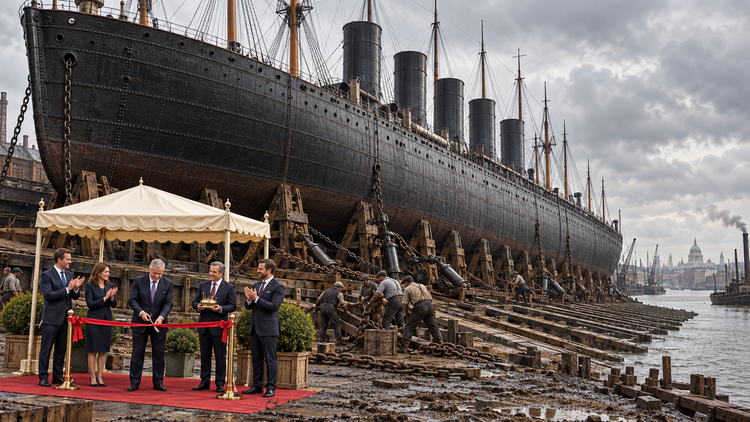
Picture the opening ceremony on a damp morning. Beyond the platform, the pumping establishment receives an award for its contribution to operational readiness. Maintenance submits another request concerning the leather. The carriage team confirms that passengers can board. A director admires how little machinery the train now carries, while somewhere along the line an unattended valve lets air back into the pipe. Everyone present can point to something they have successfully completed. The passengers sit beneath the completed roof, waiting to leave.
Historical sources:
- Didcot Railway Centre, Brunel’s Atmospheric Pipe.
- Didcot Railway Centre, Going Loco, March 2021.
- Historic England, The Pumping Station, Totnes.
The corporate railway and opening ceremony are imagined satire. The organisational comparisons are interpretation, not claims about the historical railway’s management.
Member discussion