Friday Fun: A Launch Event Without a Launch
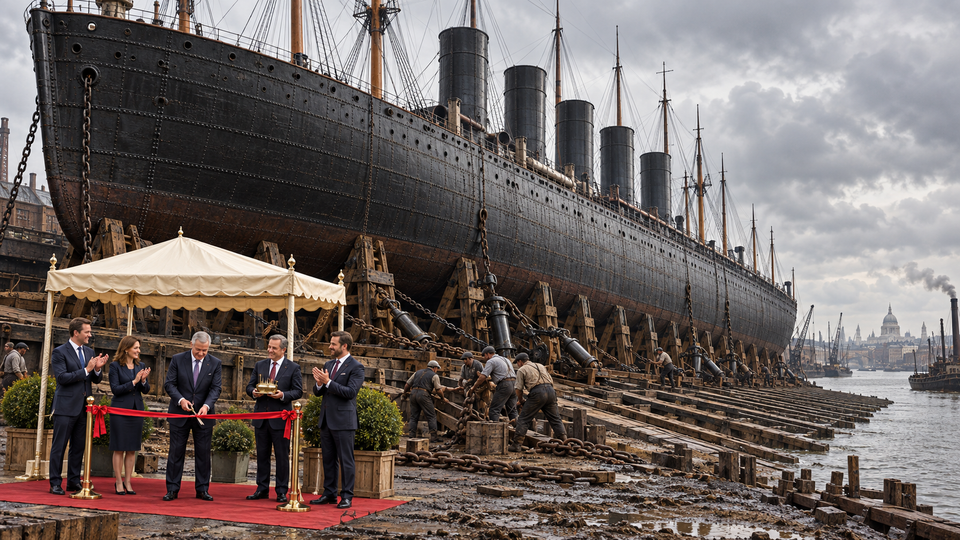
In November 1857, on the Thames at Millwall, an enormous iron ship stood beside the water she had been built to cross. Great Eastern measured 692 feet in length, a dimension that made the surrounding vessels look like preliminary sketches. Isambard Kingdom Brunel had designed her for journeys to India and Australia. Everything about her suggested distance, endurance and movement, except her present relationship with the river. On 3 November, the first attempt to launch her failed. The ocean would have to wait for the riverbank to release its investment.[1]
A convincing argument for a very large ship
The scale had a purpose. Long steamship voyages required coal, and coal occupied space that could otherwise carry paying cargo. Refuelling also meant dependence on ports, supplies and the arrangements connecting them. Brunel proposed a vessel with enough carrying capacity to make the Australian voyage and return without taking on more coal. Great Eastern’s immense size expressed an attempt to change the economics of distance, rather than merely to win an argument about whose ship looked most impressive from Greenwich.[2]
The engineering deserved attention independently of the commercial ambition. The ship combined paddle wheels and a screw propeller, driven by separate engines, with auxiliary sail. Her cellular double bottom represented an important structural innovation. These features addressed real problems of propulsion, endurance and survivability. Whatever later judgement might attach to the investment, the vessel contained substantial technical achievement. The interesting contradiction begins precisely there. An impressive answer to one set of problems can still meet another set for which its impressiveness provides very little assistance.[3]
A ship that can carry fuel across an ocean must first enter that ocean. Usually, launching occupies a relatively brief interval between construction and fitting out. At Millwall, however, Great Eastern’s length complicated the usual stern-first approach: the opposite bank of the Thames left insufficient room. She had therefore been built parallel to the river for a sideways launch. The river imposed a condition that the vessel’s future ocean-going capabilities could not negotiate away. Carrying more coal did not make the Thames wider.[4]
The capabilities required before the capabilities
Launching required its own engineered system. Great Eastern rested on two enormous cradles above inclined launch ways, supported by timber, piles and concrete. The arrangement had to bear the hull, allow movement and control that movement as support passed from land to water. Between early November and the end of January, progress remained painfully slow, hampered by equipment failures and weather. The ship finally floated on 31 January 1858. A transition expected to precede the maritime story had become a substantial engineering story of its own.[5]
The mechanics offer a useful distinction. On land, the vessel’s weight passes through concentrated supports into the ground. Afloat, displaced water supplies buoyancy across the immersed hull. Between those conditions, the distribution of support changes continuously. The launch apparatus must manage that change without permitting uncontrolled motion or unacceptable structural loading. Designing a ship to function once afloat and designing a system to get her afloat involve related knowledge, but neither task disappears into the other. A diagram containing both states does not, by itself, contain a working passage between them.
Even an elementary model of sliding reveals another complication. Resistance must be overcome before movement begins, and friction can change once surfaces start moving. A force insufficient to start a load may behave differently after it breaks free. Increasing force therefore creates a second obligation: controlling what happens when the resistance changes. Hydraulic rams helped move Great Eastern towards the water, but an engineer could not treat pressure alone as proof of progress. Pressure describes what the apparatus applies. Displacement describes what the ship does.[6]
A modern organisation could find this distinction unnecessarily restrictive. Its launch dashboard might record active rams, approved pumping capacity and excellent attendance at the pressure coordination meeting. Hull displacement would remain amber pending agreement on a measurement methodology. The programme could therefore receive an award for mobilisation while the ship remained ashore. Asking whether she had moved would sound increasingly hostile, especially after Communications had published the success story. The employee who asked twice could be invited to reflect on how their language affected confidence.
A perfectly serviceable organisation for standing still
The absurdity becomes more interesting when every participant behaves reasonably. One department completes its component and closes its tickets. Another awaits a decision it lacks authority to make. A third refuses the change because accepting it would threaten a target agreed before anyone discussed the launch. Each department can demonstrate compliance, and each can identify another department responsible for the delay. The ship occupies the precise point where all their successful performances meet. At the annual review, everyone could qualify for a bonus except the vessel, whose lack of initiative remains difficult to defend.
Brunel’s ship makes the distinction unusually visible. The hull, the launch ways and the river had to participate in the same physical event. Their separate readiness could not substitute for their interaction. In an organisation, that interaction may involve migrating customer data, changing support procedures, retiring an old service and altering how revenue gets recognised. The product can work in a demonstration while the business still lacks a viable route into using it. The launch event then celebrates the condition of the exhibit.
This explains why additional effort sometimes produces so little movement. If the constraint concerns who may authorise a change across several departments, more engineers prepare more work for the same unresolved decision. More reporting documents the accumulation. More urgency makes waiting a full-time occupation. Eventually, an executive asks why delivery lacks ownership, and ownership passes to somebody who can neither authorise the change nor alter the approval process. The organisation now has a name to put beside the delay. The ship remains stationary, but accountability has made considerable progress.
There is also a difference between resistance encountered and resistance manufactured. Great Eastern faced an enormous load, its supports and a tidal river. Organisations can add approval stages, split authority across budgets and reward departments for protecting their schedules. They then commission a transformation to overcome the resulting friction. The machinery that prevents movement sits on the steering committee of the programme charged with restoring it. When delivery slips, the committee introduces another approval gate to understand why the existing gates have proved so difficult to pass.
The emergency acquires a business model
A difficult transition creates demand of its own. At Millwall, additional hydraulic equipment helped get the vessel afloat. Within an organisation, the corresponding need can sustain integration specialists, escalation meetings and temporary coordinators whose temporary assignments outlast several permanent employees. Some perform essential work. Others inherit a more durable proposition: a service that makes obstruction survivable. Getting the ship into the water would complete the assignment. Keeping her nearly ready can support a department.
Once the obstruction funds a recurring activity, removing it threatens workload, spending authority and visible contribution. Nobody needs to conspire against improvement. Recurring coordination has dependable demand and an established budget. Eliminating its cause requires an investment whose benefits would appear elsewhere, perhaps after the budget holder has moved on. Another season of pumping offers a much safer purchase. In the corporate shipyard, the launch apparatus could acquire a succession plan before the ship acquired a wake.
The economics then become difficult to recognise from the programme’s own accounts. A delayed ship ties up capital and postpones earning revenue. A delayed organisational transition can also keep two systems running, divide engineering attention and extend obligations to maintain obsolete arrangements. Yet those costs often appear in different places. The migration reports its expenditure, operations reports its workload and finance reports disappointing returns. The riverbank charges rent through several departments, so no single invoice describes the price of remaining on it.
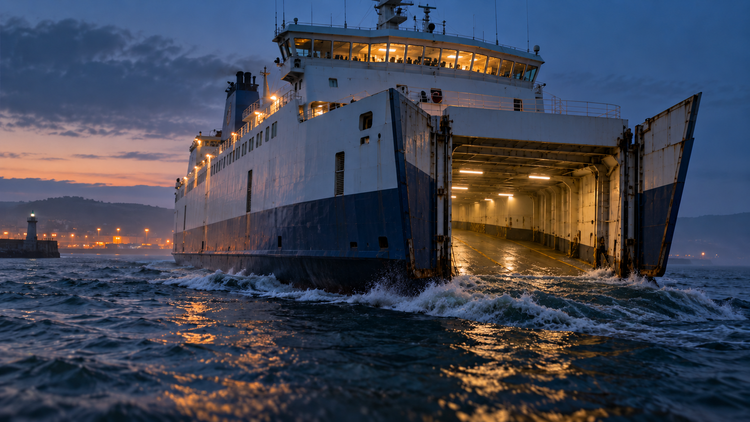
Temporary arrangements can reinforce the same condition. An exception lets one customer through, a manual conversion rescues another, and an experienced employee supplies knowledge the process cannot express. Such interventions have real value, but they also shelter the arrangement from its consequences. In our imaginary shipyard, a small ferry could carry passengers while the liner remained ashore. Management would celebrate the ferry crew’s resilience, leave the launch unresolved and eventually cut the ferry budget because the company had already invested in a much larger ship.
The water cannot approve the business case
The history refuses to end at the most convenient point for the analogy. Great Eastern did reach the Thames. That achievement resolved a formidable transition problem, but it did not establish the commercial success of the service envisaged for her. Her passenger career on the Atlantic proved uneconomic. She later found successful employment as a cable-laying vessel. The capacity that had struggled to earn its return in one use became valuable in another.[7]
This complicates the familiar corporate demand to remove blockers. Some obstruct a worthwhile undertaking. Others stand between an organisation and an expensive discovery about its assumptions. Removing either kind produces movement without establishing that the destination warrants the investment. A beautifully executed migration can increase operating costs. An efficient release can deliver an unwanted product ahead of schedule. Fortunately, the launch team’s objectives may concern neither cost nor demand, allowing the subsequent disappointment to arrive in somebody else’s reporting period.
Great Eastern’s second career prevents an equally lazy verdict in the opposite direction. Commercial disappointment did not render every engineering decision worthless. The vessel’s capabilities survived the failure of their original economic justification. Her eventual cable work required a different relationship between those capabilities and a demand outside the ship. The iron did not need to apologise for having once appeared in the wrong forecast. Nor did the later success retroactively make the earlier investment thesis correct.
Organisations have a harder time preserving that distinction. A project’s name binds together its technical achievements, commercial promises, sponsors and expenditure. Reconsidering the purpose threatens the story attached to the money. Redeployment then requires someone to explain why the celebrated passenger strategy has produced an excellent cable ship. Keeping the cabins empty may look less damaging than admitting they need removing. A further review can always investigate insufficient sales effort while the useful capacity inside the hull waits for permission to contradict the brochure.
At Millwall, the Thames eventually took Great Eastern’s weight. It offered no opinion on her intended routes, her investors’ expectations or the speeches delivered beside her. Had a modern launch committee attended, it could have accepted the transfer to water, released the final payment and dispersed before the commercial results arrived. The annual report would preserve a successful launch. The empty cabins would belong to Operations.
Historical sources
[1] University of Bath Archives, The building of the SS Great Eastern and Royal Museums Greenwich, Great Eastern model. First attempted launch: 3 November 1857. Length: 692 feet.
[2] Brunel Museum, Great Eastern Launch Site. Intended endurance and scale.
[3] Royal Museums Greenwich, Great Eastern, 1858 and Historic England, launch ways. Propulsion and structural innovations.
[4] Royal Museums Greenwich, The building of the Great Eastern, 1857. Physical constraint on a stern-first launch.
[5] Historic England, Site of the launch ways of the SS Great Eastern. Launch apparatus and eventual flotation.
[6] The Metropolitan Museum of Art, Hydraulic Ram Used in Launching the Great Eastern Steamship. Hydraulic equipment. Its collection note gives 1 February for flotation; the article follows Historic England, Bath Archives and Royal Museums Greenwich in using 31 January 1858.
[7] Royal Museums Greenwich, Great Eastern, 1858. Uneconomic passenger operation and successful subsequent cable-laying career.
The organisational scenes are satire, not accounts of events in the Victorian shipyard. The discussion of changing support and friction explains general mechanics rather than claiming a single established cause for the unsuccessful first launch.

Member discussion