Monday Myth: Precision Makes the Future Predictable
In 1922, Lewis Fry Richardson published Weather Prediction by Numerical Process, a book built around a proposition that appeared almost unreasonable at the time. Weather, he argued, did not need to remain the domain of intuition, local experience and observations of the sky. The atmosphere obeyed physical laws. If its present condition could be measured accurately enough, those laws could calculate what would happen next.
The difficulty lay less in the equations than in the labour required to solve them. Richardson had attempted to calculate a six-hour forecast for two points in central Europe using observations collected on 20 May 1910. Working by hand, he divided the atmosphere into a grid and repeatedly solved approximations of the equations governing pressure, temperature, humidity and air movement. The calculation reportedly occupied him for several weeks. By the time he had predicted the weather six hours ahead, the weather itself had moved considerably further.
The result also proved spectacularly wrong. Richardson’s calculation produced an impossible change in atmospheric pressure, not because the atmosphere had escaped the laws of physics, but because the observations used to initialise the model contained inconsistencies. Small measurement errors and unresolved atmospheric oscillations entered the equations, after which the calculation faithfully amplified them.
The failure did not invalidate the principle. It revealed what prediction would demand.
The forecast factory
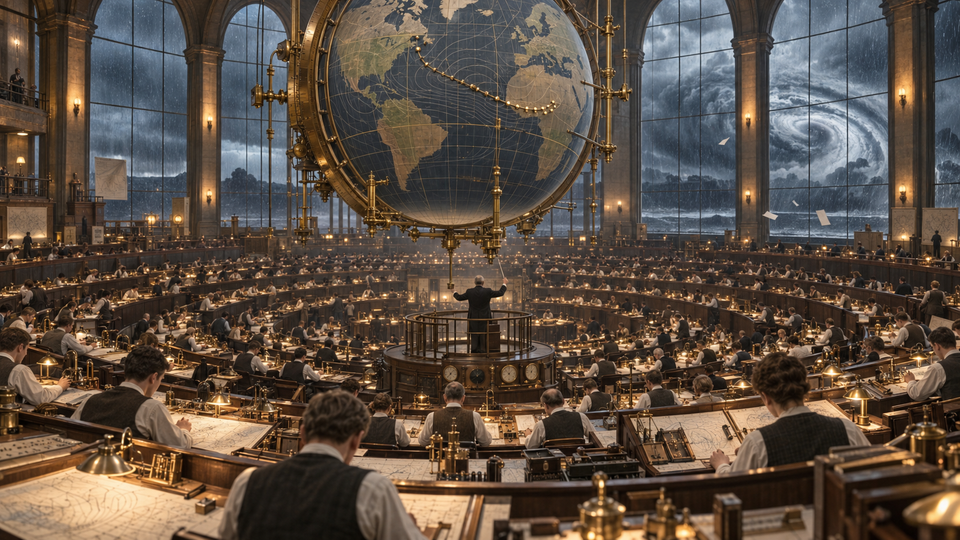
Richardson imagined a vast forecast factory housed inside a spherical hall. Thousands of human calculators would each work on a section of the atmosphere while a conductor coordinated their calculations from the centre. Information would pass between neighbouring sections quickly enough to keep the whole model synchronised. Richardson estimated that tens of thousands of people might calculate the weather at the same speed as the weather developed.
The image now resembles a distributed computing system designed before electronic computers existed. The atmospheric grid supplied the partitions. Human calculators acted as processing units. The conductor synchronised the computation. Messages crossed boundaries because weather did not respect the edges of Richardson’s mathematical cells.
Electronic computers eventually built something close to his factory without the theatre or the human calculators. In 1950, a team led by Jule Charney used ENIAC to produce some of the first computer-generated weather forecasts. The model remained highly simplified, and a twenty-four-hour forecast could take close to twenty-four hours to calculate. Yet numerical prediction had crossed an important threshold. For the first time, calculation could begin to approach the speed of the system it attempted to predict.
From there, improvement looked like an engineering problem. More observations would describe the atmosphere more accurately. Finer grids would represent smaller weather systems. Better equations would capture more physical processes. Faster computers would perform more calculations before the forecast became history.
Every generation delivered some of that promise. Satellites observed oceans and continents beyond the reach of weather stations. Radar revealed precipitation inside storms. Balloons measured temperature, pressure and wind through the depth of the atmosphere. Supercomputers divided the planet into progressively smaller cells and calculated their interactions at progressively shorter intervals.
Forecasting became more detailed, faster and more accurate. It did not become certain.
The return to the starting point
During the winter of 1961, Edward Lorenz was running a simplified atmospheric model on a computer at the Massachusetts Institute of Technology. Wanting to repeat part of an earlier simulation, he entered values printed from the previous run rather than restarting the entire calculation. The printed number contained fewer decimal places than the value stored in the machine’s memory. The difference appeared insignificant.
At first, the new simulation followed the previous one. Then the trajectories separated. After enough simulated time, they described entirely different conditions.
The machine had not malfunctioned. Lorenz had encountered a property of the system itself. In some nonlinear systems, nearby starting conditions do not remain nearby. Minute differences grow through successive interactions until they produce different futures. Greater computational power can calculate each trajectory more accurately, but it cannot determine which trajectory reality will follow if the starting state remains imperfectly known.
That distinction changed the nature of the forecasting problem. The atmosphere does not merely contain many variables. It continuously couples them. Temperature changes pressure. Pressure moves air. Moving air transports heat and moisture. Moisture changes cloud formation. Clouds alter the transfer of radiation. Each interaction modifies the conditions governing the next interaction.
Measurement cannot capture every point in that system with infinite precision. Even if instruments could do so, a numerical model must still simplify processes occurring below the scale of its grid. The forecast therefore begins not from the atmosphere itself, but from a representation of it. That representation may prove extraordinarily sophisticated without ever becoming identical to the thing represented.
Adding decimal places improves the description. It does not abolish the distance between model and reality.
Many futures from one present
Modern meteorology did not respond to this limit by abandoning prediction. It changed the object being produced.
Instead of calculating one forecast from one assumed starting condition, forecasting centres run ensembles. Each member begins with slightly different initial conditions or model assumptions, all considered plausible given the available observations. During the first hours, the forecasts often remain close. As time advances, some continue together while others diverge.
The spread matters as much as the average. When most members produce similar outcomes, confidence rises. When they separate sharply, the atmosphere has entered a region where small uncertainties may produce materially different weather. One deterministic line can still be drawn through that space, but the line conceals the most useful information: how many other futures remain plausible.
This creates an apparent paradox. A less precise forecast can support a better decision. A statement that rain will begin at 14:00 appears more useful than a distribution showing a sixty per cent probability between noon and late afternoon. The first gives an exact answer. The second reveals the uncertainty surrounding it. Only one, however, allows somebody organising a flight, protecting a crop or managing a flood barrier to judge the consequences of being wrong.
Meteorology gradually learnt that the purpose of a forecast does not involve describing the future with the greatest possible confidence. It involves helping someone act before certainty becomes available.
The distinction matters because precision and accuracy create different impressions. Precision describes how narrowly something has been expressed. Accuracy describes its relationship with reality. A forecast can predict rain at 14:07 with exquisite precision and remain wrong. Another can identify a broad period of elevated risk and enable exactly the right preparation.
The additional digits belong to the forecast. They do not belong to the sky.
The corporate forecast factory
Organisations also divide a complex environment into manageable cells. Markets become segments. Products become initiatives. Initiatives become epics, milestones and tickets. Financial years become quarters, months and reporting periods. Dependencies pass between teams while a coordinating function attempts to keep the whole structure synchronised.
The resemblance to Richardson’s forecast factory extends beyond the diagram. Each part calculates its portion of the future. Estimates flow towards the centre, where someone assembles them into a roadmap. The roadmap becomes a single trajectory through a system of customers, technologies, competitors, regulations, suppliers and human behaviour.
When confidence remains low, the organisation often responds by increasing detail. Annual objectives acquire quarterly milestones. Quarterly milestones acquire delivery dates. Delivery dates acquire percentage completion. Dependencies receive status colours. A future that nobody understands sufficiently now occupies hundreds of precisely positioned cells.
The representation has improved. Predictability may not have changed at all.
Detail can even make the underlying forecast worse. Every commitment influences the system it claims merely to describe. Teams delay small opportunities because the roadmap has allocated their capacity elsewhere. Managers suppress emerging information because it threatens an approved date. Early estimates become budget assumptions, budget assumptions become promises, and promises become performance measures. The forecast stops observing the system and begins forcing the system to imitate the forecast.
Meteorological models receive new observations several times a day and recalculate their trajectories. Corporate plans often treat deviation as a failure of execution. The atmosphere may invalidate yesterday’s forecast without being accused of lacking accountability. A team encountering new evidence receives less philosophical tolerance.
This does not make planning useless. Richardson’s failed calculation did not make meteorology useless either. It revealed that a forecast requires an honest relationship with observation. The model must remain open to correction. Its horizon must match the predictability of the system. Its resolution must not imply knowledge that the observations cannot support.
The problem begins when a plan changes category. A working hypothesis becomes a commitment. A probability becomes a date. A scenario becomes the scenario. Uncertainty does not disappear during that conversion. It merely loses permission to appear in the document.
The economics of imaginary certainty
Exact plans provide genuine organisational value, although not always the value claimed for them. They make budgets easier to approve, contracts easier to negotiate and performance easier to compare. They also distribute political risk. Once enough people have approved a date, responsibility for its assumptions becomes pleasantly difficult to locate.
That creates an incentive to reward the appearance of predictability independently of actual predictive power. A cautious estimate appears weak beside a confident one. A range invites questions. A probability sounds like hesitation. The person who exposes uncertainty creates immediate discomfort, while the person who hides it creates a problem that will mature under somebody else’s reporting period.
The organisation consequently selects for confident forecasts, then acts surprised when reality selects different outcomes.
As the gap grows, coordination expands. More meetings reconcile the plan with events. More reporting explains why milestones moved. More governance protects the original commitments from information discovered during the work. The company spends increasing amounts of capacity maintaining agreement between its representations while the system represented continues to change outside the meeting room.
AI may accelerate this tendency. It can produce plans of unprecedented completeness, decompose ambitions into convincing sequences and populate every dependency with plausible detail. Yet a faster forecast factory does not make the atmosphere less chaotic. It can calculate and narrate one imagined future more efficiently while making the exclusions harder to notice.
The danger does not come from the machine inventing certainty. Organisations already manufacture that in considerable quantities. The machine merely industrialises the formatting.
Beyond the horizon
Weather forecasts lose resolution as their horizon extends. Tomorrow can support hourly detail. The following week demands broader statements. Seasonal forecasts describe tendencies and probabilities rather than the weather over a particular town at a particular hour. Meteorology changes the form of the forecast because the system no longer supports the same kind of claim.
Organisations frequently do the reverse. The further an initiative extends into the future, the more elaborate its roadmap becomes. Uncertainty expands, but the document accumulates milestones. The least observable part of the journey receives the greatest narrative certainty because senior approval requires a complete destination and a believable route.
Somewhere inside the organisation, people usually know that the forecast has diverged. Customer behaviour changed. Integration exposed an unknown constraint. A technical assumption failed. The market moved. The knowledge exists locally long before it reaches the official model. Yet updating the roadmap may carry a higher political cost than continuing along a trajectory already known to be false.
Richardson’s imaginary hall placed a conductor at its centre, but the atmosphere never waited for the conductor’s instructions. The calculators could only observe, exchange information and calculate again.
Perhaps the strangest feature of the modern forecast factory is not that its predictions sometimes fail. It is that, after the instruments have detected a different future forming outside, thousands of people may continue calculating the old one.





Member discussion