Friday Fun: The Corporate Mobility Programme

Human civilisation has spent several centuries improving its ability to move people from one place to another. Roads acquired surfaces, junctions acquired signals, aircraft acquired instruments, and transport networks gradually developed the unglamorous disciplines required to prevent several tonnes of machinery from arriving unexpectedly through somebody’s kitchen. Progress depended less upon enthusiasm than upon a growing respect for physical constraints. Vehicles require space. Aircraft require lift. Braking takes distance. Two objects cannot occupy the same piece of infrastructure simultaneously without generating paperwork of a considerably more serious kind.
The flight simulator emerged from this recognition. It allowed pilots to rehearse dangerous situations without destroying an aircraft whenever somebody misunderstood a warning light. Modern simulators reproduce weather, instrument failures, engine behaviour, terrain and the peculiar experience of discovering that several independent problems have formed a committee. Their value comes from fidelity. A simulator that guarantees perfect visibility, obedient winds and functioning equipment might provide an uplifting afternoon, but it would prepare pilots principally for careers in corporate strategy.
Roundabouts solve another transport problem. Instead of forcing every vehicle to stop while a central authority distributes permission individually, they establish a few simple constraints and allow drivers to coordinate locally. Vehicles already circulating receive priority. Those entering observe the actual traffic rather than submitting a forecast of expected traffic conditions for approval. Capacity remains finite, exits must remain accessible, and anyone who misses one accepts the mild humiliation of travelling around again.
These systems work because neither confuses representation with reality. The simulator earns its usefulness by reproducing resistance. The roundabout earns its usefulness by allowing movement to adjust continuously to resistance. One prepares people for constraints. The other helps them negotiate constraints as they emerge. Corporate transport engineering has improved both designs by removing these inconvenient properties.
The Executive Flight Simulator, Now Without Weather
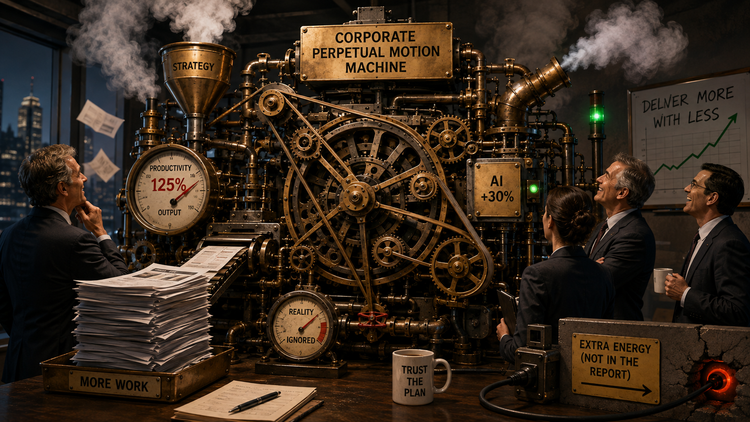
The executive flight simulator occupies a climate-controlled room several floors above the weather. Its purpose involves constructing a multi-year strategy while preventing operational reality from contaminating the controls. Customers appear as market segments, employees as capacity, systems as capabilities and competitors as coloured arrows moving across a quadrant. Gravity remains available as an optional assumption, although Finance may remove it from the baseline scenario when the resulting trajectory fails to support the investment case.
The simulation begins with a destination. Perhaps the company intends to double revenue, enter four markets, become AI-first, reduce costs by thirty per cent and improve customer satisfaction without increasing headcount. Commercial aviation would traditionally regard simultaneous requirements of this kind as a reason to inspect the aircraft’s maximum take-off weight. Corporate aviation regards them as ambition, particularly when the person defining the payload will not travel in the hold.
The crew then selects a route. Since the simulator contains no legacy systems, contractual commitments, undocumented dependencies, recruitment delays, regulatory ambiguity or customers who insist upon using the product in ways the strategy team finds inconvenient, the route appears remarkably direct. Transformation will begin in the first quarter, accelerate in the second, achieve scale in the third and produce measurable benefits shortly before annual bonuses require measurable benefits.
A roadmap renders the route visible. This matters because strategy acquires credibility in proportion to the number of horizontal arrows used to represent it. Thin arrows suggest uncertainty. Thick arrows indicate conviction. Several thick arrows converging upon a brightly coloured destination demonstrate that the organisation has achieved alignment, or at least that the presentation software offers snapping guides.
The simulator’s weather controls deserve particular admiration. Market uncertainty can be reduced through scenario planning, organisational resistance through stakeholder engagement, technical risk through architectural alignment and insufficient capability through a workstream labelled “Capability Enablement”. Every turbulent phenomenon receives a rectangle. Once placed inside a rectangle, uncertainty loses much of its ability to alarm senior management.
The aircraft now leaves the simulated runway. Revenue climbs, operating cost descends and employee engagement remains reassuringly level despite the simultaneous restructuring of roles, teams, systems and incentives. The programme passes smoothly through a cloud marked “Execution Risk”, after which the chief transformation officer announces that the organisation has successfully navigated complexity. Nobody has yet left the building, but the catering workstream has delivered on schedule.
Please Collect Your Strategy at Ground-Level Execution
Eventually, someone must deliver the strategy. The immaculate aircraft therefore lands at the boundary separating executive intent from organisational capability, where passengers transfer to the Corporate Mobility Programme. Their luggage, consisting mainly of assumptions, will follow on a later flight.
The programme maintains a fleet of initiatives. Each vehicle carries a strategic label large enough to remain legible during steering committees: Customer Centricity, Platform Modernisation, Operational Excellence, Digital Acceleration or AI Everywhere Except the Parts Where Data Quality Matters. Older vehicles receive fresh paint when their original destination loses executive sponsorship. A failed cost-reduction initiative can return the following year as Simplification. An abandoned platform programme can re-enter service as Digital Foundations. Nothing truly dies in corporate transport. It changes livery and acquires a new executive sponsor who has not read the accident report.
Before entering the network, every initiative must demonstrate urgency, strategic alignment and an ability to deliver independently of all the other initiatives demonstrating urgency, strategic alignment and an ability to deliver independently. Dependencies receive separate documentation because placing them directly on the roadmap would make the roadmap appear dependent upon reality.
The organisation now encounters the first difficulty omitted from the simulator. Several initiatives require the same people, systems and decisions at approximately the same time. In physical transport, this would indicate congestion. In corporate transport, it indicates insufficient governance. A steering committee quickly addresses the problem by establishing another steering committee. The new body does not replace the previous one because that might interrupt continuity. Instead, it coordinates the committees responsible for coordinating delivery, producing the first genuinely scalable component of the transformation.
The Roundabout Where Every Priority Has Right of Way
At the centre of the network stands the Corporate Roundabout, an elegant solution to the dangerous possibility that work might travel directly from decision to completion.
Vehicles enter from every direction. Product brings customer commitments. Engineering brings architectural constraints. Sales brings promises that have already become customer commitments. Finance brings a request to reduce fuel consumption while increasing average speed. People and Culture brings a leadership-development bus that stops at every competency framework but carries no passengers. The transformation office arrives in a helicopter, takes photographs of the congestion and leaves before anyone can ask where it intends to land.
Nobody possesses priority because everyone has executive sponsorship. Consequently, the organisation introduces a prioritisation process. Each initiative receives a score derived from revenue potential, strategic importance, customer value, delivery confidence and the seniority of the person asking why it has not started. The first four variables ensure methodological credibility. The fifth ensures accuracy.
Once prioritised, initiatives begin circulating. Progress dashboards report that ninety-two per cent have started, an achievement made possible by defining “started” as the existence of a meeting. The remaining eight per cent await kick-off meetings and therefore already appear in the calendar, allowing an appropriately mature organisation to report one hundred per cent mobilisation.
Exits remain more complicated. To leave the roundabout, an initiative requires architectural approval, security approval, budget confirmation, resource allocation, operational readiness and agreement that the promised outcome still matters. Since each authority meets on a different cadence, the vehicle completes another circuit while its passengers update the business case to reflect the time lost updating the business case.
Occasionally, management notices the congestion. It responds by widening the roundabout. New programme managers create additional lanes, portfolio tools provide aerial traffic views, and reporting specialists install signs indicating how efficiently every vehicle continues to circulate. The increased capacity permits more initiatives to enter without improving the rate at which any initiative leaves. This receives immediate recognition as improved throughput because counting entrances remains easier than waiting for arrivals.
The roundabout soon develops its own economy. Programme offices sell maps. Consultants provide navigation workshops. Tool vendors offer real-time visibility into journeys whose destinations nobody can now remember. A transformation communications team publishes interviews with passengers explaining how excited they feel about the road ahead, carefully avoiding footage through the windows.
The Ministry of Steering Without Direction
The Corporate Mobility Programme naturally requires steering. Actual steering would involve choosing a direction and accepting the destinations thereby abandoned, but this interpretation creates avoidable tension. Corporate steering instead means assembling representatives of every interested function so that no decision can travel faster than collective discomfort.
The steering committee receives a dashboard using the international traffic-light standard. Green means the programme manager believes recovery remains possible without executive attention. Amber means recovery requires executive attention but requesting it might turn the status red. Red means events have become visible outside the programme and terminology no longer offers adequate concealment.
The colours rarely correspond to physical conditions. A project may have no credible delivery date, half its required team and an unresolved architectural dependency yet remain green because the next milestone lies six weeks away. Time provides considerable protection against evidence. As the milestone approaches, the project transitions carefully through pale green, greenish amber, strategic amber and finally red after missing the date, at which point the committee expresses surprise at the sudden deterioration.
The resulting root-cause analysis identifies execution challenges, insufficient accountability and opportunities to strengthen communication. It rarely identifies the approved plan, since the people who approved it also approve the root-cause analysis. The committee responds with increased monitoring. Weekly reports become twice-weekly reports, allowing delivery teams to explain more frequently why producing reports has reduced their delivery capacity. New checkpoints ensure that problems surface earlier, usually by asking the same people for the same information before they have had time to change it. Nothing restores executive confidence like making the struggling system carry additional observers.
AI Satnav: Recalculating the Same Mistake Faster
The arrival of artificial intelligence transforms the Corporate Mobility Programme by allowing it to generate directions faster than anybody can travel.
Where strategy teams once required several weeks to produce a plausible route, they can now create twelve before lunch. AI drafts business cases, decomposes programmes, identifies risks, proposes mitigations and generates status summaries explaining why implementation has not kept pace with the increased efficiency of status-summary generation.
This produces an extraordinary leap in simulated velocity. The executive flight simulator can now test multiple futures simultaneously, each containing the same optimistic assumptions expressed in slightly different prose. Leaders compare the scenarios, select the one offering the greatest transformation at the lowest cost and congratulate themselves for making a data-informed decision from twelve computationally enhanced versions of their original preference.
At ground level, AI equips every vehicle with an enthusiastic navigation assistant. When an initiative misses an exit, the assistant recalculates instantly and proposes a new route through the same approval boards. If a dependency blocks the route, AI converts it into three actionable workstreams. If the workstreams remain blocked, it generates a dependency-management framework. Should the framework fail, it can draft an executive summary explaining that adoption requires further maturity. The organisation no longer merely drives in circles. It receives personalised turn-by-turn commentary on the strategic significance of each circuit.
Productivity metrics improve rapidly. More documents appear, more tickets reach refinement, more initiatives enter planning and more code reaches repositories. Unfortunately, the production environment, rather like an old bridge, remains stubbornly unimpressed by the volume of traffic models describing what ought to cross it. Technology has not created the roundabout. It has installed brighter signs, translated them into fourteen languages and generated a dashboard proving that ninety-eight per cent of drivers have seen them.
Roadside Assistance Will Now Explain Why It Did Not Design the Vehicle
Every transport system eventually requires recovery vehicles. In the corporate version, these carry experienced engineers, product people and operational staff who understand where the road actually goes.
They arrive after the simulated aircraft has landed somewhere unsuitable and the strategic vehicles have exhausted their fuel circulating between governance bodies. Their assignment involves delivering the promised outcome without changing its scope, date, budget, architecture, dependencies or political interpretation. This grants them the rare privilege of exercising complete ownership over everything except the conditions determining success.
The recovery teams remove unnecessary cargo, repair neglected components and discover that several vehicles share an engine which nobody formally owns. They negotiate directly with people from adjacent functions, construct temporary exits and reduce the journey to what physics permits. Progress resumes, although it no longer resembles the original roadmap closely enough for the transformation office to claim it safely.
This creates a delicate reputational problem. A team that exposes constraints may appear less capable than one that confidently ignores them. The simulator rewards the clarity of the proposed flight path. The ground system punishes anyone who mentions weather. Those closest to reality consequently acquire the least attractive narrative. They speak about trade-offs, sequencing, failure modes and capacity, while everyone else discusses acceleration, usually from a stationary vehicle.
When delivery finally occurs, the organisation attributes success to strategic alignment. When it fails, execution lacked accountability. The simulator therefore retains its perfect safety record, while the roadside assistance team receives a development objective concerning positive communication.
Arrival Information: Delayed Due to Unforeseen Reality
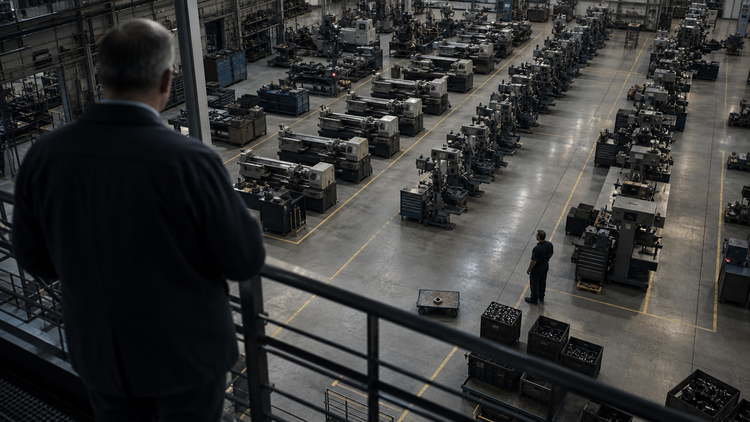
From the executive control tower, the Corporate Mobility Programme looks magnificent. Aircraft move across strategic horizons. Initiatives circulate through governance. Dashboards blink, portfolios rebalance and hundreds of professionals attend meetings devoted to acceleration. Every visible instrument confirms motion, and every measurement comes from a system designed by the people responsible for explaining it.
At ground level, customers continue waiting for the promised service. Engineers recognise vehicles carrying initiatives cancelled two reorganisations earlier. Product managers wave as Customer Centricity completes another circuit past the architecture board. A programme director announces that congestion demonstrates exceptional organisational engagement and commissions a new lane for next quarter.
Somewhere above them, another simulated aircraft begins its descent. The destination remains unchanged, the weather remains disabled, and the pilot has just received an AI-generated flight plan proving that the journey should take half as long.
... Nobody on the roundabout looks up. They have seen this aircraft before, and it has never yet carried anyone who needed to find the exit.



Member discussion