Monday Myth: Order Creates Efficiency
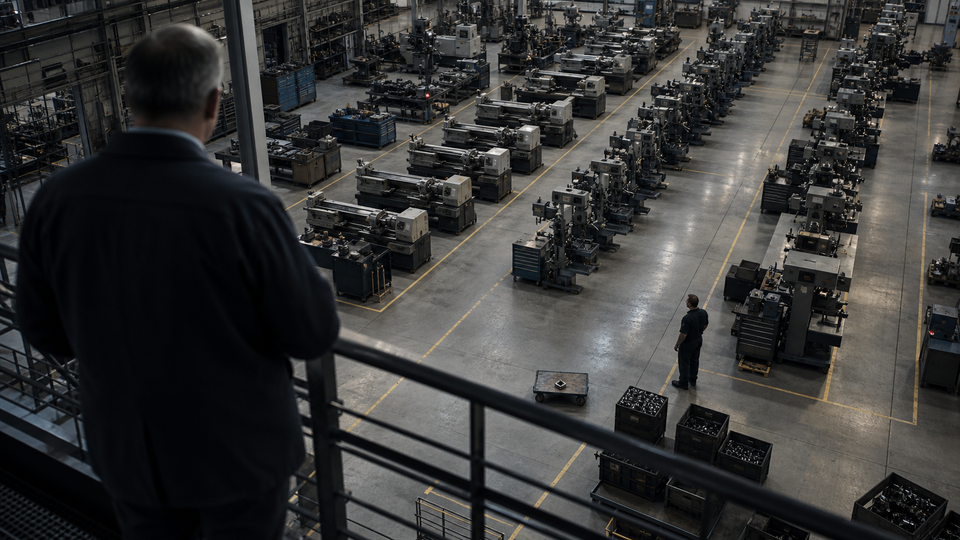
Walk through a conventional machine shop and its logic reveals itself before anyone explains it. Lathes stand with lathes, milling machines with milling machines, drills with drills. Similar tools occupy similar spaces. Operators who share a craft work under the same supervision, replacement parts sit in one place, and each department develops an intimate knowledge of its own equipment. From the factory gantry, the arrangement looks almost self-evidently rational. Every object belongs somewhere, and everything resembling it belongs there too.
The arrangement follows a powerful instinct. Classification reduces apparent complexity. A factory containing two hundred different machines seems easier to understand once those machines have been divided into departments. The turning department turns, the milling department mills, the paint shop paints and inspection inspects. Each area can measure its utilisation, refine its methods and defend the quality of its specialised work. Managers can compare like with like. Engineers can standardise tooling. Supervisors can allocate operators without first learning the details of every product passing through the building. Order becomes visible in straight rows and clean boundaries.
The Component’s Factory
The component experiences a different factory.
A metal housing may begin at a saw, travel to a lathe, wait for milling, cross the building for drilling, return for deburring, disappear into treatment, queue for painting and finally reach inspection. The machines remain stationary while the work undertakes a tour of the organisation. Because each department processes many unrelated products, it rarely receives the next component precisely when it has capacity. Work therefore waits. To make the movement economical, factories release it in batches. Batches make the waiting larger, conceal defects for longer and fill the spaces between departments with unfinished inventory. The department may remain busy even while the product remains motionless.
Nothing in this factory lacks order. The difficulty arises because the order belongs to the resources rather than to the work.
Cellular manufacturing disturbed that arrangement. Instead of placing identical equipment together, factories began arranging different operations in the sequence required by a family of products. A lathe might stand beside a mill, a drill, a washing station and an inspection bench. Machines that previously belonged in different departments now occupied the same patch of floor. Operators moved among processes. Components travelled through the cell one at a time rather than accumulating in batches between specialist territories. The United States Environmental Protection Agency describes such cells as sequences of equipment designed to support material flow with minimal transport or delay. Their defining departure from batch-and-queue production lies in bringing different process steps immediately beside one another. Its account of cellular manufacturing captures the physical reversal. The factory stops arranging itself around categories of machinery and begins arranging itself around the journey of the product.
To someone committed to departmental purity, the cell can look like a small act of vandalism. It duplicates capabilities that centralisation had carefully consolidated. It places unlike machines together. It asks operators to cross boundaries that once protected specialist knowledge. A traditional machine shop expresses order through similarity. A cell expresses order through sequence. The first asks what each machine is. The second asks what the work must become next.
The Number of Possible Factories
This difference cannot be understood by counting resources alone. Both factories may contain the same machines, employ the same people and possess the same aggregate expertise. Their productive capacity changes because their configuration changes. In one arrangement, the required capabilities exist but remain separated by queues, schedules, transport and departmental authority. In the other, complementary capabilities have already been assembled around a class of outcomes. The machinery has not become more intelligent. The distances between necessary states have become shorter.
Configuration carries a more demanding meaning than composition. Composition asks which elements a system contains. Configuration asks how those elements can combine. A box containing all the parts of a watch does not tell the time. A factory containing every required process does not necessarily produce flow. An organisation may employ every expertise demanded by its strategy and still struggle to bring those expertises together at the moment when work requires them. Possession describes inventory. Capability describes an arrangement.
Physics approaches a related problem through the idea of configuration space, the set of states a system could occupy given the possible positions and properties of its constituent parts. Statistical mechanics does not identify a system merely by listing its particles. It considers the immense number of microscopic arrangements compatible with its visible condition. Entropy, in this setting, concerns the multiplicity of those possible arrangements. The idea becomes dangerous when imported carelessly into organisations, where randomness can masquerade as adaptability and confusion can acquire the flattering language of emergence. Yet the configuration perspective reveals something that the organisational chart hides.
A functional department permits many small rearrangements while preserving one dominant condition. Backend engineers may exchange tasks, rotate services or adopt different tools, but a backend department remains a backend department. Its local configuration contains great depth and limited completeness. A data team can reorganise its analysts, engineers and scientists in numerous ways, but most customer outcomes still require it to connect with other departments whose priorities, workloads and definitions of urgency differ. The organisation possesses many theoretical combinations of expertise. Few remain continuously available, and fewer still prove easy to reach.
Capability That Cannot Assemble Itself
Every cross-departmental initiative attempts to construct a temporary configuration from this dispersed inventory. A product manager requests frontend capacity, negotiates for backend capacity, enters a data queue, seeks security approval and waits for operational support. On a diagram, the required configuration already exists because all the necessary boxes appear somewhere on the page. In time, however, it does not exist. One capability becomes available this week, another next month, and a third only after the annual priority cycle. The organisation owns the elements simultaneously but cannot make them present simultaneously. Its configuration space appears large while its reachable space remains small.
Cross-functional teams alter that geometry. They place unlike capabilities inside a persistent boundary, bringing product, design, frontend, backend, data and operations together in proportions suited to a domain of work. Internally, such a team looks less ordered than a functional silo because its members do not share a single craft. Their methods, vocabularies and professional instincts differ. The team contains more possible interactions, more ways of dividing a problem and more routes through which information can travel. It also contains more potential disagreement. Diversity of capability does not remove coordination. It draws coordination inside the unit where the consequences of delay remain visible.
Externally, however, something unexpected happens. Teams begin to resemble one another. One may serve payments and another fulfilment. One may support customer identity and another logistics. Their subject matter differs, but each contains a recognisable mixture of capabilities capable of moving work from observation to production. The organisation has increased difference within its teams while reducing difference between them.
Difference Within, Similarity Between
The siloed organisation performs the opposite transformation. It minimises difference within each team and maximises difference between teams. Look into one department and nearly everyone speaks the same technical language. Move sideways across the structure and the productive properties change abruptly. A request entering through the data organisation encounters an entirely different capability from one entering through engineering or design. What the system can do depends on the direction from which one approaches it.
Materials science calls a system isotropic when its relevant properties remain similar in different directions. The analogy should not be pressed into literalism, but it sharpens the organisational distinction. A functionally divided organisation behaves anisotropically. Capability varies strongly by direction. It can analyse here, build there, approve elsewhere and operate somewhere beyond that. A cross-functional organisation attempts a more isotropic distribution of delivery capability. Demand can enter through several teams and encounter a locally sufficient combination of skills. The teams need not become identical. They need only possess comparable productive properties.
This produces a peculiar inversion of entropy and order. The conventional structure looks orderly because it reduces local variety. The cross-functional structure looks less orderly because it admits variety within every team. Yet the first arrangement forces the work through a greater number of organisational states. Each handover changes ownership, context, queue and often the meaning of completion. The second arrangement places more possible configurations close to the work, allowing the team to adapt without repeatedly reconstructing the surrounding organisation.
The useful quantity, then, cannot simply be the number of possible configurations. A disorganised company may possess an enormous number because nobody knows who should do what. Nor should entropy become an elaborate compliment for chaos. What matters is the number of viable configurations, arrangements capable of producing a complete outcome under real constraints. More important still is reachability, the time, negotiation and energy required to move from the present configuration to the one the problem demands.
The Reachable Organisation
A railway network illustrates the distinction. Adding track increases the number of possible routes, but a route that requires incompatible gauges, unavailable locomotives or impossible junction movements exists only on the map. Connectivity does not guarantee reachability. In organisations, the equivalents are competing priorities, specialist bottlenecks, approval rights and overloaded people whose presence in a directory creates the appearance of access. The system contains the route. The work cannot travel through it.
This helps explain why adding specialists can make an organisation simultaneously more capable and less able to deliver. Each new function enlarges the catalogue of available expertise, but it may also add another boundary through which work must pass. Expertise accumulates while viable configurations become harder to assemble. Coordination systems expand to compensate through planning forums, dependency maps, portfolio boards, programme managers, alignment meetings and increasingly ornate representations of work that still cannot move. The organisation responds to the distance between its capabilities by improving its description of the distance.
Technology amplifies the chosen arrangement. Digital workflow tools can make departmental queues more visible, APIs can reduce certain handovers and artificial intelligence can supply fragments of missing expertise. None of these determines whether capability sits near the outcome or behind a sequence of organisational borders. A faster scheduling system may move requests between silos more efficiently while leaving the configuration problem untouched. The timetable improves. The railway retains its incompatible junctions.
Cross-functional teams carry their own limits. Some expertise cannot sensibly appear in every cell. Scarce disciplines require concentration, expensive infrastructure resists duplication, and professional communities protect standards that local autonomy may gradually erode. A manufacturing cell still depends on the factory around it through maintenance, materials, metrology, engineering and processes too costly or hazardous to reproduce beside every product family. Isotropy never means perfect uniformity. It describes the deliberate distribution of enough capability that ordinary work does not require an expedition through the entire system.
The difficult design question therefore concerns where incompleteness should remain. Every team lacks something. The consequential choice lies in whether it lacks a capability required daily, monthly or only under exceptional conditions. Organisations frequently centralise according to professional identity, placing similar people together because their similarity is administratively legible, rather than according to the frequency and cost of the dependencies imposed on the work. The resulting structure optimises the elegance of the categories and sends the product to pay for it.
Order from Above
From the gantry, the old machine shop still offers the more satisfying view. Its rows align. Its departments have names that correspond exactly to what sits inside them. Utilisation reports rise neatly through the hierarchy, each one describing a recognisable class of asset. The cellular factory looks compromised by comparison, with different machines crowded together, boundaries drawn around product families rather than professions, and local arrangements varying with the work.
Only when a component begins moving does the nature of the order become visible. In one factory, everything has a proper place except the product, which spends much of its life waiting between them. In the other, the machines have surrendered some of their categorical purity so that the product may possess a continuous path. Perhaps the most expensive disorder in an organisation is the kind that appears perfectly ordered from above.





Member discussion