Monday Myth: The Clock That Had to Leave the Workshop
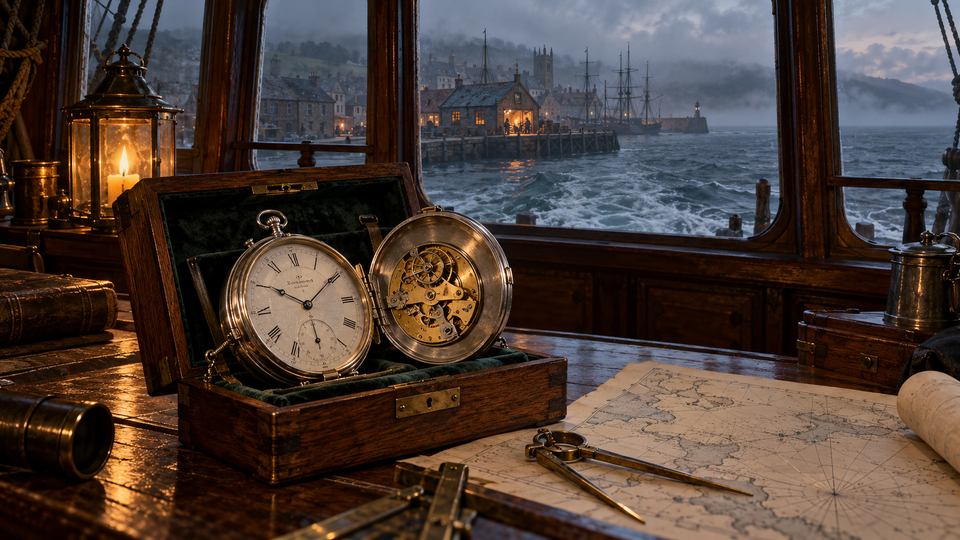
In an eighteenth-century workshop, a clockmaker could compare a new mechanism with an established clock, observe its behaviour over successive days and adjust it until the discrepancy narrowed. The floor remained still. The clock stayed upright. Whatever difficulties temperature, friction and imperfect workmanship introduced, the maker could examine them without the room pitching beneath his feet. Precision demanded ingenuity, but the workshop offered something almost as valuable: a reasonably stable world against which ingenuity could prove itself.
Take the same ambition aboard a ship and that world disappeared. The vessel rolled, pitched and changed direction. A voyage carried its instruments between climates. A pendulum depended on a relationship with gravity that the movement of its support continually disturbed. The sea did not merely make a good clock less convenient to use. It interfered with the physical conditions through which the clock kept time. An instrument could deserve its reputation ashore and still fail at the task for which a navigator needed it. [1]
The navigator wanted something deceptively simple. By comparing local time, established through astronomical observation, with the time at a reference meridian, he could calculate his longitude. Earth turns through 360 degrees in twenty-four hours, so an hour of time difference corresponds to fifteen degrees of longitude. Allowing for the necessary astronomical corrections, four minutes of error in the reference time meant a degree of error in longitude. At the equator, that degree covers roughly sixty nautical miles. The mathematics fitted comfortably on paper. Preserving the reference time across an ocean did not. [2]
A clock aboard a ship therefore carried a peculiar responsibility. It had to accompany the navigator through changing conditions while preserving information about a place it had left behind. Local observation supplied one part of the calculation. The mechanism supplied the other. Neither could replace its counterpart, and an impressive instrument alone could not tell the captain where he stood.
A mechanism against its surroundings
John Harrison approached this problem through machinery. His first marine timekeeper, now called H1, used two interconnected balances to reduce the influence of the ship’s movement. Later work led towards the much smaller H4, completed in 1759. Its appearance suggested a large pocket watch, but its stable, rapid balance represented a substantial departure from the behaviour of an ordinary watch. The reduction in size concealed a different approach to the problem rather than a miniature version of the first machine. [3]
That distinction matters mechanically. A timekeeper does not acquire accuracy merely because someone machines its parts with greater care. Its oscillator, the mechanism supplying its impulse and the surrounding conditions interact. Temperature can alter dimensions and the behaviour of a spring. Friction can change the energy that reaches moving parts. A mechanism might perform well at one combination of conditions while responding poorly when that combination changes. The task extends beyond removing manufacturing imperfections to understanding how disturbances travel through the instrument.
Harrison’s work belonged to that deeper task. The point of compensation was to make the mechanism respond to a change in ways that counteracted its effect. In the H4 family of mechanisms, a bimetallic compensation device adjusted the effective working length of the balance spring as temperature changed. The instrument retained precision through an engineered response to its surroundings. Its environment remained active even when its hands appeared serenely indifferent. [4]
There lies a subtle difference between adjustment and capability. Adjustment can make a particular instrument agree with a reference under particular circumstances. Capability concerns what happens afterwards, when the circumstances cease to co-operate. A workshop result measures a relationship among the mechanism, the maker and the test conditions. A voyage discovers how much of that relationship the mechanism can carry with it.
What crossed the Atlantic
In 1761, Harrison’s son William took H4 on a trial voyage to Jamaica. Further testing followed, including a voyage to Barbados. These trials brought the proposed solution into contact with the undertaking it claimed to support. The timekeeper travelled, experienced changing conditions and supplied information against which navigational observations could be compared. The crossing turned an argument about machinery into evidence about navigation. [5]
Yet even a successful crossing left another question unresolved. Could anyone else make an instrument that performed similarly? The Board of Longitude’s insistence on reproduction became entangled in a bitter dispute about rewards and requirements. That dispute deserves more care than the familiar story of an ingenious outsider obstructed by foolish officials allows. Whatever judgement one makes about the treatment of Harrison, a nation seeking a navigational capability faced a different problem from a craftsman seeking recognition for a working invention.
An exceptional object and a reproducible means of navigation occupy different places in the world. Larcum Kendall’s K1, commissioned as a copy of H4 and completed in 1769, helped explore that difference. Captain Cook carried it on his second voyage, where its performance strengthened the practical case for marine timekeeping. Another maker’s work had left another workshop and accompanied another undertaking. The evidence now reached beyond the original instrument and its original creator. [6]
Reproduction still did not settle affordability. Early marine chronometers cost enough to restrict their adoption. Subsequent makers, including John Arnold and Thomas Earnshaw, helped develop simpler and more reproducible designs. A mechanism could cross the threshold of technical success long before enough ships could acquire one. The sea cared about the instrument’s performance. The shipping economy also cared about its price, availability and the work required to keep it useful. [7]
The work hidden inside success
The phrase “it works” compresses those different achievements into a single claim. A similar compression occurs when an organisation presents a successful pilot. A small group delivers a result with direct access to specialists, rapid decisions and unusually attentive support. Difficulties receive immediate intervention. Knowledge travels through conversations that nobody records because everyone involved already understands the context. The result may demonstrate a valuable possibility while revealing remarkably little about the conditions needed to sustain it.
When another team receives the software or process, those conditions do not necessarily follow. Decisions take longer. Exceptions compete with ordinary work. A conversation becomes a request across departmental boundaries. The receiving team appears to struggle with something already proven, although the transferred arrangement differs materially from the arrangement that produced the proof. The visible artefact crossed the boundary. Much of its supporting machinery remained behind.
Completion itself can conceal the difference. A project meets its acceptance criteria, delivers the agreed scope and obtains approval. Its account closes around a defined undertaking. The receiving service inherits a continuing obligation, including whatever exceptions and dependencies the undertaking left unresolved. Both teams can report accurately within their respective boundaries while the organisation draws an inaccurate conclusion about its capability. The project finished. The work required to make its output routinely usable did not.
The boundary also determines where the cost appears. Specialist intervention charged to operations no longer troubles the project’s budget. Customer assistance conceals difficulties that would otherwise appear in adoption figures. A watchmaker could not preserve his instrument’s reputation by allocating its loss of precision to the navigator’s department. An organisation can distribute the consequences of incomplete capability across enough accounts that no single account describes it.
The rescue that keeps the arrangement alive
Early intervention often creates necessary knowledge. A sea trial discovers behaviour that a workshop cannot fully reproduce, and a pilot exposes interactions absent from its specification. The difficulty begins when intervention stops informing the design and becomes its permanent substitute. Hypercare continues because the system needs help, while the declaration of completion reduces the claim that further engineering work has on available time.
Recognition can reinforce this arrangement without anyone intending it. The delivery team receives credit for launching. The operating team earns trust by keeping the service running. The specialist becomes indispensable through repeated rescue, sometimes reluctantly. Customers receive enough assistance to continue. Each participant achieves something locally useful, and each successful intervention makes the underlying dependence easier to postpone. The service survives through the very effort whose necessity its success obscures.
That creates a self-sustaining pressure. The person best placed to remove a recurring problem also receives the calls when it recurs. Immediate recovery restores service and produces visible relief. Removing the cause requires protected time and offers a less dramatic result: future incidents that never happen. Repeated rescue consumes the capacity needed to make rescue unnecessary. The organisation can sincerely want independence while continually allocating its attention in ways that preserve dependence.
Growth exposes the constraint. More customers create more occasions for intervention, while the expert’s attention scarcely expands. Additional staff can increase the volume of work arriving at that person without increasing the capacity to resolve it. Queues form around knowledge rather than around the formal team structure. Delays then encourage faster escalation, which interrupts the expert more frequently and further reduces the time available to change the system.
The chronometer gives this analogy a necessary limit. It never eliminated the navigator’s skill, observation or care. Organisational capability likewise includes human judgement. The distinction concerns what ordinary operation demands from that judgement. A navigator using a dependable instrument performs the voyage’s work. A navigator continually compensating for an unreliable instrument performs that work while also carrying an unfinished part of the maker’s undertaking.
What reproduction must preserve
There remains a more difficult question beneath the instruction to scale a successful model. What, exactly, must travel? Kendall copied Harrison’s mechanism to establish that another maker could reproduce its performance. Later developments changed the design so that more instruments could reach more ships. Continuity of navigational purpose allowed substantial changes in the means through which that purpose became practical.
An organisational process depends on relationships that a diagram rarely captures. A pilot may succeed because its engineers can challenge assumptions immediately, its product counterpart can resolve uncertainty and its participants share enough knowledge to recognise a poor decision early. Copy its meetings, workflow and documentation into a setting where authority remains distant and specialists remain unavailable, and the procedure may look identical while behaving differently.
Literal copying can therefore destroy fidelity to the original achievement. A team given a standard process may need different decision rights, different access to knowledge or a different distribution of skills to achieve the same outcome. Variation does not automatically signal resistance or weak execution. It may reveal that the organisation has standardised the observable form while overlooking the relationships that gave that form its usefulness.
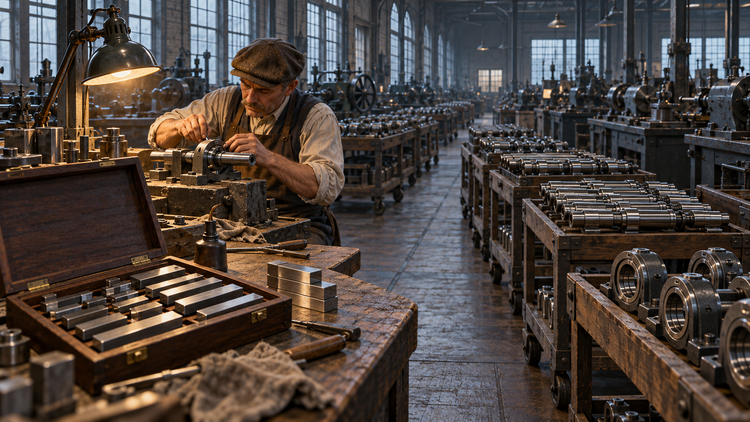
Manufacturing faces a related distinction. A specimen assembled through meticulous fitting proves that the object can exist. Repeated production requires a process that accommodates variation in parts, materials and working conditions. The marine chronometer faced both problems: preserving performance through the voyage and making that performance available beyond an exceptional object. Organisations can reproduce their procedures widely while leaving the capability those procedures supposedly express confined to the original workshop.
The fleet beyond the display case
The consequences spread beyond the service that needs help. An expert attending to an old delivery cannot give the same attention to a new one. A customer waiting for assistance experiences the dependence as delay. Another team experiences it as unavailable capacity. The original project can remain complete in every report while its unresolved work continues shaping decisions elsewhere. Its completion has become an administrative fact with an operational cost that travels.
Harrison’s achievement grows more substantial when these complications remain visible. Making precision survive the voyage demanded one kind of ingenuity. Making reliable timekeeping reproducible and more widely available demanded others. The historical story becomes less tidy as it becomes more explanatory, because the working object and the practical capability emerge through connected undertakings rather than a single triumphant demonstration.
A museum can place an extraordinary timekeeper behind glass and identify the moment of its completion. Beyond the case, the fleet presents a less manageable exhibit: instruments acquired, observations made, mechanisms cared for, voyages undertaken by people who never met the inventor. Somewhere in an organisation, a celebrated pilot may already occupy its own figurative display case while the people expected to sail with it still wait for the person who knows how to make it work.
Historical sources
[2] Royal Museums Greenwich: What is longitude?
[3] Royal Museums Greenwich: H4 collection record
[4] Royal Museums Greenwich: Marine timekeeper K1, technical description
[5] Royal Museums Greenwich: Harrison’s timekeepers
[6] Royal Museums Greenwich: K1
[7] Royal Museums Greenwich: A unique history of timekeeping
The organisational discussion develops an analogy, rather than claiming a historical equivalence between marine navigation and modern organisations.


Member discussion