(Untitled)
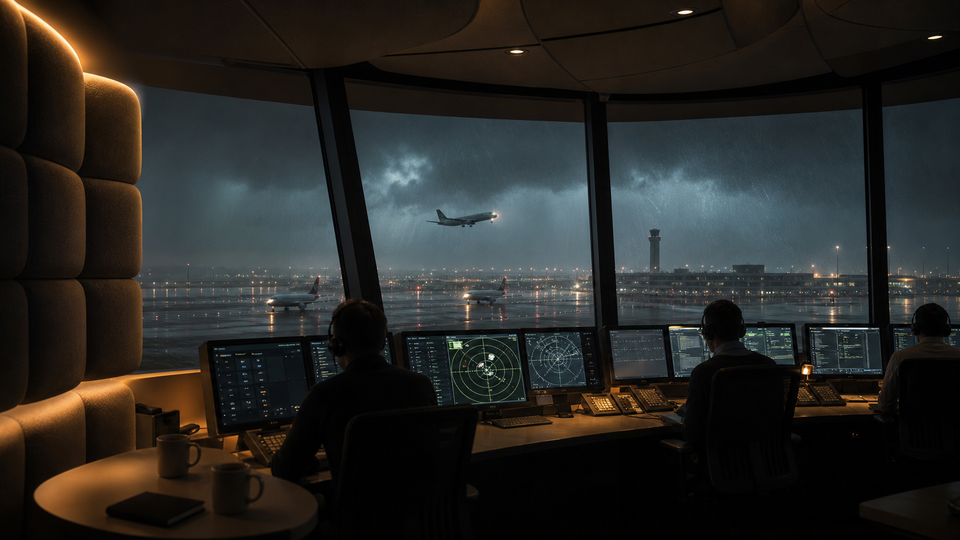
The Room That Reality Never Leaves
An air traffic control centre does not become quiet because the people inside it have reached the end of their working day. Aircraft continue to enter its airspace. Weather crosses established routes. Crews request different altitudes. Equipment fails, runways close and delays created hundreds of miles away arrive as somebody else’s immediate operational problem. The system cannot ask reality to return when everyone feels better prepared to receive it.
Controllers therefore work within a structure built around continuity. They transfer aircraft between sectors, centres and shifts. Each transfer must preserve an accurate picture of a moving system. Responsibility cannot disappear into the space between two people because one believed the other had accepted it. Nor can an aircraft remain unaddressed because the person responsible for it finds the situation unfair, stressful or inconsistent with the day they expected to have.
This does not make air traffic control indifferent to human needs. Fatigue, workload, distraction and ambiguity carry serious consequences, so the system must take them seriously. Shifts, breaks, staffing levels, communication protocols and escalation procedures exist because human attention has limits. The system protects the controller because protecting the controller helps protect the aircraft.
The sequence matters. Air traffic control begins with the mission and designs humane working conditions capable of sustaining it. It does not begin with the emotional comfort of the controller and then perform whatever portion of the mission remains convenient.
Many organisations have quietly reversed that sequence.
What No-Blame Culture Once Meant
Safety-critical industries learnt that punishing the person closest to an accident often produces a satisfying culprit but an inadequate explanation. The final mistake may have emerged from confusing procedures, badly designed controls, missing information, excessive workload or a series of small deviations that had gradually become normal.
A system that punishes every reported error teaches people to conceal errors. Silence then creates the appearance of control while hazards accumulate beneath it. Aviation consequently developed reporting and investigative practices intended to understand what happened before deciding who deserved blame.
This represented a major advance. Human error became the beginning of the investigation rather than its conclusion. Investigators examined equipment, procedures, communication, training and organisational assumptions. They distinguished understandable mistakes from recklessness and weak processes from deliberate violations.
No-blame culture did not mean no standards. It did not give controllers the right to ignore procedures because correction felt personal. It did not make performance unmeasurable or transform responsibility into a form of emotional aggression. It made truth safer to report because the system needed truth in order to improve.
Remove those distinctions and psychological safety degenerates into psychological immunity. “Do not humiliate people” becomes “do not make people uncomfortable”. “Investigate the system” becomes “nobody can be held accountable”. “Listen to how the decision affected me” becomes “my reaction determines whether the decision was legitimate”.
The organisation eventually avoids looking at reality because reality has failed to complete the appropriate sensitivity training.
The Politics of Immediate Comfort
Political correctness began with a defensible proposition: language and behaviour have consequences, and power can make those consequences difficult to challenge. Organisations needed to hear people who had previously carried the cost of remaining silent. Respect mattered. Humiliation did not become productive merely because somebody called it candour.
The distortion began when impact stopped contributing to judgement and started replacing it. “This affected me” gradually acquired the force of “this should not have happened”. Discomfort became evidence of wrongdoing. Feeling controlled became evidence of excessive control. Feeling judged became evidence of unfair judgement. Feeling threatened by change became evidence that the change itself lacked legitimacy.
An organisation cannot operate on that basis because reality distributes consequences without consulting emotional preference. A defective product remains defective when its measurement causes anxiety. A customer remains unsupported when an on-call arrangement feels inconvenient. An activity remains vulnerable to automation when discussing that vulnerability creates fear. Economic losses do not become less real because displaying them might make somebody feel blamed.
Political correctness becomes organisationally destructive at the moment subjective impact acquires veto power over objective necessity.
The organisation may collect facts, but it must negotiate permission to act upon them. It may define standards, but only until somebody experiences a standard as an attack. It may request ownership, but responsibility becomes conditional upon whether the responsibility feels compatible with an individual’s preferred interpretation of the role.
The immediate result often looks humane. The difficult conversation disappears. The implementation slows. The duty passes to someone more willing to absorb it. Nobody leaves the meeting visibly wounded, and the organisation congratulates itself on the quality of its culture.
The cost arrives later. Productivity declines, customers leave, investment moves elsewhere and competitors learn faster. The company loses the economic capacity to provide the stability, flexibility and protection that its culture promised. By then, the connection between the avoided discomfort and the eventual insecurity has become difficult to see.
People have traded long-term material comfort for short-term emotional comfort.
They have protected themselves from the anxiety of adaptation while increasing the probability of a disruption they will not be able to negotiate away.
When Emotional Intelligence Became Appeasement
Emotional intelligence should have made organisations more capable of difficult conversations. Recognising fear, defensiveness, status and shame ought to help people communicate an uncomfortable truth without unnecessary humiliation. A manager who understands emotion should become better at maintaining clarity under tension, not more skilled at escaping tension altogether.
Corporate culture often produced the opposite result. Emotional intelligence became confused with the ability to keep every interaction agreeable. Empathy meant accepting another person’s interpretation. Psychological safety meant preventing exposure to judgement. A successful conversation became one from which nobody emerged disturbed, regardless of whether anything necessary had been said.
Emotional intelligence recognises emotion as information. Emotional appeasement accepts emotion as authority.Once that substitution occurs, focus becomes difficult.
A conversation about performance turns into a conversation about how performance was discussed. A disagreement about evidence becomes an investigation of tone. A decision about operating requirements becomes a negotiation over whether the requirement made somebody feel valued. The organisation begins with reality, passes through emotion and never returns to reality.
This creates managerial cowardice disguised as sophistication. The manager anticipates discomfort and rounds the message until it possesses no useful edge. The employee receives a conversation rich in reassurance but poor in information. Months later, the same employee discovers that promotion has not arrived, responsibility has moved elsewhere or the role has disappeared. The organisation avoided a small moment of discomfort by allowing a much larger injury to mature in silence.
Care requires saying what needs to be said while the information can still change the outcome. It requires enough empathy to understand the effect of a message and enough respect to believe that its recipient can confront it. Protecting somebody from every uncomfortable signal does not demonstrate faith in their resilience. It quietly assumes its absence.
The Instrument Panel on Trial
Overall equipment effectiveness was never designed to calculate the moral worth of a factory worker. OEE attempts to make production losses visible by examining availability, performance and quality. It asks whether equipment could run, whether it ran at the expected speed and whether it produced acceptable output.
The measure remains incomplete. Planned maintenance may reduce availability while preventing a larger breakdown. Slower operation may protect quality. A defect discovered at one machine may originate in material or decisions supplied elsewhere. Used carelessly, OEE can encourage unfair comparison or local optimisation.
That is why the number should begin an investigation rather than end one.
Yet some organisations encounter resistance before investigation can begin. Measurement allegedly reduces people to resources. Displaying performance creates pressure. Comparing shifts encourages blame. Asking why a target was missed feels controlling. The possibility of misuse becomes sufficient reason to preserve invisibility.
This confuses the person with the measurement. OEE measures what happened to a production system. It does not measure the human value of those operating it. A decline may expose poor maintenance planning, unreliable materials, unrealistic scheduling or a management decision that left operators without support. The metric can defend the frontline as readily as it can expose a mistake.
Without measurement, however, only the most politically powerful interpretation survives. Management can blame operators. Operators can blame maintenance. Maintenance can blame procurement. Everyone preserves dignity, and the factory continues losing capacity for reasons it has agreed not to examine.
Refusing OEE may protect somebody from feeling blamed today. Persistent hidden losses may eventually close the factory. Short-term emotional protection has purchased long-term economic insecurity.
A blameless culture should make investigation safer. It should not make investigation impossible.
The Service That Continued After Everyone Went Home
Software businesses meet the same reality when their products succeed. A small team can initially support customers through personal effort and informal arrangements. Growth changes the system. Customers use the service across countries and time zones. The software becomes part of their own operations. An outage at night may stop somebody else’s business.
Continuous service requires continuous responsibility.
The objection arrives in personal language: “I did not sign up for this.” It may expose a genuine organisational failure. A company cannot promise permanent availability and quietly transfer the burden to employees whose roles, compensation and working conditions never anticipated it. Twenty-four-hour support requires staffing, rotations, automation, recovery time and fair recognition.
But the objection cannot settle the operational question. The customer has already signed up for the service. The incident exists. Someone will carry the burden even if the organisation refuses to name them. Avoiding a designed support system does not protect people; it leaves responsibility to fall unpredictably upon the conscientious.
The organisation wants exponential SaaS growth without the operating discipline that growth requires. It wants the revenue of a permanent service and the responsibilities of a temporary project.
An air traffic control centre does not search for a heroic volunteer whenever the night shift begins. It builds a system in which responsibility continues while individuals rotate.
The Tool That Disturbed the Peace
Artificial intelligence exposes the same weakness at greater speed. Organisations announce ambitious adoption programmes while attempting to ensure that no role, boundary or source of status feels disturbed. They want transformation without displacement, productivity without comparison and experimentation without the possibility that an experiment might reveal an obsolete activity.
Some resistance remains rational. AI can fabricate answers, weaken accountability and automate defective assumptions at scale. Serious adoption requires testing, supervision and a clear understanding of where human judgement remains essential.
Technical caution, however, can shelter a different resistance. A tool that reduces the effort required for a task also changes the status of the person who controlled that task. Expertise sometimes attaches itself not to the value produced but to the difficulty of the existing method. When the difficulty disappears, people defend the method in the language of quality, ethics or governance.
The organisation then rounds every corner. AI will assist but never challenge. It will save time, although nobody will ask what happens to the saved time. It will increase capacity, although existing performance will remain beyond examination. It will transform the company while preserving every arrangement that transformation would need to disturb.
Employees protect today’s tasks while weakening tomorrow’s organisation. They avoid the immediate fear of becoming less necessary and increase the long-term probability that their employer becomes less viable.
Technology did not create the contradiction. It illuminated it.
A Business Is Not a Care Centre
An organisation can possess a duty of care without existing to provide care. It should not humiliate, exploit or casually exhaust people. It must create conditions in which they can perform demanding work without sacrificing their health or dignity. But unless the organisation actually operates a care service, employee comfort does not constitute its mission.
A business exists to create something for somebody beyond itself. It manufactures a product, operates infrastructure, solves a problem or serves a customer. It must generate sufficient economic value to continue doing so. Without that discipline, salaries, development programmes, flexible benefits and carefully cultivated culture eventually lose the system that finances them.
Calling a company a war machine can sound severe, yet the image contains a truth that softer metaphors conceal. A serious operating system aligns people, capital, information and technology against a difficult external objective. It concentrates effort. It accepts that resources remain finite, competitors will not wait and customers do not owe it survival.
The metaphor becomes dangerous when management treats people as expendable material and obedience as a virtue. Rejecting it entirely creates a different danger: the organisation forgets that it has a mission. One extreme produces fear. The other produces a beautifully furnished waiting room in which everybody feels welcome while nothing leaves the factory.
Economic stability does not come from eliminating pressure. It comes from constructing a system capable of converting pressure into performance without destroying the people inside it.
Values That Survive a Bad Morning
Organisations often publish values promising respect, trust, courage and collaboration. None of these words explains what should happen when respect conflicts with candour, trust encounters weak performance or collaboration disperses responsibility so widely that nobody owns the outcome.
A usable value system must survive emotion. It cannot depend upon whether feedback feels welcome on the day it arrives. It must help people act when they feel defensive, disappointed or afraid. Otherwise, the organisation has not created values. It has described its preferred atmosphere.
Modern life strengthens the preference for atmosphere. Digital systems provide rapid stimulation, visible approval and immediate relief. Dopamine participates in anticipation and learning rather than functioning merely as a chemical dose of pleasure, but the behavioural pattern matters: people become accustomed to environments that react instantly to preference.
Useful organisational consequences follow a different timetable. Training exposes weakness before it builds competence. Maintenance interrupts production before it prevents failure. Feedback produces embarrassment before it produces improvement. Automation destabilises familiar work before it creates new capacity. The cost arrives now; the value may remain invisible for years.
Political correctness gives immediate impact greater moral weight than delayed consequence. “This makes me uncomfortable” has a living representative in the room. “Avoiding this may make us economically unsafe in three years” belongs to a future that has no seat at the table.
The organisation consequently rewards relief rather than resolution. It recruits people to consume an employment experience rather than contribute to a demanding undertaking. Belonging detaches from participation, care detaches from contribution and safety detaches from truth.
Late at night, an air traffic control centre contains little of the language with which organisations decorate themselves. Screens show aircraft moving through indifferent weather. Positions must be staffed. Information must be transferred. Errors must be reported and corrected. People must remain able to say that something is wrong, and equally able to hear that something they did was wrong.
Somewhere beyond the glass, an aircraft has entered the sector. Its passengers have exchanged short-term control for the long-term security of a system willing to confront reality on their behalf. The system may care deeply about everyone in the room, but it cannot place their immediate comfort above the aircraft, because the aircraft is already moving, whether the conversation feels safe or not.





Member discussion