Wednesday Reality: Control Has Mass
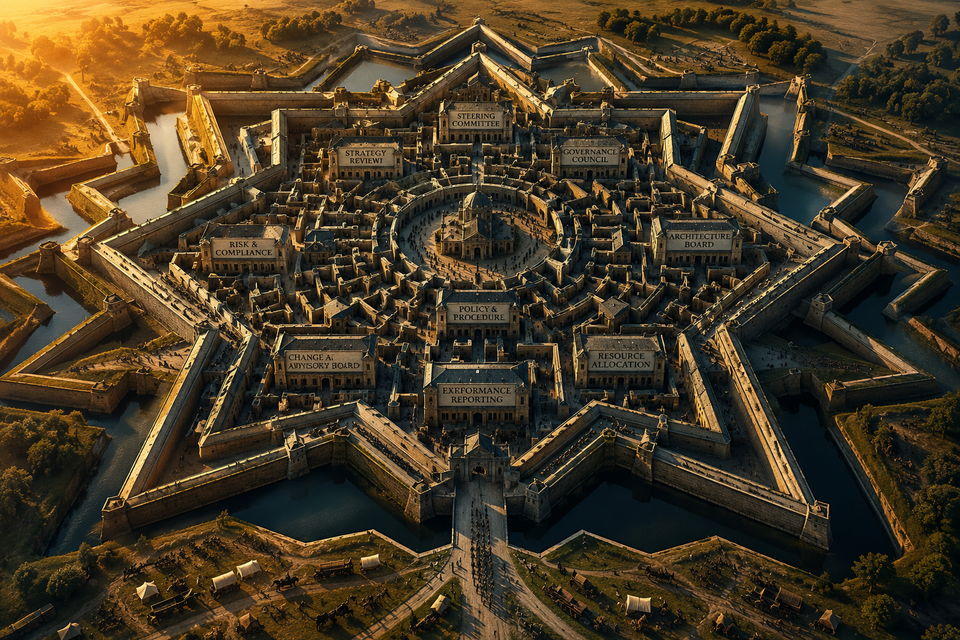
The Engineer Who Changed the Economics of Defence
Medieval Europe placed enormous faith in walls. Kingdoms raised thicker stone, dug deeper moats and built taller towers, convinced that physical strength, commanding visibility and determined defenders would discourage even the most ambitious attacker. Security appeared to increase with every additional guard, patrol and watchtower because vigilance supposedly closed the gaps left by uncertain design. Yet the history of siege warfare repeatedly exposed the weakness of that assumption. Human attention decays, fatigue corrodes judgement, communication fragments under pressure and every blind spot eventually demands another pair of eyes. Defence therefore became an increasingly expensive exercise in compensating for architectural limitations through human supervision.
Sébastien Le Prestre de Vauban approached the same problem from another direction. He did not merely draw a more elaborate fortress. He changed the economics and mechanics of defence. His angled bastions removed blind spots through geometry, overlapping fields of fire ensured that each defensive position protected another, while artillery, ammunition stores, troop circulation, supply routes and access points formed one coherent system rather than a collection of isolated precautions. The fortress no longer depended primarily upon exceptional men performing exceptional acts at exactly the right moment. Ordinary soldiers operating within an intelligently designed structure could produce extraordinary defensive strength because the architecture continuously reduced the number of situations requiring improvisation or heroism.
This distinction mattered far beyond military engineering. Vauban did not respond to a weak wall by placing another guard upon it. He redesigned the wall so that fewer guards became necessary. Instead of compensating for poor architecture through vigilance, he transferred part of the defensive burden into the structure itself. The system guided behaviour, narrowed the space for error and reduced the amount of energy required to maintain control.
Modern organisations frequently travel in the opposite direction. Rather than improving the architecture of work, they increase the number of people watching it.
When Organisations Stop Trusting Their Own Engineering
No organisation deliberately chooses bureaucracy as an operating model. Governance usually accumulates through a sequence of locally reasonable responses to uncomfortable events. A failed deployment introduces another approval. An architectural mistake produces a review board. A missed commitment leads to a steering committee. Quality problems add mandatory sign-offs, while declining predictability generates more reporting, more escalation paths and more frequent requests for executive visibility. Each intervention can defend itself perfectly when examined alone. Together, however, they reveal an organisation progressively replacing confidence in engineering with confidence in administration.
The transition rarely attracts attention because it happens gradually. Teams continue delivering, meetings continue producing decisions and dashboards continue displaying reassuring colours. Yet the centre of gravity has shifted. Engineers spend more time proving that work may proceed than improving the conditions under which it proceeds. Architects review documents rather than shaping architecture. Managers explain delivery rather than increasing its reliability. Senior leaders acquire more information about the system while the system itself acquires less capacity to act.
Governance then starts to resemble maturity. Organisations point to architecture boards, release controls, programme committees and executive reviews as evidence of discipline, although each mechanism often compensates for something the underlying delivery system can no longer provide by itself. Architecture boards expand because architectural coherence has weakened. Change advisory boards multiply because deployments cannot earn trust through automation and evidence. Steering committees grow because work no longer moves through the organisation with sufficient clarity or predictability. The administrative layer expands precisely where engineering confidence contracts.
This inversion deserves attention because supervision and control do not represent the same thing. Supervision observes activity. Control comes from understanding the system well enough to influence its behaviour. An organisation may watch every movement and still remain incapable of improving outcomes. It may collect exhaustive status reports while lacking any meaningful grip on lead time, quality, flow or customer impact. Visibility can create reassurance, but reassurance alone does not alter the mechanics of delivery.
The more governance an organisation requires before work can move, the more likely it has already lost control over the conditions that make movement safe.
Control Has Mass
Governance carries weight. Every additional approval, review, committee and reporting obligation adds friction to the path through which work must travel. Organisations often treat these additions as administrative overhead, something mildly inconvenient but operationally neutral. In reality, they alter the behaviour of the entire system because each control inserts waiting, extends feedback and increases the energy required to move an idea from intention to impact.
An approval rarely consumes only the fifteen minutes required to make the decision. Work waits for the next meeting, the right attendee, the missing document or the stakeholder returning from leave. Questions travel backwards through the process, answers arrive later, priorities shift in the meantime and engineers reopen contexts they had already left behind. The visible delay may look small on a project plan, yet the cumulative effect spreads across every dependency. One gate slows the item in front of it, which then blocks another item, increases work in progress and pushes uncertainty further downstream.
Longer waiting increases lead time. Longer lead time extends time-to-market. Extended time-to-market delays customer feedback, which in turn postpones learning and correction. By the time the organisation discovers that an assumption proved wrong, it has invested more effort, accumulated more dependencies and reduced its room to manoeuvre. Control, introduced to reduce uncertainty, therefore preserves uncertainty for longer by delaying the point at which reality can answer.
The economic consequences follow directly. A useful idea creates no value while it remains in a backlog, an approval queue or a steering pack. Revenue waits. Savings wait. Risk reduction waits. Customer trust waits. The organisation may report substantial progress through completed analyses, approved designs and successful governance milestones, yet none of those activities matter economically until something changes in the external world.
Systems thinking makes the pattern difficult to ignore. Ideas, requests, initiatives and opportunities continuously enter the organisation, creating a growing stock of intended work. Governance slows the outflow by restricting the rate at which completed value can leave the system and reach customers. As inflow exceeds outflow, work in progress rises, queues lengthen and coordination consumes an increasing share of available capacity. The organisation responds to the resulting congestion with more planning and more governance, which reduces outflow further and strengthens the same feedback loop.
Traction disappears gradually rather than dramatically. The company still moves, but every movement requires more effort. Teams remain busy, executives remain informed and portfolios remain full, yet the distance between activity and impact continues to widen. The organisation mistakes internal motion for external progress because its coordination systems generate abundant evidence of work while its productive systems release less value.
Bureaucracy describes the visible surface of this condition. Organisational inertia describes its mechanics. Control adds mass, mass resists acceleration and a system that cannot accelerate eventually loses contact with a changing market.
Engineering Has Solved This Before
Mature engineering disciplines have spent centuries learning that inspection cannot compensate indefinitely for poor design. Manufacturing does not improve quality by endlessly increasing the number of people examining finished products. It redesigns production so that defects become harder to create, easier to detect at source and less likely to travel downstream. Precision engineering relies on tolerances, repeatable processes and feedback embedded close to the work because late inspection costs more and teaches less.
Aviation follows the same logic. Safety does not emerge from gathering a large committee before every departure to debate whether the aircraft deserves permission to fly. It comes from disciplined maintenance, component reliability, standard operating procedures, checklists designed around known failure modes, clear accountability and evidence produced continuously by the system. Oversight remains, but it sits upon a foundation of engineering capability rather than substituting for it.
Software engineering possesses equivalent mechanisms. Automated tests, observability, deployment pipelines, progressive delivery, rollback capabilities, clear interfaces, service-level objectives and disciplined architecture all transfer confidence into the system itself. A trustworthy pipeline removes the need for a manual release ceremony. Reliable telemetry reduces dependence upon status meetings. Clear operational ownership shortens escalation paths.
Well-designed boundaries allow teams to act without repeatedly negotiating permission.
Yet many technology organisations invest more energy in strengthening the controls around delivery than in strengthening delivery itself. They add approval gates because tests inspire insufficient confidence, architecture councils because interfaces lack clarity, and steering committees because plans remain disconnected from operational reality. The organisation then describes the surrounding administration as governance maturity, even though the productive system underneath it has changed very little.
This distinction matters because capability and coordination scale differently. Capability increases the amount of value a system can produce. Coordination consumes part of that capacity in order to organise production. Some coordination remains essential, just as some inspection remains essential, but problems emerge when the coordination system grows faster than the productive system it supposedly supports. At that point, the organisation no longer governs work. Work increasingly exists to feed governance.
The result resembles a factory that employs more people checking forms than improving machines. Every process appears controlled, every deviation documented and every decision traceable, while throughput quietly declines.
Making Complexity More Comfortable
Artificial intelligence enters this story not as the cause of bureaucracy, but as its newest preservation mechanism. Organisations already burdened by approvals, reports, committees and fragmented information increasingly use AI to summarise meetings, draft governance packs, review documentation, generate compliance evidence and prepare executive presentations. Each use may save time locally, and some may genuinely remove repetitive labour. The deeper question concerns what happens to the system once the pain of bureaucracy declines.
When five approval meetings stand between an idea and production, one organisation asks why those meetings exist. Another asks whether AI can summarise them more quickly. The first confronts the architecture of work. The second makes the existing architecture easier to tolerate. Both may claim innovation, but only one changes the conditions that created the delay.
This difference exposes an organisational resistance to change that technology often disguises. Simplifying a system requires judgement and frequently demands conflict. Someone must challenge controls introduced by respected predecessors, remove committees that support established roles, question reporting structures valued by senior leaders and accept that some forms of visibility provide comfort without creating control. The work reaches beyond process improvement because governance accumulates constituencies. Every meeting has an owner, every report has an audience and every approval grants authority to someone.
Automation avoids those confrontations. AI can reduce the administrative burden without disturbing the arrangement that created it. Reports arrive faster, minutes appear instantly and compliance artefacts materialise with less effort. The organisation experiences relief and interprets that relief as progress, although the number of gates, hand-offs and decision points remains unchanged. Technology removes the symptoms that might otherwise have forced redesign.
This makes AI an unusually powerful instrument of organisational denial.
It can extend human capability inside a coherent system, but it can also extend the life of a poor system by making its weaknesses less painful. A bloated process that once consumed ten hours may consume two, which looks like an 80 per cent improvement until someone asks why the process exists at all. Efficiency improves inside a structure whose effectiveness remains unexamined.
The metaphor of dust beneath a carpet captures the inversion well. Cleaning properly requires moving furniture, opening cupboards, discarding what no longer serves a purpose and sometimes repairing the floor underneath. Each action demands effort and exposes neglect. A more powerful vacuum cleaner offers an easier alternative: remove what can still be seen and push the remainder further out of sight. The room looks cleaner, visitors notice the improvement and nobody needs to confront the condition of the house.
AI can play exactly that role. It does not necessarily remove organisational complexity. It can make complexity more comfortable. It does not necessarily reduce governance. It can make governance cheaper. It does not necessarily accelerate the productive system. It can accelerate the coordination system surrounding it. The organisation then congratulates itself for moving faster while the outflow of customer value remains constrained by the same approvals, queues and structural dependencies.
Technology has not created the dust. It has simply become remarkably effective at hiding it.
The Walls Reveal Their Architects
Vauban understood that the strength of a fortress could not be measured by counting the soldiers stationed upon its walls. A large garrison might indicate power, but it might equally reveal weak geometry, poor visibility, fragile logistics or a design that demanded constant human compensation. The number of guards told observers something about the confidence the architect had placed in the structure.
Organisations reveal themselves in the same way. Each approval, committee, governance board, dashboard and escalation path records a decision about where trust resides. Some controls reflect genuine regulatory or operational necessity, but their accumulation often marks the places where architecture, accountability and engineering discipline have failed to carry the burden. The visible machinery of control expands around the invisible absence of confidence.
AI now joins that machinery. An agent can prepare the reports, summarise the committees and maintain the evidence required by the controls, allowing the surrounding bureaucracy to operate with fewer people and less irritation. That may reduce cost, but it does not automatically restore flow. A lighter garrison still defends the same walls.
The uncomfortable question therefore concerns neither governance nor AI in isolation. It concerns what the organisation chooses to preserve. When technology removes repetitive work from a coherent productive system, it expands capability. When it removes the discomfort generated by a weak system, it can protect that weakness from scrutiny.
Vauban changed defence by refusing to confuse more guards with stronger fortifications. Modern organisations often make the opposite mistake, then use increasingly sophisticated tools to manage the consequences.
The fortress may look quieter, the reports may arrive faster and the carpet may appear cleaner, while the walls remain exactly as weak as before.




Member discussion