Friday Fun: The Corporate Weather Office
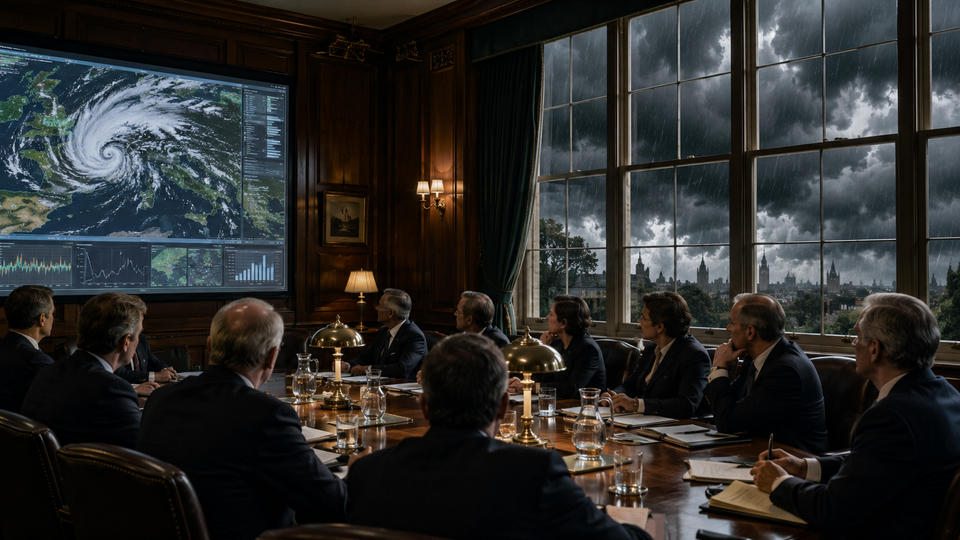
The Corporate Weather Office occupied the fourth floor of the Ministry because weather had, over time, acquired considerable strategic importance. Earlier generations had regarded the atmosphere as a largely operational matter that individuals managed for themselves, generally by opening a curtain before leaving home. While undeniably simple, the arrangement suffered from obvious limitations. Different people occasionally reached the same conclusion using different observations, different vocabulary or, in particularly unfortunate cases, different points of view. As the Ministry expanded, such inconsistencies became increasingly difficult to reconcile within a coherent reporting structure.
The Review Board later concluded that the first significant governance failure occurred on a Tuesday morning.
Facilities reported light rain shortly after nine o'clock. Finance preferred the description persistent precipitation. Human Resources advised managers to recognise the potential impact of challenging atmospheric conditions upon employee wellbeing. Marketing identified an opportunity to reinforce the organisation's commitment to outdoor resilience. Communications postponed all public statements pending executive validation. By the time consensus emerged, the rain had already moved east.
The subsequent review reached a conclusion that few challenged. Contrary to initial assumptions, the difficulty had never originated in the weather itself. Rain had behaved impeccably throughout the morning. Every cloud had appeared exactly where the atmosphere intended. The confusion arose because several departments independently observed the same event before the organisation had agreed what it should be called.
The Board therefore approved the Single Source of Sky Programme.
Considerable care went into the wording because earlier drafts suggested that the Ministry intended to control the weather itself, an ambition judged optimistic even by departmental standards. The Programme merely sought to ensure that every employee discussed precisely the same weather, irrespective of the one that happened to exist beyond the windows. Consistency, after all, represented the first requirement of effective coordination, whereas reality had demonstrated only intermittent enthusiasm for behaving consistently.
The windows remained in place throughout the transformation. Their continued presence reflected the Ministry's long-standing commitment to openness and transparency, values considered entirely compatible with discouraging unnecessary observation. Employees retained the freedom to look outside whenever circumstances genuinely required it, although guidance recommended reconciling any direct atmospheric assessment with the Dashboard before discussing it with colleagues. Independent observation had not been prohibited. It had simply become administratively inconvenient.
The arrangement proved remarkably successful. Reports became noticeably more consistent within a few weeks. Forecast confidence increased steadily. Executive briefings shortened. Cross-functional disagreement declined almost immediately. Whether organisational understanding improved belonged to a different family of metrics administered elsewhere.
Each morning the Forecast Coordination Committee assembled in Conference Room Cirrus. Representatives attended from Forecast Operations, Dashboard Integrity, Forecast Assurance, Atmospheric Communications and Strategic Planning. The Committee concerned itself primarily with forecast quality rather than forecasting quality, a distinction that occasionally confused new employees until the induction programme explained it properly. Forecast quality described the degree to which forecasts respected approved methodology, confidence classifications and reporting standards. Forecasting quality referred to whether tomorrow eventually resembled the forecast. Experience demonstrated that the former admitted considerably greater managerial influence and therefore offered more promising opportunities for continuous improvement.
Outside the Ministry, meteorologists continued operating in a rather different fashion. Thousands of weather stations quietly reported pressure, temperature and humidity every few minutes. Merchant ships crossing the Atlantic contributed observations from places where permanent stations could never exist. Commercial aircraft continuously transmitted atmospheric measurements while carrying passengers who remained blissfully unaware that they had briefly become part of one of the largest scientific observation networks ever assembled. Weather balloons disappeared into the upper atmosphere twice each day carrying instruments destined never to return. Firefighters watched smoke before consulting fire maps. Farmers still walked their fields. Mountain guides looked towards the ridges before reading avalanche bulletins. Airline pilots occasionally glanced through the windscreen despite having access to instrumentation of extraordinary sophistication. Modern meteorology did not replace observation. It multiplied it.
The Ministry regarded this approach as difficult to govern.
The following year brought artificial intelligence.
The Programme Board considered the development a natural progression. Executives no longer needed to compare multiple forecasting systems because the platform now reconciled competing atmospheric models before producing a concise executive interpretation suitable for strategic consumption. A subsequent enhancement summarised the executive interpretation into a format considered more appropriate for senior leadership whose responsibilities understandably limited prolonged engagement with operational meteorology. Internal surveys recorded a substantial reduction in executive weather consumption without any corresponding decline in confidence. The Board regarded this outcome as particularly encouraging.
By now, very few employees opened the curtains.
The change attracted surprisingly little attention. New recruits accepted the Dashboard as the natural starting point for any discussion concerning weather. Longer-serving employees occasionally paused beside a window through force of habit before quietly continuing towards the meeting room. The curtains remained available, although their practical purpose had gradually become less obvious than their symbolic one.
The question itself arrived during an otherwise routine Forecast Coordination Committee.
A recently appointed graduate engineer apologised for interrupting before asking whether anyone had looked outside.
The Chairman thanked him for raising an interesting point. He explained that direct observation occasionally differed from the Dashboard during periods of rapid atmospheric evolution. Such discrepancies rarely improved organisational understanding because they introduced competing interpretations before the approved reporting cycle had completed its work. The Committee therefore preferred allowing reality sufficient time to align with the Dashboard before encouraging unnecessary observational activity.
The explanation appeared entirely satisfactory.
No further questions arose.
The meeting concluded shortly before midday. Committee members gathered their papers, exchanged polite remarks regarding the encouraging improvements in Forecast Quality and dispersed towards lunch. Several walked past the windows. One paused briefly beside a curtain before remembering that there was very little left to discover there.
The weather had already been explained.




Member discussion