Friday Fun: The Office Escape Room
A Carefully Engineered Puzzle
Long before escape rooms became fashionable corporate team-building exercises, engineers, locksmiths and craftsmen had been designing mechanical puzzle boxes whose sole purpose was to challenge the human mind. Every hidden compartment, sliding panel and concealed mechanism existed because somebody had deliberately imagined the complete journey from confusion to discovery. The participant experienced uncertainty, but the designer never did. Every obstacle served a purpose, every clue rewarded careful observation, and every solution moved the player one step closer to the exit.
Modern escape rooms follow exactly the same philosophy. Their creators spend months constructing an experience that feels chaotic while remaining perfectly orchestrated beneath the surface. Nothing appears by accident. Every lock belongs somewhere. Every key eventually fits. Even the dead ends exist to create tension rather than frustration. The complexity may feel intimidating, but it remains entirely intentional.
It is, in many respects, a remarkable piece of systems engineering.
An Unexpected Sense of Familiarity
This perhaps explains why escape rooms have become such popular corporate activities. Organisations proudly invite teams to spend an afternoon solving puzzles together, communicating under pressure and discovering that collaboration often succeeds where individual effort fails. The promise sounds irresistible. Leave the office for a few hours, solve an artificial mystery and return having strengthened trust, communication and collective problem-solving.
The curious part arrives about twenty minutes into the exercise. Someone inevitably remarks that this feels remarkably similar to an ordinary sprint.
The room falls silent, not because anyone disagrees, but because everyone suddenly realises they have already been rehearsing for this event every working day.
The First Challenge
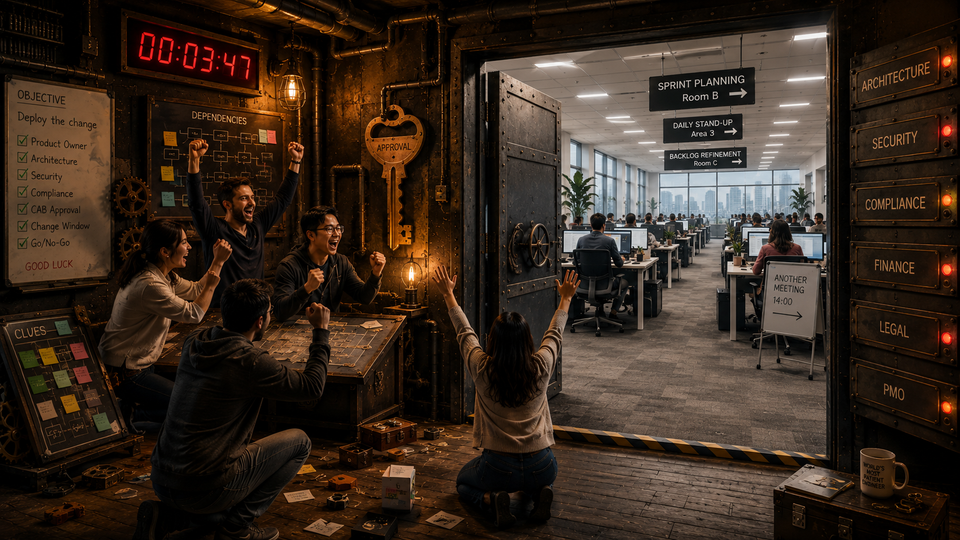
Our own adventure began with a deceptively simple objective. Deliver a small software change before the countdown reached zero. The technical work itself appeared almost trivial. Unfortunately, nobody could begin until the Product Owner confirmed the priority, Architecture validated the approach, Security reviewed the implications, Compliance confirmed the interpretation, and somebody located the latest version of a document whose title suggested it had already been replaced three times.
Progress arrived slowly, not because the engineering proved difficult, but because every solved puzzle revealed another door.
Finding the Product Owner unlocked Architecture. Architecture unlocked Security. Security unlocked Compliance. Compliance unlocked Governance.
And Governance unlocked a meeting whose purpose seemed to involve deciding when the next meeting should take place.
Nobody questioned the sequence. Experienced participants simply nodded with the quiet confidence of people who had clearly escaped similar rooms before.
Every Puzzle Once Solved a Problem
The fascinating difference between commercial escape rooms and organisational ones lies in their origin.
Professional designers begin with the complete picture before creating the first obstacle. They know exactly where participants will struggle, exactly where they will succeed and exactly when they will feel satisfaction. The entire system exists because someone intentionally designed the journey.
Organisations almost never enjoy that luxury.
Nobody wakes up one morning determined to create a maze. Every additional approval once addressed a genuine concern. Every governance forum emerged after an uncomfortable incident. Every spreadsheet answered an executive question. Every checkpoint reduced a specific risk. None of these decisions appeared unreasonable when considered individually, and most probably represented sensible responses at the time.
The difficulty begins several years later, when every solved problem still leaves its lock behind.
Eventually nobody remembers why the door exists. They simply know that another key must be found.
The Facilitator's Congratulations
By late afternoon our facilitator gathered everyone together and congratulated the teams on their excellent communication. We had collaborated effectively, shared information openly and remained remarkably calm despite the mounting pressure. Apparently, the exercise had demonstrated the importance of teamwork in complex environments.
Several engineers exchanged polite smiles.
One quietly observed that the artificial version had actually felt rather efficient. The clues all belonged to the same puzzle, the objectives never changed halfway through the exercise, and every person involved appeared to understand what counted as success. Nobody announced a strategic pivot with twelve minutes remaining. Nobody introduced an additional approval after discovering the team was making good progress. Most importantly of all, the game designer had every intention of allowing participants to leave.
That last feature deserved particular appreciation.
The Largest Escape Room in the Building
Perhaps organisations have misunderstood the value of escape rooms entirely.
The objective was never to teach people how to navigate unnecessary complexity. Most engineers, product managers and delivery teams have already mastered that discipline through years of professional experience. They know how to locate missing information, negotiate conflicting priorities, decode contradictory documentation and identify the one individual who somehow still understands a process introduced before half the company joined.
The remarkable achievement is not that they continue escaping. The remarkable achievement is that they continue delivering anything once they do.
Back to Work
At the end of the afternoon the facilitator unlocked the final door, thanked everyone for participating and handed out certificates celebrating our collaborative problem-solving abilities. We returned to the office smiling, convinced that the exercise had been enjoyable, professionally organised and surprisingly realistic.
Then someone opened their laptop, discovered eighteen approval requests waiting in their inbox and quietly realised that the day's escape room had merely served as a warm-up.
Unlike the commercial version, this one had not been designed by a systems engineer.
It had simply evolved. And nobody could remember where the exit was supposed to be.




Member discussion