Wednesday Reality: Engineering Begins Where Certainty Ends
Two Voyages into the Unknown
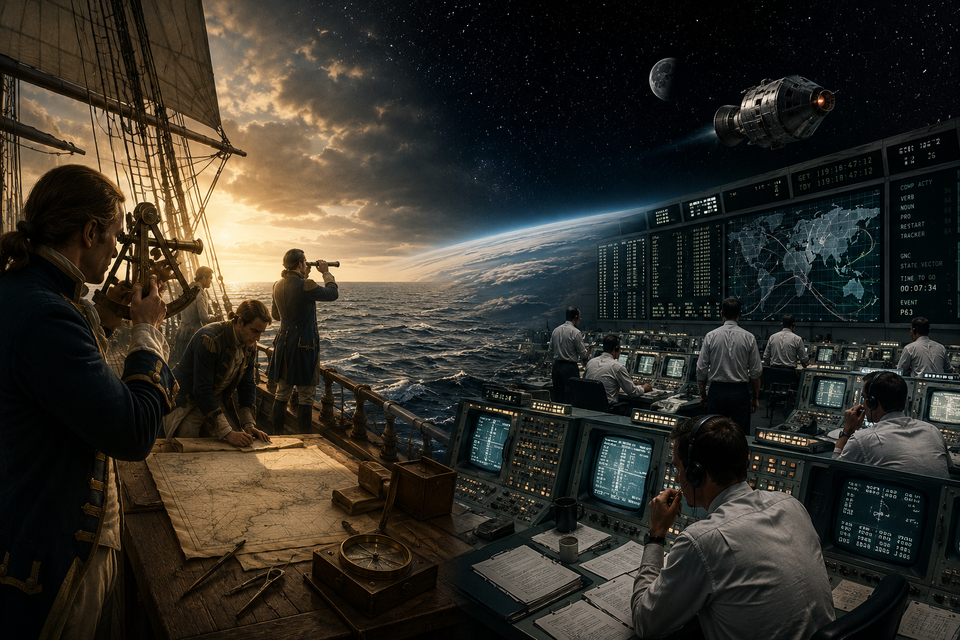
In August 1778, HMS Resolution pushed deeper into the Pacific under the command of Captain James Cook. Three centuries later, Apollo 11 climbed from Launch Complex 39A towards the Moon. The distance between the two journeys could hardly appear greater. One relied on timber, canvas and celestial navigation. The other depended on computers, liquid hydrogen and guidance systems that represented the pinnacle of twentieth-century engineering.
Yet both embarked upon exactly the same endeavour.
They left the known world.
Neither the Royal Navy nor NASA expected reality to honour their plans. Charts remained incomplete. Weather changed without warning. Equipment failed. Calculations drifted. Human judgement remained imperfect. Every mile travelled increased the possibility that reality would present something nobody had anticipated.
That understanding shaped not merely their technology, but the way they organised themselves. Exploration has never rewarded confidence. It has always rewarded organisations capable of discovering reality faster than reality discovers their weaknesses.
Observation Before Certainty
The Royal Navy understood that a chart represented yesterday's understanding of the sea. Officers continuously updated bearings, measured winds, observed currents and questioned their own assumptions because they recognised that every decision slowly drifted away from reality. Navigation never ended when the voyage began. It became more demanding precisely because the ship had left familiar waters.
Apollo inherited exactly the same philosophy. Mission Control did not exist because NASA distrusted its astronauts. It existed because NASA distrusted certainty itself. Thousands of telemetry points streamed continuously across consoles because engineers assumed that somewhere, somehow, the spacecraft would eventually disagree with the simulation. Procedures filled entire libraries, not because they described every possible event, but because they trained engineers to recognise when reality had begun writing a different story.
Apollo 13 demonstrated this more clearly than any successful mission ever could. The explosion did not threaten the mission simply because hardware failed. Spacecraft fail. Components break. Models prove incomplete. The mission survived because an entire organisation had been built around one assumption: reality would eventually surprise them, and when it did, learning had to move faster than failure.
Three centuries separated Cook from Apollo, yet both organisations practised exactly the same discipline. They expected the unknown. They rehearsed uncertainty. They designed systems that could observe, interpret and adapt before small deviations became irreversible disasters.
When Organisations Stopped Exploring
Somewhere along the way, many organisations quietly reversed that logic.
Modern technology companies often produce extraordinary representations of reality. Roadmaps stretch eighteen months into the future with remarkable confidence. Dashboards refresh every few minutes. Jira boards display thousands of meticulously organised tickets. Quarterly business reviews summarise delivery, risk and utilisation with impressive precision. None of these artefacts lack sophistication.
What increasingly disappears is direct contact with reality itself.
The roadmap slowly becomes more trusted than production. Velocity becomes more trusted than customer behaviour. Executive summaries become more trusted than the engineers wrestling with systems every day. Governance expands while observation contracts. Organisations collect ever more information while understanding progressively less about the systems they believe they control.
The irony would have amused both Royal Navy navigators and Apollo flight directors. Neither confused the map with the ocean, nor telemetry with the spacecraft. Both understood that every model remained a temporary approximation of a world that continued changing without asking permission.
Engineering Was Never About Certainty
Perhaps the greatest loss, however, has occurred within engineering itself.
Engineering once represented humanity's organised response to uncertainty. Shipwrights designed vessels knowing they would encounter storms no architect could predict. Bridge designers accepted that wind, temperature and material fatigue would never behave exactly as calculations suggested. Apollo engineers assumed that equipment would eventually behave in ways no simulation had reproduced. The objective never involved eliminating uncertainty. It involved building systems capable of surviving it.
That remains true today, although many organisations appear to have forgotten it.
Software engineering has gradually become obsessed with certainty. Requirements must arrive complete. Estimates must become commitments. Roadmaps must remain stable. Deviations trigger governance reviews rather than curiosity. Engineers increasingly receive work already decomposed into tickets, bounded by role descriptions and constrained by processes designed to minimise surprise rather than encourage discovery.
Yet software has never operated in a more uncertain environment. Technologies evolve relentlessly. Customer expectations shift overnight. Artificial intelligence changes entire product categories within months. Cybersecurity threats adapt continuously. Regulations emerge unexpectedly. Distributed systems produce interactions too complex for any individual to predict completely.
The profession faces more uncertainty than ever before while many organisations ask engineers to behave as though uncertainty were evidence of poor planning.
This reverses the very nature of engineering.
Great engineers have never been distinguished by possessing complete knowledge. They distinguish themselves through their ability to move confidently within incomplete knowledge.
They observe, question, adapt and continuously search for balanced solutions that acknowledge uncertainty instead of pretending it has disappeared. Every resilient architecture reflects that philosophy. Redundancy, graceful degradation, observability, circuit breakers, retries, feature flags and fault isolation all begin with exactly the same admission: reality will eventually disagree with the design.
The unknown is not engineering's enemy.It has always been its raw material.
The Forgotten Discipline
The finest engineering organisations understand this instinctively. They recruit people who remain curious when assumptions fail. They rehearse crises before crises arrive. They expect production to teach them something their specifications could not. They value engineers who reduce the distance between theory and reality rather than those who merely execute yesterday's plan with increasing efficiency.
Many organisations still employ software engineers. Far fewer still cultivate an engineering culture in its original sense. Administration gradually replaces exploration. Compliance replaces investigation. Predictability replaces learning. The profession slowly forgets that its greatest achievements have never emerged from environments where every answer already existed.
Exploration Never Ended
The Royal Navy never mastered the oceans because its charts proved flawless. Apollo never reached the Moon because every procedure anticipated every failure. Both succeeded because they accepted that the unknown would always remain larger than the known, and they built organisations capable of learning before reality imposed its own conclusions.
The oceans have changed. Space has changed. Technology has changed.
The physics of exploration have not.


Member discussion