Monday Myth: Great Organisations Feel Dynamic
The Accident That Changed the Sky
On 30 June 1956, two commercial airliners collided above the Grand Canyon, killing all 128 people on board. The tragedy shocked the aviation industry, not simply because of its scale but because it exposed a far more uncomfortable truth. Commercial aviation had outgrown the system responsible for coordinating it. Aircraft had become faster, passenger numbers had increased dramatically and more routes crossed the same airspace than ever before, yet many operational practices still belonged to an earlier era.
The response that followed remains one of the most remarkable examples of systemic engineering. Aviation did not simply ask pilots and controllers to become more careful. It redesigned the operating system itself. Radar coverage expanded, controlled airspace grew, communication standards became stricter, responsibilities became clearer and procedures became increasingly standardised. Every investigation contributed another layer of institutional learning. Every lesson became part of the infrastructure rather than remaining inside the memory of individuals.
Modern air traffic control did not emerge because someone imagined a better process. It emerged because reality made the previous one unsustainable.
A System Built Around Reality
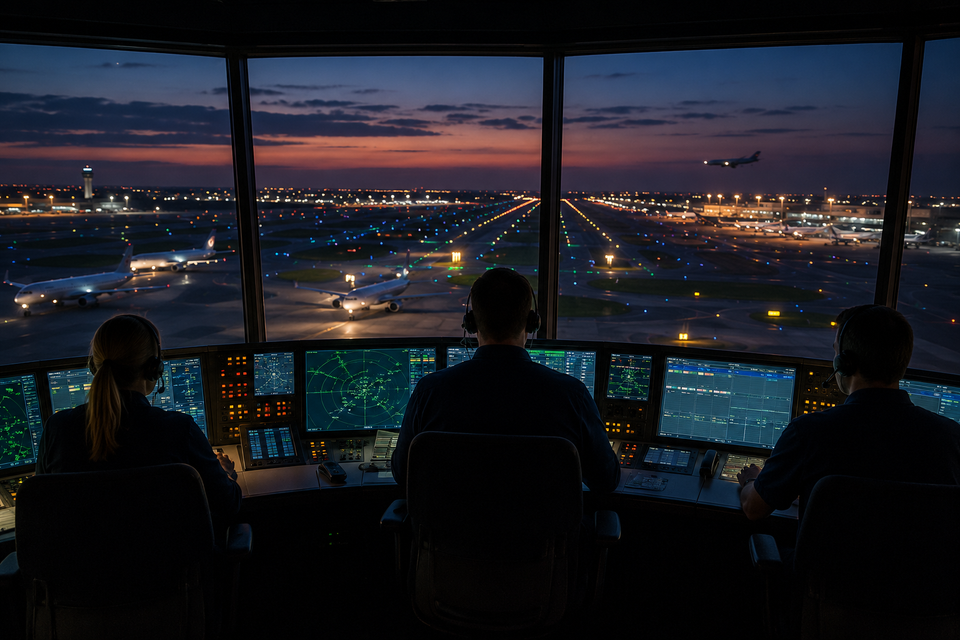
Stand inside the control tower of a major international airport and the scale of the operation becomes almost overwhelming. Hundreds of aircraft arrive and depart every day. Ground vehicles move continuously between taxiways and terminals. Runways change according to weather conditions. Aircraft consume fuel at different rates, climb at different speeds and arrive from different countries with crews speaking many native languages. Every movement influences countless others across the network.
Yet the control room rarely resembles the dramatic scenes portrayed in films. Conversations remain measured. Instructions follow familiar patterns. Handover procedures occur with remarkable regularity. The apparent calm almost feels disproportionate to the complexity being managed.
The explanation does not lie in exceptional individuals making brilliant decisions every few seconds. It lies in a system that has progressively removed unnecessary variation from almost every aspect of its operation.
Controllers speak a common language that leaves little room for interpretation. Pilots respond using the same phraseology regardless of nationality. Altitude, speed, heading, separation and fuel are measured through universally understood references rather than personal judgement. Maintenance follows predefined schedules instead of intuition. Training reinforces procedures until disciplined execution becomes second nature.
None of these constraints exist to limit professional capability. They exist because aviation remains permanently connected to reality.
Gravity ignores optimism. Weather pays little attention to commercial objectives. Separation minima cannot be negotiated because the airport faces a busy holiday weekend. Every operational decision eventually collides with the physical world, and the physical world has never accepted persuasive presentations or optimistic forecasts as valid arguments.
Reality dictates the rules long before management begins discussing them.
When Complexity Changes the Economics
There is another lesson hidden inside the evolution of aviation, and it rarely receives the attention it deserves.
Discipline did not emerge because the industry developed a particular admiration for procedures. It emerged because growth fundamentally changed the economics of operating the system.
When relatively few aircraft occupied the skies, experienced professionals could compensate for inconsistency through judgement and local knowledge. As traffic increased, every additional aircraft multiplied the number of interactions requiring coordination. A misunderstood instruction no longer affected a single crew. It influenced dozens of aircraft operating within the same environment. Small variations became expensive long before they became dangerous.
The industry therefore solved a fundamentally economic problem.
Instead of asking skilled professionals to make thousands of identical decisions every day, it transformed those decisions into common operating principles. Standard phraseology replaced personal preference. Published procedures replaced local habits. Training embedded shared behaviours until consistency became more valuable than individual style.
The objective was never to constrain intelligence. The objective was to reduce the cost of coordination.
Growing organisations eventually encounter exactly the same transition. Early success often depends upon exceptional individuals solving exceptional problems. Sustainable success depends upon institutionalising those solutions so that the organisation no longer needs to rediscover them every quarter.
Architecture principles, engineering standards, deployment pipelines, operational reviews and outcome metrics all serve the same purpose. They transform yesterday's decisions into today's infrastructure.
Mature organisations do not accumulate experience. They convert experience into infrastructure.
Rehearsing the Day Nobody Wants
The calm inside an air traffic control centre does not depend upon believing that emergencies are unlikely. It depends upon accepting that they are inevitable.
Controllers repeatedly train for situations they may never encounter during an entire career. Pilots return to simulators every few months to rehearse engine failures immediately after take-off, hydraulic failures, decompression, severe weather, navigation failures and emergency landings. Maintenance engineers validate procedures that everyone hopes will remain unnecessary. Airports coordinate exercises involving emergency services, airlines and operational staff because capability cannot depend upon memory when reality eventually decides to intervene.
Preparation never waits for the crisis.
This mindset reveals another distinction between mature systems and many modern technology organisations. Most software companies possess disaster recovery plans. Far fewer possess disaster recovery capability.
Documentation exists. Runbooks occupy shared repositories. Backup strategies satisfy compliance requirements. Architecture diagrams describe regional failover. Yet organisations frequently discover whether these preparations actually work only after production has already failed.
Their first genuine rehearsal begins while customers already experience the consequences.
Aviation reached a different conclusion decades ago. The cost of practising failure never approaches the cost of discovering unpreparedness in front of the people who depend upon the system.
The Quiet Rhythm of Excellence
Technology companies often describe successful organisations as dynamic environments where constant change, continuous urgency and relentless innovation define everyday life. Heroic recoveries become legendary. Overnight production incidents create stories repeated for years. Last-minute releases generate excitement that many people gradually begin associating with meaningful work.
Air traffic control offers a remarkably different picture of excellence.
Its success depends upon rhythm rather than excitement.
Controllers follow predictable cadences. Pilots repeat familiar procedures. Maintenance teams inspect equipment according to schedules that rarely attract attention. Certification, recurrent training, operational reviews and performance measurements occur continuously, not because somebody feels inspired, but because mature systems understand that consistency compounds while improvisation accumulates risk.
The same pattern appears inside successful engineering organisations.
Teams share a common language because ambiguity slows coordination. Outcome metrics replace opinion because reality settles arguments more effectively than hierarchy. Engineering principles reduce unnecessary decisions. Predictable delivery rhythms replace bursts of frantic activity. Production incidents become increasingly uncommon because the organisation continuously removes the conditions that create them.
Visitors occasionally mistake this environment for complacency. They misunderstand what they are observing.
The apparent calm represents thousands of disciplined decisions embedded into the system long before today's engineers arrived at work.
The Great Misunderstanding
Perhaps we admire organisations that feel dynamic because dramatic environments produce memorable stories. They create heroes, crises, transformations and moments that appear significant precisely because they interrupt normality.
The organisations that quietly compound value rarely produce those stories.
Nobody applauds another aircraft that landed safely after an uneventful flight. Nobody celebrates another controller whose shift passed without incident. Nobody writes headlines about another simulator exercise that merely confirmed established procedures continued to work exactly as intended.
Passengers purchase something far less glamorous. They purchase predictability. Customers usually do exactly the same.
They rarely reward organisations for recovering brilliantly from avoidable failures. They reward those that consistently deliver value through systems that have learned to respect reality rather than argue with it.
Perhaps that explains why great organisations often feel surprisingly ordinary from the inside. As capability grows, unnecessary excitement gradually disappears. Common language replaces interpretation. Shared principles replace repeated decisions. Rehearsal replaces improvisation. Institutional knowledge replaces individual memory. The organisation becomes quieter not because ambition has diminished, but because maturity has absorbed complexity into the system itself.
The highest compliment a passenger can give aviation is that nothing memorable happened.
Perhaps the highest compliment customers can give an engineering organisation is exactly the same.



Member discussion