Friday Fun: The Corporate Airport
Check-in
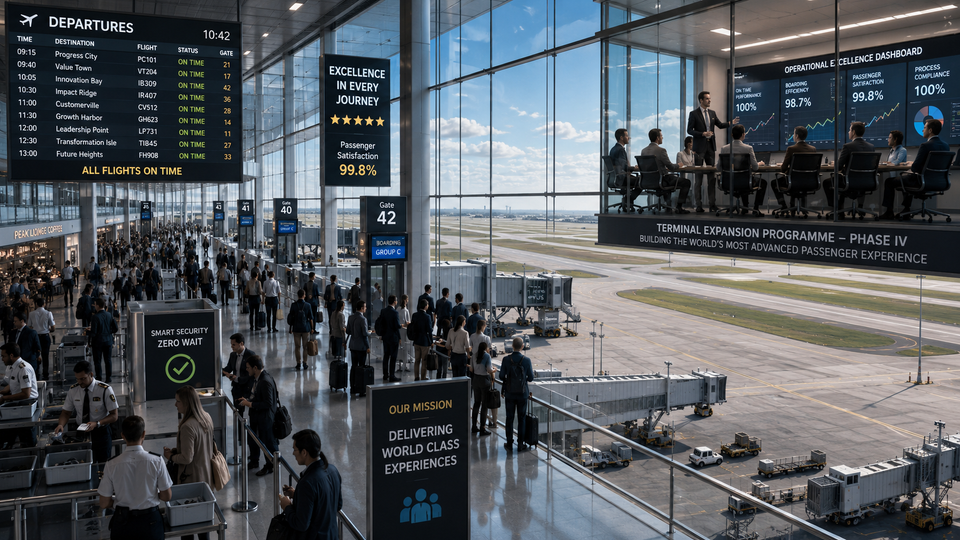
You arrive at the airport three hours before departure, exactly as your ticket recommends. It is impossible not to be impressed. The terminal is a masterpiece of modern engineering. Sunlight pours through vast glass ceilings onto polished floors that seem untouched despite the thousands of travellers passing through them. Digital displays update continuously with impeccable precision, while uniformed staff guide passengers with calm efficiency and reassuring smiles.
Your destination is displayed clearly on the departure board, and your flight is listed as on time, reinforcing the sense that everything is operating exactly as it should.
Everything suggests that this airport knows exactly what it is doing.
You glance through the enormous windows towards the runways, noticing that they appear strangely quiet, although you think little of it at first. Airports are complicated places, and aircraft are probably parked somewhere beyond your view, hidden behind terminals or maintenance hangars. After all, the entire purpose of an airport is to make aeroplanes fly, and it would never occur to you that anything else might be true.
Security
The security area resembles a finely tuned production line.
Half a dozen lanes operate simultaneously, and large screens display waiting times measured to the second. Supervisors walk between checkpoints carrying tablets that show passenger throughput, tray utilisation, passport verification accuracy and customer satisfaction scores. One proudly explains to a small group of visitors that queue times have fallen by eighteen per cent during the past quarter, making this one of the highest-performing airports in Europe.
It is difficult not to admire the achievement, as every movement has clearly been analysed, refined and measured. Shoes are removed, laptops extracted, belts placed in trays and passports scanned with almost mechanical rhythm. Within minutes you have completed the process and are thanked warmly for your cooperation.
As you collect your belongings, you casually ask which gate will handle your flight.
The security officer smiles politely before explaining that gate allocation is managed by Boarding Operations, whose office is apparently recognised throughout the industry for operational excellence. He wishes you a pleasant journey before directing the next passenger forward.
You continue into the terminal without giving the exchange another thought.
The Departure Lounge
The departure lounge feels less like a transport hub and more like an elegant shopping district.
Restaurants are busy, cafés serve excellent coffee and luxury boutiques occupy almost every available space. Travellers appear relaxed, with some reading books, others working quietly on laptops, while families watch aircraft information screens that continually reassure everyone that departures remain perfectly on schedule.
It is only after sitting for some time that you notice something unusual.
Passengers gather at their gates when boarding begins, their boarding passes are scanned, and they disappear down the jet bridges exactly as expected.
Twenty minutes later, many of them quietly return from another corridor carrying the same luggage, looking neither frustrated nor surprised. They simply walk back into the lounge, order another coffee and wait for the next announcement as though nothing out of the ordinary has occurred.
Curious, you ask the gentleman sitting beside you whether he has missed a connection.
He laughs warmly and explains that he has been boarding here for years, delivering the statement with such calm certainty that you initially assume he must be joking.
Gate 42
Eventually your own boarding group is called.
Everything proceeds with extraordinary professionalism, as your passport is inspected twice and your boarding pass is scanned repeatedly to ensure complete traceability. Several members of staff thank you for choosing the airport and wish you an enjoyable journey.
The jet bridge stretches ahead exactly as you would expect.
At its end, however, there is no aircraft.
Instead, you enter a beautifully designed room containing rows of aircraft seats, overhead lockers, carefully adjusted lighting and discreet loudspeakers playing the comforting sound of jet engines. Large screens demonstrate safety procedures while cabin crew uniforms hang neatly behind glass display cases. The experience has clearly been designed by people who understand aviation in remarkable detail.
Passengers take their seats without objection, as though this is entirely normal.
Forty minutes later, a recorded announcement thanks everyone for travelling today, apologises for any inconvenience and invites passengers to leave through the exit located at the rear of the cabin.
The rear exit opens directly into the terminal, returning everyone to exactly where they started.
Nobody appears surprised by this outcome.
Customer Experience
Convinced that some misunderstanding has occurred, you approach the customer service desk.
Within minutes you are greeted by the Customer Journey Excellence Manager, whose name badge proudly displays fifteen years of service. She listens carefully before thanking you for your feedback.
She explains that passenger satisfaction has increased every year, that boarding efficiency is the highest in the company's history, that average waiting times continue to fall, that digital engagement has doubled and that the airport recently received an international award recognising excellence in passenger experience.
The presentation is genuinely impressive and delivered with complete confidence. When she finishes, you ask the only question that still seems relevant. You explain that you understand all of those achievements, but you would like to know when the aircraft actually leaves.
She pauses, and for the first time that day, confidence gives way to uncertainty. She eventually explains that Aircraft Operations is a different department.
Continuous Improvement
While waiting for someone from Aircraft Operations, you wander through the terminal.
Behind a glass wall, a large meeting is taking place, where a dozen executives stand around an enormous screen displaying colourful dashboards.
One group proposes introducing AI to improve boarding announcements, while another presents a roadmap for redesigning lounge furniture. Someone else recommends expanding Gate 42 because passenger engagement during boarding simulations has exceeded expectations.
A lengthy discussion follows concerning whether boarding passes should become fully digital before the end of next year, with detailed debate about timelines, dependencies and stakeholder alignment.
The meeting lasts more than an hour, and throughout the entire discussion, nobody mentions aircraft or the act of flying.
Outside the meeting room, the runways remain completely empty.
Frequent Flyers
As evening approaches, you decide to leave.
Near the exit you encounter the gentleman from the departure lounge once again. He notices your expression and smiles with the sympathy of someone who has witnessed the same discovery many times before.
He asks whether it was your first visit, and when you nod, he proudly shows you a platinum frequent flyer card attached to his suitcase.
He explains that he has travelled through this airport for twelve years, that he knows every lounge, every restaurant and every boarding process, and that he was even invited onto the Passenger Advisory Council last year.
Unable to contain your curiosity, you ask him where he has travelled during those twelve years.
He looks slightly puzzled before explaining that he has not travelled anywhere, that nobody does, and that next year they are opening another terminal which everyone says will transform the passenger experience.
As you walk towards the car park, you turn for one final look at the departure board. Every flight is still listed as on time, every operational metric has been achieved and every passenger has successfully completed the boarding process.
The only thing missing is the one reason airports exist in the first place.
Real airports never confuse the terminal with the journey, because every supporting system ultimately exists to put aircraft into the sky and passengers where they intended to go.
Many organisations, however, quietly make that mistake, becoming exceptionally good at refining coordination, governance and process while gradually forgetting that these things exist only to support delivery. The terminal expands, the dashboards improve and the boarding experience becomes world class, yet the runway remains empty.
The departure board still looks magnificent, but the more important question is whether anything is actually taking off.


Member discussion