Wednesday Reality: The Steel That Passed
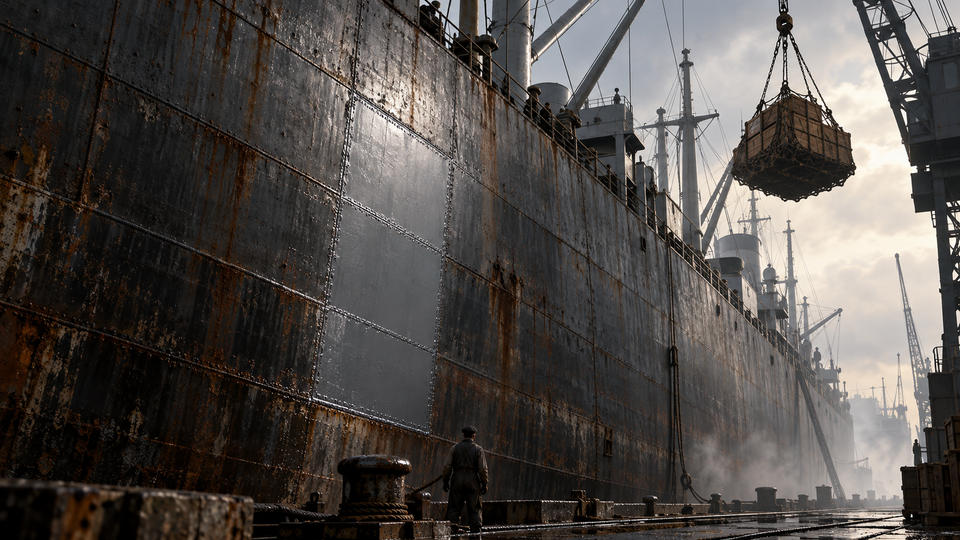
During the Second World War, a merchant ship’s value depended partly on when it reached the water. Food, fuel, vehicles and ammunition had to cross oceans, while submarines destroyed the vessels carrying them. A shipyard could produce an excellent vessel and still contribute too little if construction consumed time the supply lines could no longer afford. The industrial problem extended beyond building ships well. It required building enough of them before the losses overwhelmed the capacity to replace them.
The Liberty ship programme brought standardisation, prefabrication and extensive welding to that problem. Sections could take shape separately before joining the final assembly. Welding reduced the work involved in drilling, aligning and fastening overlapping plates, while saving weight that could otherwise reduce the useful load. These changes allowed shipbuilding to adopt a different production rhythm. Their contribution deserves recognition before examining the failures that followed.
The achievement also changed the physical character of the hull. Riveted construction assembled distinct plates through mechanical connections. Welding could create much greater structural continuity. That continuity helped make the production method attractive, but it also altered the conditions through which damage might travel. Familiar material now participated in a structure whose behaviour demanded a different understanding.
Some vessels developed serious fractures, and a small number broke in two. Suspicion fell readily on welding and hurried workmanship. The production programme had recruited and trained large numbers of workers, and a fractured hull invited questions about the people who had joined its plates. Yet an explanation centred on poor work could not adequately account for what investigators found in the steel.
What the specification could see
Constance Tipper’s work at Cambridge helped establish the significance of the transition from ductile to brittle behaviour. Below a critical temperature, the steels under investigation could fracture with much less deformation. North Atlantic conditions could bring vessels into that vulnerable range. Confidence acquired under one set of conditions did not describe the material’s behaviour under every condition the ship would encounter.
The distinction reached into the specifications themselves. Requirements for hull steel had concentrated on properties including tensile strength, yield point and elongation. Much of the plate material that fractured could have satisfied the standards applicable when it was purchased. Acceptance could therefore proceed correctly while leaving a consequential vulnerability unexamined. Investigators faced material that could meet the stated requirements and still fail in service.
A tensile test asks how material responds to a particular form of loading. Understanding fracture also requires attention to flaws, local stress concentrations and the conditions under which a crack can advance. These questions overlap without becoming interchangeable. A satisfactory answer to one cannot automatically supply the answer to another. The confidence attached to the test can exceed the territory the test actually covers.
Welding complicated that territory further. A crack in a continuous structure could acquire a route through regions where separate plates and joints might otherwise interrupt its progress. Material properties, structural details and the connections between plates all mattered. The failures could not be understood by inspecting workmanship alone, nor by treating the hull as an enlarged version of an earlier arrangement.
The wartime investigations helped advance industrial fracture mechanics. They enlarged the engineering account of what a structure must withstand, including the presence of flaws and the possibility of their propagation. A ship could no longer be assessed adequately through an idealised picture of sound material carrying its intended load. The behaviour of imperfect material belonged inside the explanation.
The assumptions that came aboard
Changing a construction method changes more than the activity performed in the shipyard. It can change the meaning of evidence inherited from the previous arrangement. Properties that once supported a reasonable judgement may remain relevant while becoming insufficient. The difficulty lies in recognising which surrounding conditions helped make that judgement reliable.
Organisations encounter a comparable problem when they consolidate systems. Consider a company replacing several customer-specific processing paths with a common integration service. The proposal carries a credible economic argument. Engineers maintain fewer implementations, corrections reach more customers, and duplicated infrastructure disappears. The new service may deliver those benefits exactly as expected.
Before consolidation, however, an invalid transaction might have interrupted one customer’s processing. Suppose the common service handles transactions through a shared queue and waits for a failed record to succeed before proceeding. The same error can now delay work for several customers. Nothing about the original error needs to become more severe. Its position within the operation has changed its consequences.
The service can pass its functional tests. Each valid transaction produces the expected result, and each invalid transaction receives the specified response. What remains unexamined concerns the transactions behind it, the customers sharing the path, and the behaviour of the operation while somebody investigates. The tests may accurately establish what happens to a record without establishing what happens to the business around it.
The work around the incident
Once processing stops, recovery begins to draw people into a problem they did not create. An engineer examines the rejected record. Operations identifies which customer transactions have stalled. Another team checks whether downstream systems have received partial results. Customer support needs an explanation before anyone can confidently describe the extent of the interruption.
Each request makes sense locally. Together, they consume capacity far beyond the task of correcting the original error. People abandon planned work to reconstruct a shared picture, establish which actions remain safe and determine what can restart. The organisation experiences the incident through this expanding recovery effort, although its eventual technical description may occupy only a few lines.
The defect and the disruption consequently have different dimensions. One concerns what went wrong at the point of initiation. The other concerns how many activities became dependent on resolving it. A precise account of the first can coexist with a remarkably incomplete account of the second.
The hull investigations make that distinction difficult to ignore. Explaining where a crack began does not finish the investigation into why it travelled. Similarly, correcting a parser can remove a particular trigger while preserving the arrangement through which another exception might interrupt the same customers. The repair can succeed within its stated scope while leaving the operation exposed in much the same way.
The price of sharing
A shared service does not have to behave like this. It can separate customer workloads, isolate exceptions or permit unaffected transactions to continue. Those capabilities require design, implementation and operation. Their cost belongs alongside the savings from consolidation, although the benefits appear in different forms.
Removing duplicate infrastructure produces an identifiable reduction. The value of isolation appears partly through disruption that never spreads. One customer encounters a problem while others continue processing. Their ordinary afternoon provides weak evidence for the expenditure that protected it. The saving carries an invoice or a budget line. The avoided coordination effort leaves considerably less documentation.
This difference can shape decisions even when everybody acts conscientiously. A proposal may count the implementation work needed to combine services while treating operational recovery as a general responsibility already funded elsewhere. Consolidation then appears cheaper partly because some of its consequences enter another account.
The same movement occurs with people. Sharing a specialist across teams may reduce apparent duplication, while making several streams of work depend on that person’s availability. Most days, the arrangement functions. During an incident, the specialist’s existing commitments become delays distributed across other teams. Those delays can look like separate delivery problems even though they originate in the same concentration of dependency.
Continuity therefore has an economic character as well as a technical one. Connecting activities can remove repeated work while increasing the number of commitments affected by one interruption. Whether the exchange proves worthwhile depends on the operating conditions, the available containment and the cost of recovery. A clean organisational chart or a smaller infrastructure bill cannot settle that question.
Where responsibility settles
The people who approve a shared service, the people who build it and the people who operate it often occupy different positions. Each sees a different part of the decision. A consolidation programme can close after demonstrating the promised reduction in duplication. The operating team then inherits an ongoing obligation to keep the resulting arrangement dependable.
Later, an incident review can describe that team’s actions in exceptional detail. Logs establish when the alert appeared. Messages show who responded. The timeline records how long diagnosis took and whether somebody followed the recovery procedure. Immediate work leaves evidence that can be examined minute by minute.
The earlier decision has a different documentary life. Its assumptions may sit across a business case, a design discussion and several budget conversations. Some constraints may never have reached the final record. Reconstructing why isolation was omitted takes a different investigation from establishing why an engineer waited twelve minutes before restarting a process.
Responsibility can consequently settle where evidence happens to be most precise. The organisation examines the recovery team’s judgement closely while accepting the architecture as the condition within which judgement had to operate. A design choice made months earlier becomes part of the landscape against which somebody else’s performance gets assessed.
No deliberate evasion is necessary. The programme delivered its agreed scope, the service passed its tests, and the operating team followed its procedures. Every account can contain accurate statements. Their arrangement can still leave the most consequential question between them: which decisions determined how much of the business would need to participate in recovering from an ordinary fault?
Back in service
Some responses to the ship fractures addressed the path of propagation itself. Riveted seams served as crack arresters in Liberty ships, introducing interruptions that could help contain a fracture. Such measures accompanied the developing understanding of steel properties and service conditions. The work extended beyond repairing the place where damage had become visible.
This did not erase the achievement of welded shipbuilding. It made the engineering more complete. Production had changed, structural behaviour required investigation, and evidence from service forced questions that earlier acceptance criteria had not adequately answered. The ships remained products of industrial ingenuity, including the ingenuity required to reconsider what their successful construction had established.
A repaired vessel returns to the quay with fresh paint across the affected plates. Cargo comes aboard, the paperwork reaches completion, and departure again becomes the immediate concern. From the dock, the repaired area draws the eye. Beyond it, most of the hull remains exactly as it was, extending forward and aft beneath a surface that gives little reason to stop looking.



Member discussion