When Technology Stopped Feeling Human
1. When Technology Had Presence
There was a period when technology did not only feel useful. It felt understandable.
Not perfect. Not always cheap. Not always reliable by today’s standards. But it carried a form of coherence that many modern systems have lost. You could sit in front of a workstation, drive a well-designed car, use a camera, type on a proper keyboard, or operate a piece of industrial equipment and feel that someone had thought about the person using it.
The object did not just exist as a delivery mechanism for features. It had a relationship with the hand, the eye, the body, and the task. It created feedback. It reduced ambiguity. It gave the operator a sense of control.
A Saab dashboard, an IBM keyboard, a Sun workstation, a mechanical camera, a Braun radio, or a well-built hi-fi amplifier did not need to explain itself endlessly. The design contained intent. Controls sat where they made sense. Functions had weight. Interfaces had hierarchy. You could learn the system through use, because the system respected the way humans perceive, remember, and act.
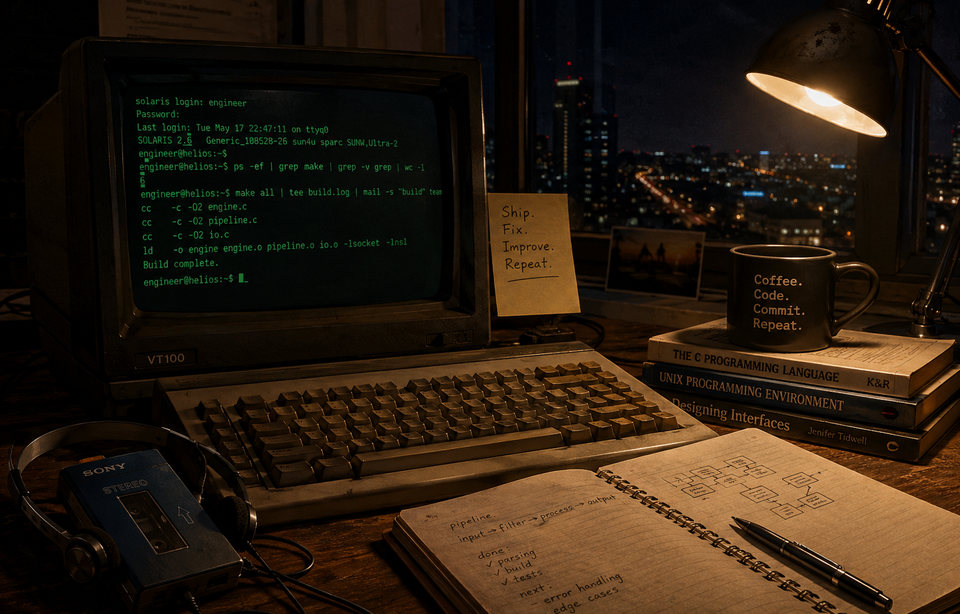
Even computing carried a form of physical presence that modern technology often lacks. Programming late at night on a noisy VT100 terminal, hearing the violent mechanical sound of the keys echo through the room, listening to music through a cheap Walkman clone, waiting for code to compile, learning systems through manuals and experimentation, all of it created a strange sense of immersion. Machines had texture. Interfaces had friction, but meaningful friction. Nothing felt disposable. Every kilobyte mattered. Every machine had limits. Every optimisation carried visible consequences.
Scarcity forced intent. Constraints forced clarity.
Engineers often understood the systems beneath their tools because abstraction remained expensive. You could feel economics, hardware, ergonomics, and engineering colliding directly in front of you.
2. When Economics Started Driving Design
This is not nostalgia for old technology. Many old products were slow, fragile, expensive, inaccessible, or limited. The past does not deserve romantic protection. But something important changed when engineering moved from making coherent systems to optimising business models.
The economics of technology changed first. Products stopped competing only on usefulness, durability, clarity, or long-term satisfaction. They increasingly had to support subscriptions, data extraction, engagement loops, upgrade cycles, procurement theatre, advertising models, ecosystem lock-in, and quarterly margin pressure.
This shift did not simply change pricing. It changed design.
A product optimised for ownership behaves differently from a product optimised for recurring revenue. A tool built for an operator behaves differently from a platform built to capture behaviour. A car designed around safe, intuitive control behaves differently from a car whose interface must also reduce manufacturing cost, enable software monetisation, and signal modernity through glass surfaces.
Many modern products no longer optimise primarily for user satisfaction. They optimise for business model compatibility.
That sentence may sound harsh, but the symptoms are everywhere. Physical buttons disappear even when they were faster, safer, and easier to use. Simple tools become cloud services. Software becomes heavier while performing the same basic task. Devices become harder to repair. Interfaces hide frequent actions behind layers of menus. Dashboards multiply while operational clarity declines. Notifications increase while attention decreases.
Even in computing, something fundamental shifted. One can contemplate elaborate serverless Lambda compositions spread across countless managed services, but it will never fully reproduce the simplicity of a well-designed Solaris pipeline running directly on visible hardware with immediate feedback and near certainty of completion. One model increasingly asks engineers to trust layers of abstraction they cannot fully observe. The other maintained a direct relationship with reality. You launched a command, watched the system respond, understood the machine state, and learned through tangible consequences.
Modern systems often maximise optionality and scale, but they also increase distance. Between intention and execution. Between cause and effect. Between operators and the systems they supposedly control.
The economic system did not always ask for better ergonomics. It often asked for more measurable engagement, more retained users, more captured data, more upgrade paths, more defensible ecosystems, and more visible modernisation.
At some level, this resembles Goodhart’s Law applied at industrial scale. Systems progressively stop optimising for reality itself and begin optimising proxies of reality instead. Engagement replaces satisfaction. Feature volume replaces coherence. Delivery velocity replaces completion certainty. Telemetry replaces understanding. Optionality replaces mastery.
As optimisation drifts toward abstractions, systems slowly lose immanence. The relationship between cause and effect becomes harder to observe directly. Operators increasingly interact with layers of interpretation rather than tangible system behaviour. The machine still functions, often at extraordinary scale, but the human relationship with the system weakens.
3. The Quiet Death of Ergonomics
Ergonomics usually disappears quietly.
Nobody announces that a system has become hostile to the human nervous system. Nobody writes a strategy deck saying that the next release will increase cognitive load by 18%. Nobody celebrates the moment when a product becomes slightly more tiring to operate, slightly less repairable, slightly less legible, and slightly more dependent on external services.
Yet this is how degradation often happens. Not through one catastrophic decision, but through hundreds of small trade-offs that treat the user’s attention, posture, memory, time, and patience as infinite resources.
In systems terms, poor ergonomics increases entropy. It pushes complexity from the product into the user. It turns design debt into cognitive debt. It makes people compensate with habit, training, documentation, support, shortcuts, shadow processes, and eventually resignation.
4. Capability Increased. Immanence Declined.
The irony is that many of these changes arrive under the banner of efficiency.
We remove physical controls to reduce cost and simplify manufacturing, then create interfaces that take longer to operate. We centralise tools to improve governance, then force users through slower workflows. We add dashboards to improve visibility, then bury the actual signal under decorative data. We automate fragments of work, then leave humans to reconcile the gaps between systems.
Capability increases, but coherence declines.
This distinction matters. A system can have more features and still provide a worse experience. A platform can have more integrations and still reduce autonomy. A product can look more modern and still disrespect the operator. A company can invest heavily in transformation while making everyday work slower, more fragmented, and more abstract.
Impact is not created by novelty alone. It comes from the quality of the relationship between a system and the work it enables.
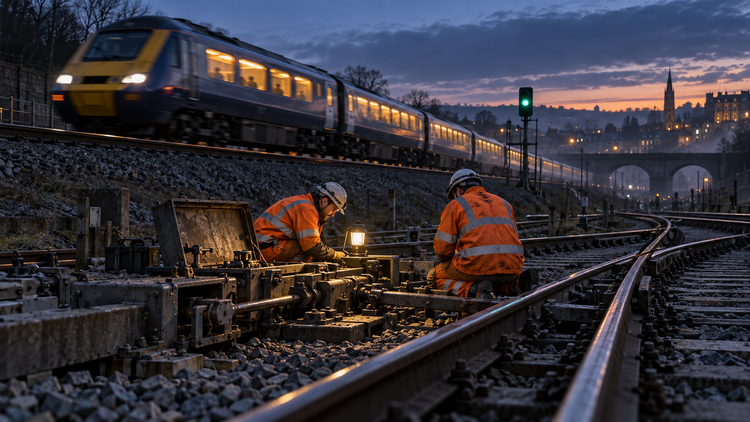
The best engineering traditions understood this. Aerospace, industrial design, medical devices, rail systems, watches, cameras, and serious tools all share one principle: the operator matters. Their attention matters. Their muscle memory matters. Their ability to understand the state of the system matters. Their ability to recover from error matters.
This is why good design often feels calm. It does not scream. It does not ask for constant interpretation. It does not turn every interaction into a small negotiation. It creates trust because the system behaves with discipline.
Modern digital products often confuse flexibility with quality. They assume that because anything can be changed in software, everything can be moved, hidden, personalised, animated, measured, or reconfigured. But infinite malleability without strong design judgement does not create freedom. It creates instability.
5. Organisations Started Mirroring the Same Problem
The same problem appears in organisations.
When companies optimise only for local economics, internal KPIs, delivery velocity, or roadmap volume, they often lose the equivalent of ergonomics at organisational level. Work becomes harder to navigate. Teams spend more energy interpreting priorities than delivering value. Customers receive more features but less clarity. Employees receive more tools but less leverage.
At some point, many companies also lost track of the customer itself. Not the abstract persona living inside slide decks or analytics dashboards, but the real operator trying to accomplish something with limited time, attention, and patience.
One of the most influential ideas in modern technology came from the belief that customers do not know what they want. Steve Jobs famously repeated versions of this argument, and to some extent he was right: customers rarely describe breakthrough products accurately in advance. But the industry quietly transformed this insight into something far more dangerous. It started assuming that users could be ignored entirely.
Yet people often knew exactly what they valued. They valued clarity. Responsiveness. Physical controls. Repairability. Reliability. Simplicity. Systems that respected their attention instead of competing for it. They may not have articulated these things in the language of product strategy, but they recognised them immediately when they experienced them.
That may explain why so many people now feel nostalgia for systems they once considered ordinary. They are not only remembering old products. They are remembering the feeling of interacting with systems designed around human reality rather than behavioural extraction or perpetual engagement.
The result is not dramatic collapse. It is a slow loss of human fit.
Technology stopped feeling human when we stopped asking enough human questions. Who is using this? Under what pressure? With what level of attention? How often? What happens when they make a mistake? What does this remove from their day? What does this add to their cognitive load? Does this system create confidence, or does it merely create dependency?
These questions may sound soft. They are not. They are economic questions. They are operational questions. They are impact questions.
A product that respects the operator reduces training, support, rework, errors, fatigue, and abandonment. A system that feels coherent compounds trust. A tool that makes work easier creates adoption without coercion. Ergonomics is not decoration. It is productivity made physical, cognitive, and emotional.
6. Recovering Human-Centred Engineering
Perhaps the next wave of serious engineering will not come from adding more intelligence to every object, interface, and workflow. Perhaps it will come from recovering discipline: fewer useless interactions, clearer feedback, better affordances, stronger ownership, repairable systems, calmer interfaces, and a renewed respect for the person doing the work.
Great technology does not merely expose capability. It reduces friction between humans and reality.
Which may explain why some people still miss the brutal sound of a VT100 keyboard late at night. Not because old terminals were objectively better machines. Not because the past deserves blind romanticism. But because what we built, delivered, and operated still carried a visible sense of purpose. The relationship between effort, system behaviour, and customer value often felt shorter, clearer, and more tangible.
That may be why some old systems still remain in memory. Not because they were perfect. Not because the past was better. But because they carried a form of respect that people could feel through their hands, their eyes, and their work.




Member discussion