Monday Myth: This Time Technology Will Replace People
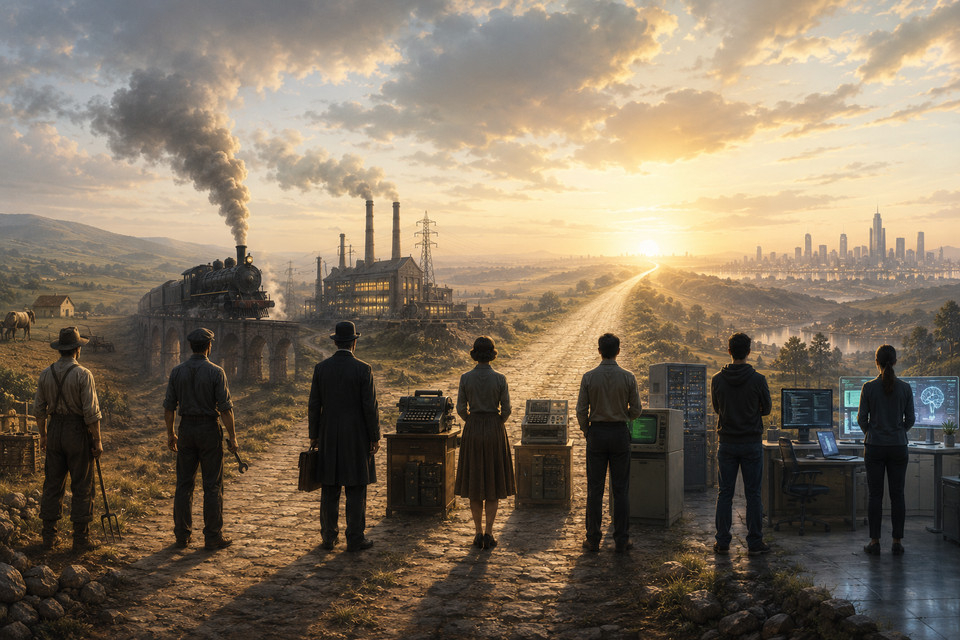
Every generation believes it has finally found the machine that will make people obsolete.
The loom would destroy craft. The steam engine would eliminate labour. Electricity would erase entire professions. Computers would automate the office. The internet would remove the need for middlemen, retailers, publishers, and perhaps half of civilisation. Now AI arrives, and we hear the same prediction again, wrapped in new terminology and delivered with supreme confidence.
The technology changes.
The story rarely does.
The Old Legend in a New Jacket
Each time a major technological breakthrough appears, the first reaction mixes fascination, fear, opportunism, and lazy prediction. We imagine replacement because replacement looks simple. A machine performs a task. A person used to perform that task. Therefore the person disappears.
Clean logic. Terrible systems thinking.
Technology rarely replaces people in a straight line. It replaces tasks, reshapes constraints, changes interfaces, alters economics, and redistributes power. Then people reorganise around the new possibilities. Some jobs vanish. Others mutate. New ones appear. Work moves, stretches, fragments, recombines, and eventually becomes normal enough for the next generation to forget the panic.
The industrial revolution did not remove people from production. It changed the scale, rhythm, and organisation of production. Railways did not remove movement. They created modern logistics, commuting, tourism, standardised time, and entirely new forms of coordination. The telephone did not remove conversation. It expanded the radius of coordination. The computer did not remove clerical work. It transformed information work into something faster, denser, and more abstract.
Even when technology destroys painful forms of labour, it often helps people suffer less. That part gets strangely ignored by those who romanticise the old world. Machines reduced some of the worst physical burdens. Automation improved safety. Digital tools removed repetition from many administrative tasks. Medical technology extended lives. Communication networks helped families, teams, researchers, and businesses collaborate across distance.
Productivity gains did not always distribute fairly, but the human benefit cannot be dismissed simply because the economic system handled part of the transition poorly.
The Question Nobody Wants to Ask
The real question has never been whether technology replaces people. It has always been what kind of human contribution remains valuable once the tool becomes ordinary.
That question makes executives uncomfortable because it forces them to stop pretending that headcount reduction qualifies as strategy. Cutting people because a tool looks impressive does not prove technological maturity. It often proves conceptual poverty.
You bought a lever and immediately tried to sell the arm.
The same mistake appears in engineering organisations. A new tool arrives and, instead of asking how it changes flow, quality, feedback loops, leverage, or learning, the organisation asks how many people can disappear. That mindset turns every breakthrough into a spreadsheet ritual. It confuses cost reduction with capability creation.
The irony is that organisations frequently underestimate the people they already employ. Years of accumulated context, informal networks, operational knowledge, customer understanding, and institutional memory rarely appear on a balance sheet. Yet these assets often determine whether a transformation succeeds or fails. Removing people because a tool appears capable of performing a subset of their tasks can destroy value faster than the technology creates it.
Automation Removes Toil, Not Responsibility
AI will automate parts of software delivery.
Good. Some work deserves to disappear.
Boilerplate, repetitive glue code, basic test generation, documentation drafts, query exploration, support triage, and low-value translation between formats should not require heroic human effort. Nobody should defend pointless toil because it provides employment theatre.
But removing toil does not remove responsibility. It raises the level at which responsibility must operate.
When a tool can produce code quickly, discernment matters more. When everyone can generate options, taste matters more. When analysis accelerates, framing matters more. When execution becomes cheaper, deciding what deserves execution becomes more expensive.
The bottleneck moves from typing to thinking, from production to selection, from effort to intent.
This distinction matters because organisations often confuse tasks with value. Tasks are what people do. Value is the outcome those activities create. Technology excels at attacking tasks. History shows it repeatedly automating calculation, transportation, communication, manufacturing, documentation, and distribution. Yet value tends to migrate rather than disappear.
As machines take over execution, humans move towards interpretation. As information becomes abundant, discernment becomes scarce. As production becomes easier, deciding what deserves production becomes harder. The economic centre of gravity shifts, but it rarely vanishes.
This explains why every technological revolution creates winners and losers. The winners recognise where value has moved. The losers continue defending tasks that no longer matter.
This matters because many companies still manage technology as if the scarce resource were keyboard time.
It is not. The scarce resource is coherent judgement applied to a meaningful problem.
The danger with AI does not come from machines replacing engineers. The danger comes from organisations that never understood engineering in the first place and now believe they can replace it with autocomplete at scale.
The Productivity Trap
That path creates volume without comprehension.
More code. More documents. More tickets. More summaries. More dashboards. More noise.
The organisation feels faster because artefacts multiply. Then complexity compounds, ownership blurs, interfaces decay, and nobody understands why delivery became harder after everyone received a productivity miracle.
This is the old myth wearing a new jacket. Technology will replace people. Then somehow it requires more integration, more coordination, more ethics, more architecture, more systems thinking, more judgement, and more leadership than before.
Eventually, people grow into the new reality. They acquire new skills, develop new expectations, and discover new ways of creating value. The transition rarely feels comfortable. Entire industries can spend years resisting it. Yet history reveals a remarkably consistent pattern: technology changes the landscape, and people adapt to it. The machine transforms the environment, but human contribution evolves alongside it.
That adaptation often matters more than the invention itself. Steam power changed factories, but it also created engineers, planners, operators, and managers. Computing changed offices, but it also created software developers, product designers, cybersecurity specialists, data scientists, and digital businesses that previous generations could not have imagined.
The breakthrough creates the opportunity. Human ingenuity determines what happens next.
The serious response does not consist in denying disruption. Disruption happens. People lose roles. Skills expire. Organisations restructure. Entire professions can shrink. Pretending otherwise insults everyone who has lived through technological change.
The serious response consists in refusing the childish version of the story.
The Forgotten Evidence
There is a strange contradiction at the heart of every technological panic. We possess more than two centuries of evidence showing that innovation transforms work without eliminating humanity's economic usefulness, yet each new breakthrough arrives as if history started yesterday.
Two hundred years ago, most people worked in agriculture. In countries such as France, farming employed a substantial share of the population. Today, only a small fraction remains in the sector. If the replacement myth were correct, unemployment should have become a permanent feature of modern society generations ago.
Instead, people moved into manufacturing, healthcare, education, logistics, engineering, research, software, design, and countless occupations that did not previously exist.
The jobs disappeared. The people did not.
Farmers became factory workers. Factory workers became technicians. Clerks became analysts. Human calculators became software engineers. Entire categories of work faded into history while new ones emerged to replace them.
Looking backwards, the transition appears inevitable. Living through it always feels unprecedented.
What Technology Really Exposes
Technology does not remove the need for people. It removes the tolerance for weak contribution.
It punishes shallow coordination. It exposes low-agency roles. It compresses repetitive work. It increases the premium on people who can understand context, navigate trade-offs, design systems, absorb ambiguity, and carry accountability.
In many ways, technology acts as an amplifier rather than a substitute. It tends to make capable people more capable, productive people more productive, and curious people more effective. At the same time, it exposes intellectual passivity and punishes those who rely solely on routine. The tool itself remains neutral. The difference emerges from how people choose to engage with it.
This pattern appears throughout history. Literacy amplified those willing to learn. Industrial machinery amplified those able to organise production. Computing amplified those able to process and manipulate information. AI will likely follow the same path. It will reward those who can frame problems, evaluate outcomes, and exercise judgement while reducing the value of mechanical repetition.
The machine raises the ceiling. People decide whether they rise with it. That should scare some organisations more than it scares workers.
Because if a company looks at AI and only sees an opportunity to reduce people, it may reveal something ugly: it never knew what its people were truly for. It saw capacity, not capability. It saw cost, not memory. It saw execution, not understanding. It saw hands, not a nervous system.
The better organisations will use technology differently. They will remove avoidable toil. They will shorten feedback loops. They will raise the quality bar. They will make expertise more accessible. They will give teams better instruments, not merely louder engines. They will ask where human judgement creates disproportionate value and redesign work around that reality.
Where the Myth Breaks
Every generation believes its disruption is unique. Every generation explains why previous examples no longer apply. Steam was different. Electricity was different. Computing was different. The internet was different. AI certainly looks different.
Yet history teaches a humbling lesson: humans consistently overestimate short-term disruption and underestimate long-term adaptation.
The future rarely arrives in the way predicted. It usually arrives through a combination of technological change and human adjustment.
This time technology will not simply replace people. It will replace the parts of work that should probably have been challenged earlier. It will expose organisations that treated people as task containers. It will reward those that understand human contribution as interpretation, responsibility, imagination, ethics, and system-level thinking.
Perhaps the real lesson of technological history has never concerned machines.
The remarkable story is not that tools become more capable. The remarkable story is that people repeatedly discover new ways to create value once the old ones disappear.
Every generation mistakes that process for replacement. Every generation eventually calls it progress.
AI will not change that pattern. It will simply become the next chapter.





Member discussion