Monday Myth: The Seeds We Did Not Need
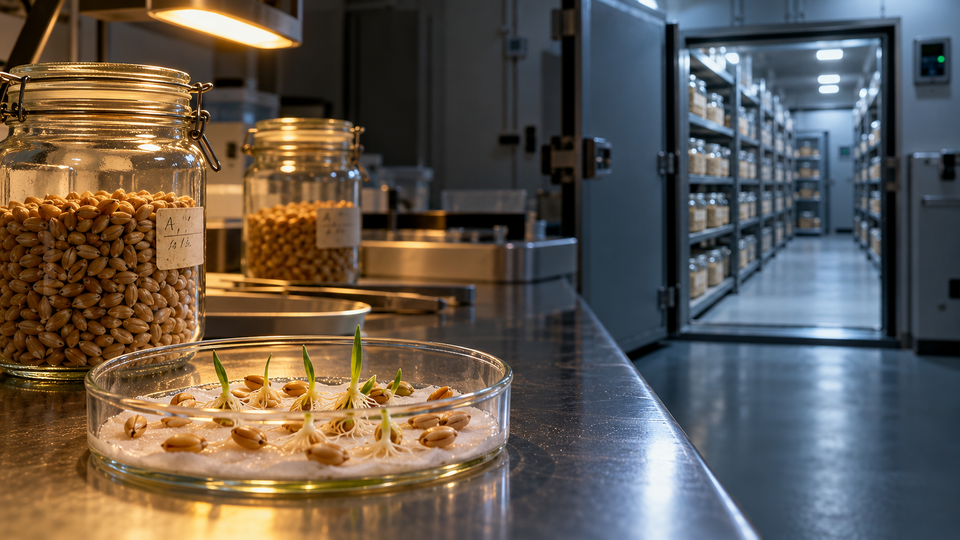
A small sample comes out of cold storage and receives the conditions under which it might germinate. The rest of the collection stays behind. For a seed bank, this modest experiment addresses a question that shelves of carefully labelled containers cannot answer: how much of what has been preserved can still grow?
At the Millennium Seed Bank at Wakehurst, samples undergo germination testing after storage and at intervals thereafter. The continued presence of a collection does not establish its continued viability. Seeds can lose the ability to germinate while their containers remain sealed and their records remain perfectly legible. An inventory can account for the material without settling what that material can still do.[1]
The test reverses the work performed by the vault. Seeds suited to conventional banking undergo controlled drying and storage at around minus 20 degrees Celsius, extending their lives while postponing growth. Testing brings a sample back towards activity. Preservation depends upon occasionally interrupting the conditions that make preservation possible.[1]
The work outside the freezer
Cold storage does not suit every seed. Some cannot tolerate drying; others survive poorly under conventional freezing conditions. Even among suitable species, longevity varies. A conservation system must understand the biology of its contents rather than assume that one successful storage method makes every collection equally secure.[2]
Identity matters too. A packet of living seeds can lose scientific usefulness if its origin becomes uncertain. Kew’s curation includes identification, collection records and knowledge of how to overcome dormancy. A failure to germinate can require investigation of the test conditions as well as the seeds. Recovering a plant demands more than recovering its container.[2]
In crop genebanks, declining viability can trigger regeneration: growing plants from stored seeds and harvesting a fresh supply. This renewal carries risks. Contamination, small populations and differences in reproductive success can alter what survives. Keeping a collection alive therefore involves decisions about when to intervene and how faithfully another generation carries the material forward.[3]
The freezer occupies only one part of that system. Around it sit testing, cultivation, records and expertise, consuming resources while producing little that resembles a harvest. A visitor counting containers could miss almost all the work that makes those containers worth counting.
When the duplicate became the source
Between 2008 and 2014, ICARDA deposited duplicates of much of its seed collection in the Svalbard Global Seed Vault. In 2015, after war disrupted its operations in Syria, it began withdrawing material to help rebuild collections in Lebanon and Morocco. Packets that had remained undisturbed acquired an immediate role in reconstructing an interrupted scientific institution.[4]
Their retrieval did not complete the recovery. ICARDA undertook regeneration and characterisation work at its new locations. People still had to grow, investigate and multiply the material. The preserved seeds could contribute because facilities, knowledge and continuing work could turn their survival into a usable collection.[4]
Before the disruption, the duplicates had provided protection without producing a harvest. Their eventual withdrawal made that protection visible. A review based only upon previous withdrawals would have found little activity to explain the expense, although the possibility of recovery already existed.
A seed bank makes the weakness of that calculation apparent. Elsewhere, the same calculation can sound admirably practical. When a capability sees little demand, asking whether the organisation still needs it hardly seems unreasonable. The difficulty begins when the record of demand supplies the answer.
The budget and the growing season
Consider an engineering group able to recover a service from an unusual failure. Several quiet years pass. Familiar incidents follow familiar paths. The exceptional procedure remains unused, while exercises, specialist knowledge and teaching continue to consume time. During a budget review, the visible expenditure belongs to the present. Its justification depends upon conditions nobody can promise will occur.
Those reviewing it may face genuine alternatives: protect this capability, improve a fragile customer journey or remove a recurring source of incidents. Retaining everything would merely move the risk elsewhere. Yet recent utilisation provides a poor means of comparing an activity that produces frequent results with one maintained for an infrequent but consequential event.
The accounting period adds another distortion. A review might cover twelve months while rebuilding the capability would take several years. Removing its maintenance creates a saving within the current decision. Reconstructing it, if required, belongs to a later budget and perhaps another executive. No cynical intent is necessary. The calculation rewards one timescale while leaving another outside its frame.
The seed bank cannot negotiate with the time required to grow another generation. An organisation has more freedom to negotiate its plans, but that freedom can disguise equally stubborn delays. Declaring expertise replaceable does not establish that it can be replaced before circumstances require it.
The first thing removed
An organisation need not abolish the capability outright. A compromise looks more responsible. The procedure stays, the specialist remains available, and the recovery commitment survives. Only the exercise moves out of this quarter. Teaching waits until delivery pressure eases. An environment used for testing disappears because maintaining it costs more than its recent activity seems to justify.
Each adjustment removes work around the capability while leaving its most visible signs intact. The document still opens. Somebody still owns it. A report can continue to describe recovery as available because no decision has formally withdrawn that commitment. The saving appears before anyone has to settle whether the remaining arrangement can deliver it.
Meanwhile, infrastructure acquires different identities, dependencies and security controls. Instructions that once worked accumulate assumptions nobody has tested. The specialist remembers the original system more accurately than the current one. The distance between possessing the procedure and performing it grows without requiring an obvious failure.
Here the seed comparison reaches a boundary. Human judgement generally cannot survive through inactivity as well as suitable seeds survive in cold storage. People need practice, feedback and encounters with changing conditions. Removing every occasion to exercise an ability can become a method of losing it, even while the organisation continues paying for the person who once possessed it.
The second person at the screen
Imagine an experienced engineer investigating an unfamiliar failure while a less experienced colleague watches. The senior engineer considers several plausible explanations, checks a detail that appears unrelated and abandons a line of enquiry that initially looked promising. The second person asks why. Answering slows the investigation, but exposes reasoning that the eventual incident report may never contain.
On a delivery schedule, both people occupy time. Only one may appear necessary to resolve the immediate problem. Reassigning the observer produces an intelligible gain: another task moves forward while the expert continues the diagnosis. Repeated often enough, that gain changes what the organisation can reproduce.
Formal training can continue throughout. Courses get completed, procedures circulate and newer colleagues handle routine cases successfully. What becomes scarce concerns the occasions on which someone sees judgement exercised under uncertainty. The organisation develops familiarity with the instructions while consuming the people who know when those instructions have stopped being sufficient.
Genebank regeneration presents a different problem, but sharpens the question of continuity. Another generation must carry forward something worth preserving. An organisation can replace its headcount while passing on less of its capability, particularly if the experiences allowed to successors contain only the familiar cases that current demand makes easy to justify.
The evidence of a quiet year
After the exercise disappears, nothing may happen. The service continues operating. The following review finds lower costs and no serious consequence. That result offers real evidence about performance under the conditions encountered. It offers much less evidence about the organisation’s ability to handle conditions that never arrived.
Nevertheless, the apparent success can support another reduction. Several such decisions gradually narrow the range of circumstances the organisation can manage, while familiar conditions continue producing reassuring results. The capability disappears in stages, and the absence of a test makes the moment of disappearance difficult to identify.
This complicates any later account of failure. The final departure of an experienced person may attract attention because it provides a date and a name. Yet the ability to develop a successor could have weakened years earlier. The visible loss merely closes a period during which the organisation retained the appearance of continuity.
A seed collection can similarly remain present between tests while its viability changes. The interval matters because the next observation cannot restore an opportunity already lost. Discovering deterioration and preventing it belong to different moments, however neatly a report combines them.
The collection nobody can afford
None of this makes accumulation a reliable strategy. An obsolete technology can absorb the expertise needed to establish a better replacement. Every retained capability competes with other protections and with productive work. Refusing to let anything disappear can leave an organisation unable to develop abilities that changing circumstances actually require.
Seed conservation carries its own scarcity. Testing and regeneration consume resources, and unnecessary regeneration can introduce risks. Research into longevity and monitoring investigates how to direct effort more effectively. Conservation involves choices about the work needed to preserve viability, rather than an assumption that more intervention always means better protection.[3][5]
Organisational choices also depend upon what can be recovered elsewhere. An infrequently used tool available from several suppliers differs from expertise that requires years of shared experience. A familiar internal team may preserve something distinctive, or duplicate a capability readily obtained outside. Neither rarity nor historical attachment settles the question.
The difficult expenditure to recognise often lies between retention and removal: enough continuing work to keep an option usable. It may involve a modest exercise, a difficult case shared with a successor or a dependency checked before the original expert leaves. Such work looks dispensable precisely because the capability still appears to exist before it happens.
The date on the label
At the seed bank, a germination result belongs to a particular test. It records an observation made under particular conditions. As time passes, the collection remains in storage, but the age of that observation increases. The next sample must leave the freezer before anyone can replace an earlier result with new evidence.
An organisation can allow the equivalent date to fade from view. Its recovery plan remains approved, its knowledge remains documented and its capability remains listed. The exercise that would test those claims has slipped through several planning cycles, each crowded with work whose usefulness can be demonstrated immediately.
On the next review, the capability occupies its familiar row. Beside it sits the last successful test, old enough to describe a system that no longer runs and a team that no longer exists. The proposed saving concerns the next exercise. The row itself requires no amendment, because nobody has yet established that anything has been lost.
Sources
[1] Royal Botanic Gardens, Kew, “How to preserve seeds for the future”. https://www.kew.org/read-and-watch/seed-collecting-msb
[2] Royal Botanic Gardens, Kew, “Seed Collection”. https://www.kew.org/science/collections-and-resources/collections/seed-collection
[3] Fiona R. Hay and Katherine J. Whitehouse, “Rethinking the approach to viability monitoring in seed genebanks”, Conservation Physiology, 2017. https://pmc.ncbi.nlm.nih.gov/articles/PMC5356937/
[4] ICARDA, “ICARDA and Svalbard Global Seed Vault”, 2019. https://icarda.org/media/news/icarda-and-svalbard-global-seed-vault
[5] CGIAR Genebanks, “Seed Longevity”. https://genebanks.cgiar.org/the-platform/conservation-module/seed-longevity/




Member discussion