Friday Fun: The Ocean Has Rejected Our Stretch Target
Leadership Chronicles
An Unacceptable Amount of Ship Remains Above Water
At the quarterly fleet review, someone notices that a substantial part of the ship remains above water. The company paid for the whole hull. It maintains the whole hull. Yet only the lower portion appears to participate in carrying the cargo. The upper portion spends every crossing full of air, apparently enjoying a permanent exemption from commercial accountability.
The naval architect calls the distance from the waterline to the relevant deck line freeboard. The presentation calls it headroom. A photograph appears on slide seven, with an arrow pointing towards the opportunity. Before anyone has touched the cargo, the same piece of ship has acquired two very different futures.
A floating vessel displaces its own weight in water. Add cargo and the hull settles until the extra displacement supports the extra mass. Within the vessel’s limits, this is normal. Archimedes does not require a steering committee. The question concerns what remains available after loading, when the ship leaves the sheltered water in which everyone currently feels qualified to assess it.
The watertight volume above the waterline provides reserve buoyancy. As more of the hull becomes immersed, it can displace more water. This arrangement depends heavily on the sea remaining outside spaces intended to exclude it. Hatches and doors therefore have responsibilities beyond appearing in the equipment register. A steel box with an open lid has a markedly different operating model.
Freeboard also affects how readily waves come aboard. Water on deck needs to drain away; water entering the hull creates a worse problem. Load-line arrangements consequently sit alongside requirements for closures, drainage, strength and stability. The painted mark belongs to an entire physical arrangement. It cannot compensate for a hatch cover whose contribution to safety consists of being somewhere nearby.[1]
Even a vessel that still floats can have unacceptable stability or structural loading. Cargo position matters as well as total weight. “It has not sunk” leaves a considerable amount of naval architecture unaddressed, although adopting it as the sole inspection criterion would deliver immediate administrative savings.
There is another complication. Fresh water is less dense than seawater, so the same vessel at the same weight sits deeper in it. Different seasons and regions also expose ships to different hazards. Load-line markings distinguish between operating circumstances.[2] The naval architect cannot provide one universal capacity figure valid everywhere, indefinitely. This disappointing lack of clarity is recorded as a communication issue.
The Business Case for One More Crate
The commercial question remains perfectly reasonable. There is a crate on the quay. Its dimensions can be measured, its passage invoiced and its arrival confirmed. The customer would like it transported. Reserve buoyancy offers none of these advantages. It has no account manager, no sales pipeline and no persuasive explanation for why it needs to accompany every voyage.
On a calm crossing, its contribution remains especially difficult to establish. Nobody at the destination signs to confirm that the unused margin arrived in excellent condition. The ship earns the same freight revenue whether the reserve proves necessary or spends the entire journey doing nothing visibly heroic. Asked to demonstrate its value, reserve buoyancy can only describe things that might have happened. The crate has a purchase order.
Nineteenth-century shipping supplied a brutal version of this argument. Commercial incentives encouraged dangerous overloading, and Samuel Plimsoll campaigned against the conditions that sent unsafe ships and their crews to sea. The early legislative response contained a revealing weakness: the 1876 arrangements required load-line markings on specified vessels, but owners could determine where to put them. Standardised assignment came later.[3]
For a while, the industry had acquired an obligation to display a limit while retaining considerable freedom over the limit displayed. The distinction between having a control and being constrained by it had already entered production. Our fictional fleet review can proceed with the comfort of knowing that its difficulties have a distinguished heritage.
The proposed extra crate receives a careful assessment. It fits. The crane can lift it. The customer will pay. Its weight represents only a small proportion of the vessel’s total displacement, which sounds reassuring when expressed as a percentage of something very large. The reduction in remaining margin receives less space on the slide. That would require a smaller denominator and a less encouraging colour.
The ship sails. The weather stays calm. The crate arrives, and the invoice gets paid. At the next review, the engineer still has calculations about the conditions the vessel might encounter. Finance has a receipt. Only one of these can be booked this quarter.
Last Year’s Exception Is This Year’s Capacity
The successful crossing changes the status of the crate. Initially, it travelled under an exceptional arrangement. Now it supplies evidence of what the vessel can demonstrably carry. Removing it would reduce performance against the previous period. Its place aboard has become easier to defend than the empty space it displaced.
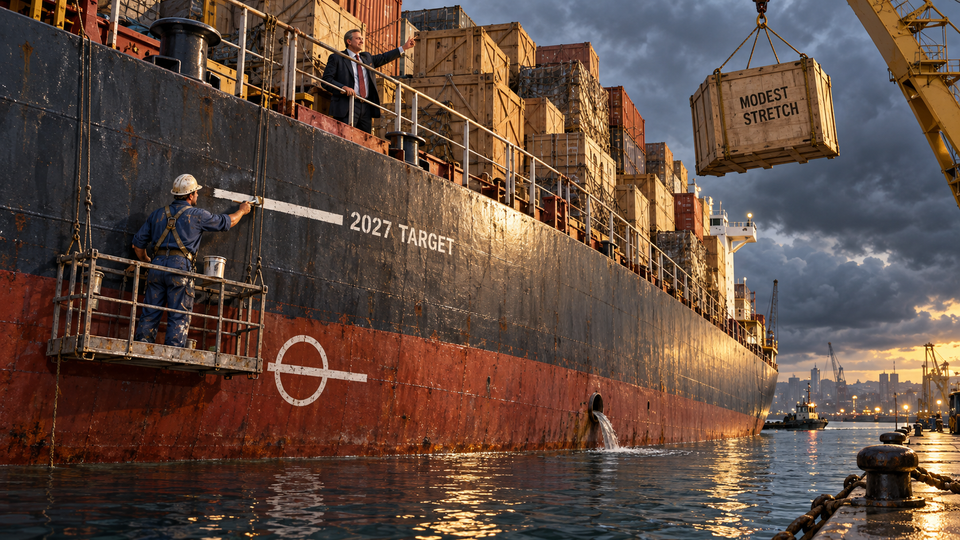
A second crate follows, described as a modest stretch. The first decision no longer needs justification; it has become the baseline against which the second must demonstrate ambition. After several agreeable crossings, the loading plan contains a growing collection of exceptions that have acquired permanent accommodation. The ship has developed a proud record of exceeding its original assumptions.
By this point, the cargo resembles an engineering portfolio. A team absorbs an unplanned commitment by postponing maintenance. Experienced people cover the gaps. A difficult release lands after several weekends quietly disappear. The customer receives what was promised. The delivery record captures the additional output with admirable precision; the recovery time consumed and the work displaced remain distributed across calendars, private conversations and a maintenance queue nobody has recently opened.
At the next planning round, the organisation has higher observed output and a smaller reserve. Planning accepts the first as evidence of capacity. The second arrives as a request for investment, competing with proposals that promise growth. Someone asks why the team needs additional resources to do something it has already demonstrated it can do. Somewhere below the waterline, last quarter’s answer has started leaking.
Each addition retains a convincing individual justification. One protects a renewal. Another meets a regulatory date. A third supports a strategically important prospect whose importance increased considerably after the commitment was made. The vessel receives their combined weight. It has no facility for distinguishing a tonne of contractual necessity from a tonne of executive enthusiasm.
Nor does buoyancy improve when the cargo belongs to separate budgets. Five departments can each fund a reasonable addition to the same voyage. Every business case passes its review while the hull settles another few inches. Everyone has paid for their crate. Nobody appears to own the diminishing distance between the deck and the sea.
Winter Was Not in the Approved Assumptions
The loading plan assumes an available specialist, a dependable service, a stable supplier and a customer who knows what they want. Each assumption seems defensible in isolation. Together, they describe a climate so agreeable that the crew should consider retiring there. The plan has effectively selected tropical conditions for a route that includes November.
When conditions deteriorate, the people aboard begin compensating. They rearrange work, catch mistakes, answer messages on leave and keep old components functioning through knowledge that has never quite made it into the documentation. From the quay, the crossing looks routine. Below deck, maintaining that appearance requires a surprising amount of pumping.
The performance chart records another successful arrival. It contains no obvious distinction between a voyage completed with ample margin and one completed because several people spent the night preventing water from reaching the machinery. Both produce a reassuring dot. The second may even receive more favourable commentary because it demonstrates commitment under challenging circumstances.
The crew win an award for resilience. Their citation describes how they overcame resource constraints, absorbed unexpected demands and maintained service through extraordinary dedication. During the following planning cycle, the same document circulates as evidence that the operating model works. The trophy has become a capacity assessment.
This creates an unusual relationship between competence and loading. The more effectively people conceal the consequences of depleted margin, the stronger the apparent evidence that the margin was excessive. Their intervention preserves the decision that made the intervention necessary. Successful rescue work returns to the organisation disguised as permission.
People eventually leave, and their replacements inherit both the workload and the reputation of a team that always finds a way. They also inherit a system whose ordinary performance depended on interventions nobody recorded as part of ordinary performance. The handover explains where the pumps are. It rarely explains how recently everyone started needing them.
The Line Has Been Updated to Reflect Our Ambition
Eventually someone introduces a load indicator. It accounts for commitments, available people and a respectable allowance for interruption. For a brief period, the picture looks uncomfortable. Several things already promised appear to exceed the capacity available to deliver them. This prompts a constructive discussion about the indicator.
Some commitments carry senior sponsorship and therefore cannot sensibly count in the same way as ordinary work. Others qualify as business as usual. A third group will be delivered through efficiency gains expected from a programme that also needs the same people. After these refinements, the organisation discovers considerably more capacity without the inconvenience of acquiring any.
There are practical reasons for preferring this outcome. The customers have been told. The revenue has been forecast. Other plans depend on the delivery dates. Reducing the load would make these consequences immediate and visible, whereas sailing again offers a reasonable possibility that the weather will cooperate. The last several voyages support that possibility. The people warning about winter have been wrong before, in the limited sense that winter has not yet arrived.
Another successful crossing helps settle the matter. The pumps stop, the crew go home, and temporary repairs remain in place because the next departure has already been sold. Customers quite reasonably expect the service they received last time. On the quay, another crate waits beside the crane. It belongs to an important account and has already been included in the forecast.
The ship lies almost motionless. A thin strip of painted steel separates the water from the deck. Inside, the next loading plan includes everything that crossed successfully this time, plus a small allowance for growth. Outside, a man in overalls waits on a suspended platform with a paintbrush. He has been asked to refresh the markings. Before he starts, someone leans over the rail to check whether the line could go a little higher.
Sources
The fleet review, shipping-company scenes and dialogue are fictional satire.
- US Coast Guard — Purpose of load-line assignment: reserve buoyancy, hull strength, closures, drainage and stability.
- International Maritime Organization — International Convention on Load Lines: freeboard, reserve buoyancy, seasonal and geographical provisions. See also the Convention text, Regulation 6 for fresh-water and seasonal marks.
- Lloyd’s Register Foundation — What is the Plimsoll line?: overloading, Plimsoll’s campaign and the early freedom to position load lines.




Member discussion