Wednesday Reality : The Brake That Did Not Wait for an Instruction
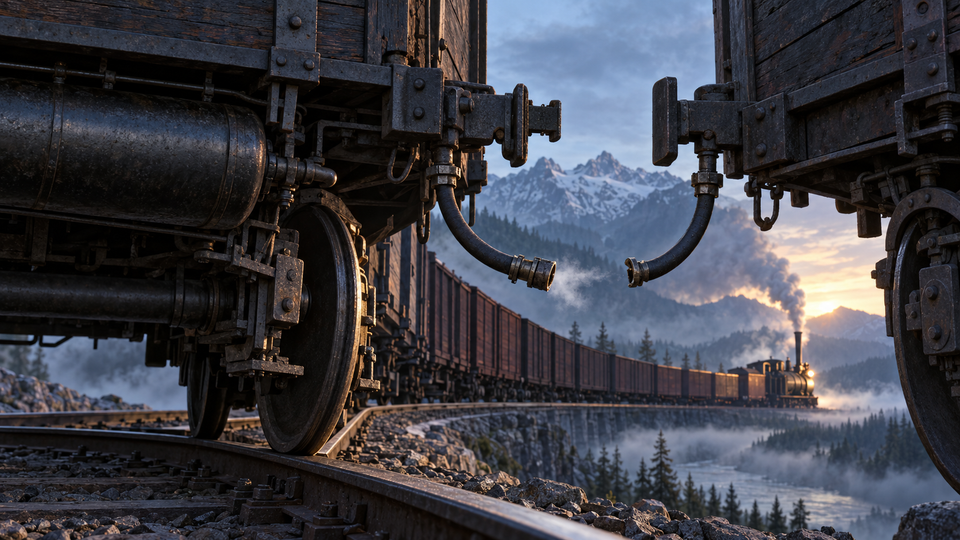
A railway coupling performs an apparently straightforward task. It allows a locomotive to pull the vehicles behind it. Attach another carriage, connect it properly, and the train grows. From the platform, the addition looks almost trivial. More seats, more freight, a little more length disappearing into the distance.
Stopping introduces a less accommodating problem. The locomotive can transmit a pulling force through the couplings, but the train needs braking effort distributed along its length. The difficulty extends beyond generating enough force. That force must reach the vehicles that need it, at the right time, including circumstances in which the connection between them has failed.
George Westinghouse’s work on railway air brakes confronted precisely this difficulty. His early direct air brake, introduced in 1869, used compressed air transmitted along the train to apply the brakes. The automatic system that followed in 1872 changed the relationship between the control connection and the response. Losing pressure could now cause the brakes to apply. A broken connection no longer had to leave the separated vehicles waiting for a command that could not reach them.[1]
The other side of the valve
The distinction deserves more attention than the familiar description of an ingenious safety device. In the automatic arrangement, each vehicle carries stored compressed air. A valve responds to changes in the pressure of the pipe running along the train. When the driver reduces that pressure, the valve admits air from the vehicle’s reservoir into its brake cylinder. The force that applies the brake therefore comes from a supply already present beside it.[2]
This separates two functions that can easily look like one. The pipe communicates a change. The local reservoir supplies the energy to act on it. The locomotive does not have to deliver all the braking air along the entire train at the moment of need. Much of that work has happened beforehand, while the system charged.
If coupled hoses separate and the pipe vents rapidly, the resulting pressure loss initiates an emergency application. Subject to the equipment functioning and holding sufficient stored air, the vehicles can respond without receiving a fresh instruction across the broken connection. The system has acquired a useful property: one of the failures that destroys communication can also initiate a protective response.[2]
Nothing here establishes that the track ahead remains clear, that every component works, or that the train can stop within any imaginable distance. The brake answers a narrower question about what happens when a particular connection fails. Its achievement rests partly on that precision. It gives a defined physical event a defined consequence.
A longer train changes the problem
Adding vehicles still complicates matters. A pressure change takes time to propagate along a pipe. On a longer train, vehicles do not all begin responding at the same instant. The Transportation Safety Board of Canada describes how the delay in releasing brakes towards the rear historically constrained train length, and how accelerated release arrangements allowed individual vehicles to contribute air locally to the brake pipe.[3]
The development follows the same underlying logic. Extending the train does not simply require a more emphatic instruction from the front. It changes the behaviour of the connection itself. The vehicles possess mass, the couplings transmit forces, and the control signal has a travelling time. What looks from the cab like a single action unfolds along the railway as a sequence.
This gives the local equipment a double significance. Each vehicle needs the means to respond, but its response also affects its neighbours. Distribution does not abolish coordination. It moves part of the coordination into the design of the connected system, where it can operate without a separate conversation for every application and release.
The locomotive remains necessary. So do common arrangements, maintenance and inspection. Yet the train’s ability to respond cannot depend entirely on the driver reconstructing the condition of every vehicle before anything happens. By the time that understanding arrived, the train would have travelled further.
The approval that survives its assumptions
An organisation can extend a programme with similar apparent ease. Another supplier joins. Another country enters the rollout. Each addition appears in the plan as a manageable increment, while the approval granted near the front of the process continues to pull everything behind it.
Consider a hypothetical customer migration approved on the understanding that transactions can be reconciled and the previous service restored if necessary. Weeks later, testing reveals unexplained differences. Subsequent changes have also made restoration more difficult. The approval remains recorded, although the conditions that justified it have changed.
Meanwhile, other departments have acted competently on that approval. Sales has informed customers. Suppliers have reserved specialists. Finance has included the expected revenue in its forecast. Other programmes have scheduled work around the release. The decision has acquired a growing constituency through the ordinary execution of the plan.
New evidence now competes with all those commitments. Reconsideration threatens costs and disruption across several departments, while continuing preserves the possibility that engineering will find a solution. The original judgement can become harder to reopen precisely because the organisation has become better coordinated around it.
A risk entry may circulate the new evidence without changing tomorrow’s work. The administrative connection remains intact, but the assumptions supporting movement have broken. On the railway, recording a pressure loss would offer little protection if applying the brake required another meeting.
Permission without a reservoir
Imagine that the engineer who discovers the reconciliation problem has explicit authority to delay deployment. She uses it. The supplier replies that its specialists will leave on Friday. Customer services explains that the new arrangements have already been communicated. Operations cannot move its maintenance window without disrupting another migration.
Each response follows a defensible local logic. The supplier manages a finite workforce. Customer services protects an external commitment. Operations protects another service. Together, those reasonable positions make a controlled pause difficult to execute. The engineer can stop her task, but cannot preserve the conditions needed for a safe restart.
The vehicle has a valve, but its reservoir sits in another department. Formal authority covers the objection. Budget, contractual influence, specialist availability and recovery capacity belong elsewhere. Exercising that authority initiates a negotiation whose participants already have reasons to resist its consequences.
As the programme expands, the number of boundaries crossed by an intervention grows. Responsibility remains distributed through departmental objectives, while the ability to interrupt depends on someone assembling an exceptional agreement across them. The brake exists in policy. Its operating mechanism consists of personal influence.
The railway’s local reservoirs work within a shared physical arrangement. In this programme, the equivalent arrangement has been left for people to negotiate after the warning arrives. The organisation has distributed the work more thoroughly than it has distributed the capacity to control it.
The cost of touching the handle
That arrangement also changes what people disclose. An engineer anticipating the supplier dispute, customer escalation and rescheduling exercise may try to resolve the discrepancy quietly. Raising it creates immediate obligations. Keeping it local preserves the possibility of a repair before those obligations materialise.
No instruction to conceal problems is necessary. If the reporting team inherits the missed date, the recovery plan and the burden of proving why delay was unavoidable, the organisation has attached a substantial price to early disclosure. Confidence travels cheaply through the programme. Doubt needs a business case.
Silence consequently becomes difficult to interpret. It may indicate satisfactory conditions, or an unwillingness to trigger an expensive process while uncertainty remains. By the time the discrepancy becomes undeniable, the programme may have accumulated still more commitments. What later appears to be late escalation can have developed through repeated, locally reasonable decisions to investigate a little longer.
A valve does not anticipate its performance review. People do. That difference limits the analogy, but also exposes why a declaration about speaking up cannot substitute for an arrangement in which speaking up produces a workable response.
The size of the interruption
An unrestricted veto would create its own problems. A payment service cannot necessarily resolve uncertainty by refusing every transaction, and a migration delay can impose genuine costs on customers. Stopping the whole programme might cause more damage than containing the affected part.
Suppose the reconciliation defect concerns one customer group. If the migration architecture allows that group to remain on the existing service, the programme has a smaller intervention available. If every customer shares one irreversible cutover, the same discovery threatens the entire launch. The technical boundary determines the organisational price of acknowledging the evidence.
Commercial arrangements can reinforce or undermine that boundary. A phased migration offers limited protection if a supplier contract permits only one support window, or if the customer agreement commits every site to the same date. The intervention must survive the contracts and staffing arrangements surrounding the software.
This makes the cost of disclosure partly a design outcome. A limited response gives uncertainty somewhere to go before it becomes a programme-wide dispute. An organisation whose only choices involve continuing or cancelling everything makes each concern politically larger than its technical scope may warrant.
The railway comparison therefore reaches beyond permission to stop. It concerns how a connected system responds without requiring every disturbance to become a negotiation over the whole journey.
The success that spends the next reserve
Suppose the team eventually reconciles the transactions through several nights of investigation, manual correction and additional checks. The migration proceeds on the advertised date. Customers encounter little disruption. The programme records a successful delivery, and the engineer’s concern becomes part of a problem that was resolved.
That outcome can support two different accounts of capacity. One includes the exceptional effort, postponed maintenance and specialists borrowed from other work. The other records the scope delivered within the elapsed time. A future plan built from the second account silently incorporates the recovery effort into its assumptions about normal performance.
The next migration may receive less contingency because the previous one succeeded. Experienced engineers acquire additional responsibilities because they have demonstrated reliability. Time held for testing or recovery becomes harder to defend when the reported success omits the additional effort that delivery required. Successful intervention can gradually erode the conditions that made intervention possible.
The brake supplies an inconvenient physical detail here. Compressed air used in braking needs replenishment. The Transportation Safety Board notes that insufficient recharge time between applications can compromise subsequent braking. A mechanism capable of responding once does not possess an inexhaustible reserve.[4]
People and organisations have different forms of replenishment. Some require rest, others protected engineering time, repaired environments or the transfer of knowledge out of a few overused heads. These activities compete for capacity with the next commitment. Their immediate output looks less impressive than another completed migration.
Eventually, a familiar team fails to recover a familiar problem. Attention turns towards its execution, although the history may contain years of successful deliveries that encouraged the organisation to remove recovery time, concentrate expertise and promise more. The apparent deterioration in performance arrives after a long period in which the recorded results suggested improvement.
From the cab, a train can look much the same after several brake applications. The vehicles remain coupled, the route still lies ahead, and the timetable still names the next station. Beneath each vehicle, however, there is a quantity of stored air that the timetable cannot replenish. The next descent will draw on whatever remains.
Sources
[1] ASME, “The Westinghouse Automatic Air Brake”: https://www.asme.org/about-asme/engineering-history/landmarks/273-westinghouse-automatic-air-brake
[2] Transportation Safety Board of Canada, Railway Investigation Report R13D0054, section 1.9.1: https://www.bst-tsb.gc.ca/eng/rapports-reports/rail/2013/r13d0054/r13d0054.html and Rail Transportation Safety Investigation Report R19V0002, section 1.8.1: https://bst.gc.ca/eng/rapports-reports/rail/2019/r19v0002/r19v0002.html
[3] Transportation Safety Board of Canada, Railway Investigation Report R17Q0061, section 1.9.1: https://www.bst.gc.ca/eng/rapports-reports/rail/2017/r17q0061/r17q0061.html
[4] Transportation Safety Board of Canada, Backgrounder R19C0015, train air brakes: https://www.tsb.gc.ca/eng/medias-media/fiches-facts/R19C0015/r19c0015-20220331-3.html



Member discussion