Monday Myth: The Factory That Changed Its Engine
The machinery above the machinery
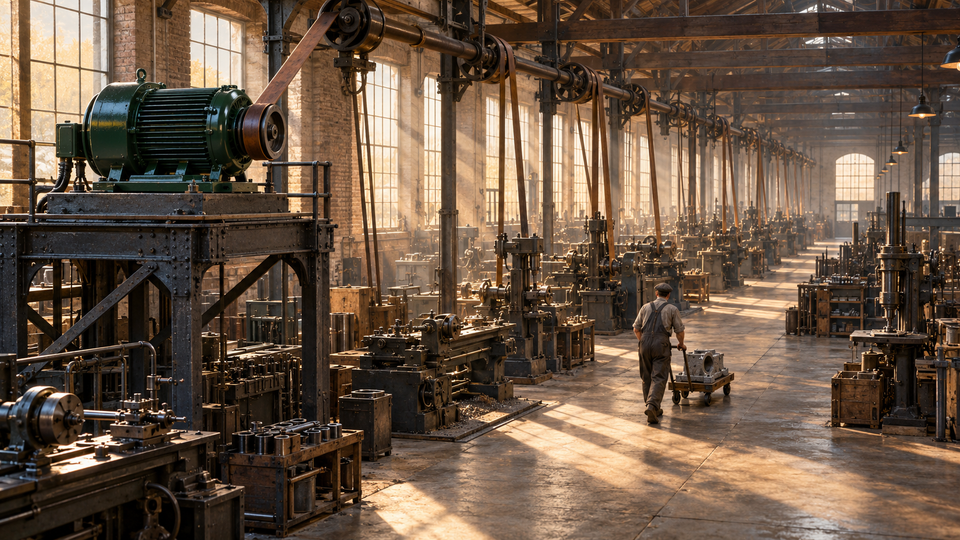
In a nineteenth-century factory, looking at the machines on the floor revealed only part of the production system. Above them ran shafts, pulleys and belts, carrying motion from a central source of power to the equipment below. A machine needed a workable connection to that moving network. Its position therefore answered two questions: where the work required it, and where the transmission system could reach it. The answers did not necessarily coincide.[1]
This arrangement solved a difficult problem. A large engine could supply many machines, but its power had to travel through a building as mechanical motion. The overhead network made that possible. It also gave the factory a geometry: a physical relationship between the source of power, its distribution and the work that consumed it. Repositioning equipment meant dealing with that relationship, not simply finding an empty patch of floor.
Electricity introduced a different possibility. Wires could carry energy to motors located where the machinery needed them. Power generation and its point of use no longer needed the same mechanical connection. The technology offered more than a replacement source of motion. It loosened the relationship between the route followed by power and the route followed by production.[1]
Yet a factory could adopt electricity without taking much advantage of that freedom. The engine could change while the arrangement of work continued to follow the old transmission system. A new source of power might leave the existing geometry almost entirely intact.
A perfectly reasonable replacement
Warren Devine’s historical study records an example at the Ponemah textile mill in Taftville, Connecticut. In 1895, electricity arrived from a hydroelectric installation upriver at Baltic. Inside the mill, motors occupied positions near the engines they replaced and drove the existing shafts. One motor powered 1,200 looms; another powered 500. Electricity changed how power reached the mill while preserving its mechanical distribution inside.[2]
Calling this a failure would misread the engineering. The mill gained access to a distant source of power through an arrangement compatible with its existing machinery. It could obtain a useful improvement without rebuilding the whole production system. The fact that a technology permits a more extensive redesign does not make every narrower application irrational.
Other installations used electric motors to drive smaller groups of machines through shorter shafts. This group-drive arrangement reduced some disadvantages of a single extensive transmission network while retaining mechanical connections within each group.[2] The transition contained intermediate solutions, each with its own costs and advantages. There was no universal morning on which an entire industry discovered the correct factory.
That complicates the familiar story about people failing to understand new technology. A factory owner could understand the possibilities and still face a sound reason to retain the old arrangement. Existing equipment continued producing saleable goods. Rebuilding consumed money and interrupted production. The relevant comparison concerned two working businesses, one of which had to survive a transition.
What could move once the shaft disappeared
Individual motors eventually allowed a more extensive change. Machinery could be arranged around the sequence of production, while lighter buildings and different layouts became possible without the same overhead transmission requirements. Paul David’s account also stresses the conditions needed to realise those possibilities: investment, practical experience and the economics of replacing still-serviceable plants. Technical possibility did not arrive as a complete, immediately profitable factory design.[3]
The distinction matters because a machine’s effectiveness depends partly on what happens around it. Imagine a component leaving one operation and travelling across a building to reach the next, then waiting before another journey. A more efficient drive can improve the economics of operating the machine. It does not automatically shorten those journeys or remove the waiting. The component experiences the arrangement of production as well as the performance of each operation.
This thought experiment reveals two different investments. One improves the equipment within an existing arrangement. The other changes the arrangement that determines how equipment contributes to a finished product. Both may create value. Their benefits come from different mechanisms, and counting the first does not establish that the second has happened.
The more difficult question therefore concerns what survives the upgrade. Some surviving constraints still serve a purpose. Others remain because changing them belongs to a different budget, disrupts another department or requires knowledge that the equipment supplier cannot provide. The new motor arrives with a specification. The new arrangement of work has to be discovered.
An order waiting to become a shipment
Consider an illustrative customer integration at a logistics provider. A customer sends orders electronically and expects confirmation when goods leave the warehouse. Business analysis documents the requirement, architecture approves the interface, and development receives a specification. The organisation has recently moved this process into a modern delivery platform. Every stage now has an owner, a recorded approval and a visible queue.
During implementation, an engineer asks what happens when only part of an order ships. The customer’s receiving system expects one confirmation for the complete order; the warehouse can dispatch several consignments on different days. The approved phrase “confirm dispatch” concealed two different meanings. Resolving it requires commercial knowledge, warehouse expertise and an understanding of the receiving software. Those people participated in different stages, and nobody had tested their interpretations together.
The question travels backwards through the workflow. A business analyst contacts the customer, operations explains the warehouse behaviour, and architecture revisits the interface. Development pauses or builds something else. Once an answer arrives, testing uncovers another question: if the receiving system times out after accepting a confirmation, can the integration safely send it again? The agreed business event now needs a technical identity that survives retries. Another journey begins.
The platform makes these journeys easier to manage. Questions remain attached to the requirement. Notifications reach the right people. Decisions no longer disappear into inboxes. Those improvements matter, but the integration still waits for knowledge distributed across departmental boundaries. The tool shortens the time spent finding an answer’s owner while preserving the sequence that postpones the question.
On the factory floor, a component could travel between machines because the power transmission dictated where they stood. Here, an uncertainty travels between departments because the workflow dictates when their knowledge may meet. The customer eventually receives a working interface, but the record of delivery contains several apparently separate tasks whose existence arose from dividing one problem.
What the handover protects
Each department can account for its part. Analysis completed an approved requirement. Architecture reviewed the documented design. Development raised a clarification. Testing identified an unhandled condition. The work required to reconnect those contributions appears as coordination, a changed requirement or an additional test case. Each classification describes something real while making the originating separation harder to see.
The arrangement also supports departmental accountability. A queue makes incoming demand visible. Completed reviews demonstrate output and help justify staffing. Earlier collaboration might prevent a misunderstanding before it becomes a reviewable document, leaving a valuable contribution with less evidence in the department’s measures. A specialist can improve the whole delivery while appearing to complete fewer of the activities through which their own function explains its value.
Nobody needs to defend waste for this system to persist. The architecture lead may reasonably protect scarce expertise from unstructured interruptions. The analysis manager needs a manageable boundary around commitments. Testing needs evidence that decisions have been resolved. Each protects a necessary capability through an arrangement that makes its contribution identifiable. Across the whole integration, the customer pays for the movement between those boundaries.
The programme that can buy a motor
A technology programme encounters these relationships as requirements. Each function asks the new platform to preserve its approvals, evidence and visibility. Challenging those requests would turn an implementation into a negotiation about responsibilities, staffing and authority. The programme has a budget for software and migration. Its sponsor may have no authority to change how several departments define successful work.
The resulting business case can contain a quiet contradiction. It promises faster delivery through better collaboration while funding a migration that must preserve the existing handovers. The project can deliver every configured feature without acquiring the authority to change the relationships on which the larger benefit depends. In the mill, buying a motor could leave the shafts in place; here, the delivery team can fulfil its mandate while retaining the dependencies that limit the promised return.
Calling that compromise an intermediate state does not establish what follows. Once the platform goes live, the project closes and its people move elsewhere. The remaining changes sit between departmental budgets. Everyone operates the new workflow; nobody retains a funded obligation to reconsider its geometry. The first stage becomes permanent through the disappearance of the circumstances that might have produced a second.
Moving the machines has a cost
Bringing the integration specialists together earlier would carry costs of its own. Warehouse expertise remains scarce. Customer representatives cannot attend every discussion. An architect examining uncertain requirements may spend time on options that never reach implementation. A group assembled around one integration also consumes capacity that other customers need. Earlier participation changes where uncertainty gets absorbed; it does not make expertise unlimited.
A broader team might resolve the partial-shipment question quickly, yet still need common rules for identifying events, handling retries and supporting interfaces after release. Duplicating every specialist across every team could become expensive and inconsistent. Individual electric motors likewise retained dependence on shared power infrastructure. Removing one form of coupling leaves other connections whose design still matters.
The distinction concerns what those connections enable. A shared convention for identifying confirmations can let teams make progress independently. Requiring the same specialist to approve every routine application of that convention can recreate a queue. Both arrangements may protect consistency, but they consume expertise differently. The factory’s layout could change only within the practical requirements of production; an organisation faces the same difficulty of separating constraints that protect the work from constraints inherited from an earlier arrangement.
A successful upgrade can preserve the shafts
Return to the integration after the platform migration. Reminders reduce forgotten questions. Dashboards expose ageing work. Templates improve the information supplied at each handover. The organisation can process more integrations with the same fragmented sequence because administering that sequence now costs less. The upgrade succeeds, and that success changes the economics of retaining the arrangement.
Previously, the effort of chasing answers might have made the handovers intolerable. Automation relieves some of that pressure. Managers can see enough to intervene when a queue grows dangerous, and coordinators can carry more work. The underlying separation becomes easier to operate. Technology has extended the useful life of an arrangement that might otherwise have become too expensive to preserve.
The comparison with factory electrification now grows less comfortable. An electric motor could justify its purchase while continuing to drive old shafts. A workflow platform can similarly earn its return by reducing the cost of coordination, even if another arrangement could eliminate some of the coordination altogether. A sound investment and a missed opportunity can occupy the same business case.
This creates an awkward problem of evidence. The visible gains belong to the system that exists: fewer lost questions, quicker responses, more work administered per coordinator. The possible gain from avoiding those questions requires a different arrangement before it can be observed. The installed system produces records supporting its continuation; the alternative initially produces estimates, disruption and a request for scarce people’s time.
What does not wear out
Paul David identified a further difference between factories and information-intensive organisations. Physical equipment depreciates, creating occasions for replacement. Information structures need not deteriorate in the same way. They can remain technically usable after their economic usefulness has diminished.[3] A workflow can cross generations of software without encountering the equivalent of a bearing that finally makes replacement unavoidable.
Its survival can even acquire the appearance of validation. Several migrations have reproduced it, years of records describe its categories, and experienced people know how to keep it moving. Replacing another tool can seem less uncertain than disturbing those relationships. Each successful migration carries the old geometry into machinery capable of sustaining it for longer.
Above the factory floor, the new motor turns smoothly. The belts need less attention, interruptions have fallen, and the owner can demonstrate that the investment paid. Below, a worker carries the unfinished component past the place where the next machine could now stand.
Sources
[1] Jesse H. Ausubel and Cesare Marchetti, “Elektron: Electrical Systems in Retrospect and Prospect”: https://phe.rockefeller.edu/publication/elektron-electrical-systems-retrospect-prospect/
[2] Warren D. Devine Jr., “From Shafts to Wires: Historical Perspective on Electrification”, 1983: https://gwern.net/doc/economics/automation/1983-devine.pdf
[3] Paul A. David, “The Dynamo and the Computer: An Historical Perspective on the Modern Productivity Paradox”, 1990: https://gwern.net/doc/economics/automation/1990-david.pdf




Member discussion