Friday Fun: The Committee That Replaced the Thermometer
The Instrument That Industrialised Agreement
Long before the thermometer found its way onto the wall of a kitchen, it had already transformed industry.
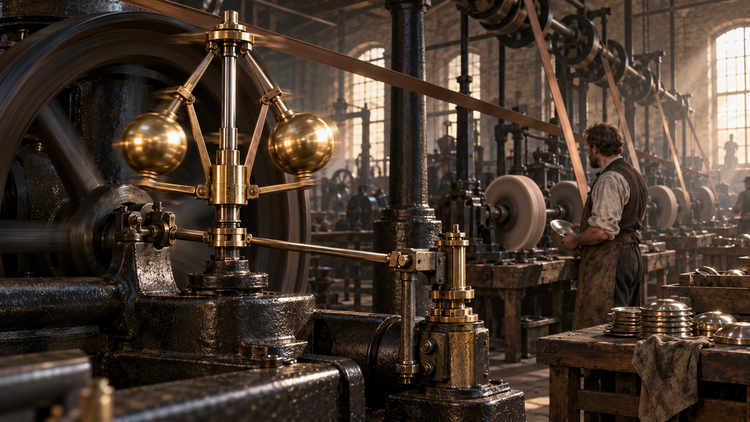
The first industrial revolution did not merely require bigger machines. It required machines that behaved predictably. Steam engines demanded repeatable boiler pressures. Steel mills demanded consistent furnace temperatures. Chemical plants demanded reactions that occurred within carefully controlled thermal boundaries rather than according to intuition. None of these systems tolerated interpretation for very long. Iron expands by a measurable amount. Water boils within remarkably narrow limits. Metallurgy ignores optimism with admirable consistency.
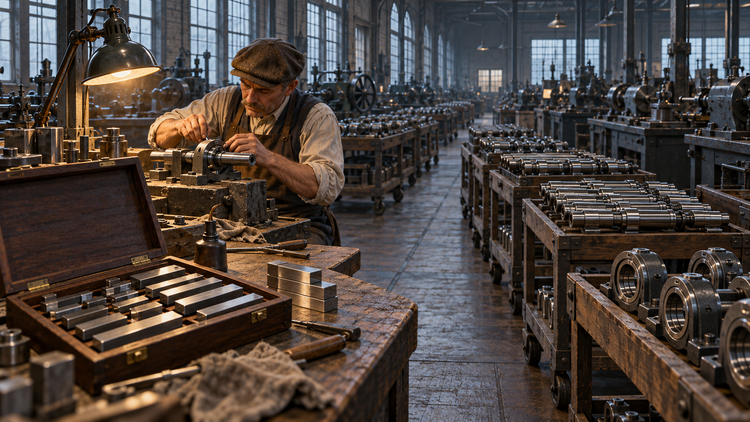
For centuries, craftsmen compensated through experience. A master blacksmith knew the colour of hot iron. A brewer recognised the smell of fermentation. A glassmaker judged heat by instinct developed over decades. Their expertise remained extraordinary, but it resisted scale because it lived inside individuals. Modern industry required something far more powerful than expertise. It required agreement.
Calibration quietly solved that problem.
A calibrated thermometer does not simply measure temperature. It allows two people, separated by hundreds of kilometres and who have never met, to observe the same physical phenomenon and reach the same conclusion. Entire railway networks, power stations, refineries and manufacturing plants quietly depend upon this simple idea. Measurement does not eliminate disagreement because people suddenly become wiser. It eliminates disagreement because reality offers a common reference.
Industrial civilisation rests upon astonishingly few ideas.
Calibration happens to be one of them.
A Question of Inclusion
Unfortunately, the thermometer suffers from a serious cultural weakness.
It displays very little empathy.
It stubbornly reports the same temperature regardless of seniority, department or strategic priorities. It fails to recognise that different stakeholders may experience identical conditions differently. It refuses to distinguish between operational concerns and executive narratives. Most disappointingly of all, it remains entirely indifferent to governance.
Such rigidity inevitably attracted attention.
Following several workshops on collaborative decision-making, senior management concluded that temperature deserved a more inclusive operating model. While the thermometer undoubtedly provided data, it lacked context. Context, after all, had become considerably more valuable than observation.
The factory therefore announced the Thermal Alignment Initiative.
Its objective sounded entirely reasonable. Replace isolated measurement with collaborative understanding.
Improving the Process Around Reality
The first improvements arrived quickly.
Rather than allowing individual operators to declare that a furnace had reached 1,150°C, every reading would now undergo collective interpretation.
A Thermal Steering Committee reviewed significant changes. Architecture published the Enterprise Temperature Reference Model to ensure consistency across furnaces. Finance requested quarterly reporting on thermal efficiency. Risk Management established a register of emerging warmth. Human Resources reminded everyone that language surrounding excessive heat should remain psychologically inclusive.
Communications recommended replacing the term "overheating" with "positive thermal acceleration", which reflected a more constructive organisational culture.
Curiously, none of these initiatives altered the temperature inside the furnace.
Calibration Without Instruments
As the programme matured, attention naturally shifted towards standardisation.
The factory had previously invested considerable effort in calibrating instruments against internationally recognised standards. Such work now appeared unnecessarily mechanical. Surely experienced professionals could interpret thermal conditions collectively. Measurement had become only one input amongst many.
A workshop explored whether boiling water represented a sufficiently inclusive reference point. Another questioned whether historical temperature scales reflected outdated industrial thinking.
An external consultancy proposed replacing degrees Celsius with a multidimensional Warmth Index capable of incorporating operational complexity, stakeholder confidence and strategic intent.
The proposal received unanimous approval. Water continued boiling at precisely the same temperature. Physics displayed little enthusiasm for organisational transformation.
Dashboards Scale Better Than Observation
Executives appreciated visibility. Thermometers provided numbers. Dashboards provided confidence.
Within months, the factory possessed an extraordinary collection of indicators.
- Thermal Governance Maturity.
- Heat Alignment Velocity.
- Cross-functional Temperature Consistency.
- Percentage of Strategic Warmth Reviews Completed Within Service Levels.
- Executive Confidence in Thermal Readiness.
Monthly reports demonstrated encouraging progress across every indicator. Governance participation increased. Committee attendance exceeded expectations. Documentation achieved record levels of completeness. Colourful dashboards suggested an organisation approaching thermal excellence.
Meanwhile, maintenance costs quietly climbed. Energy consumption drifted upwards. Product quality became less predictable. Steel occasionally left the furnace either underheated or dangerously overheated.
Fortunately, these operational irregularities appeared only in production data, which sat on a different dashboard.
The Economics of Organised Interpretation
Industrial history rarely rewards organisations for discussing reality elegantly.
It rewards those that observe reality accurately.
Every unnecessary degree of overheating consumes additional fuel. Every poorly controlled process shortens equipment life. Every failed production batch wastes raw materials, labour and time. Factories earn profits by reducing variation, not by improving the governance surrounding variation.
This distinction rarely survives organisational scale.
Coordination gradually acquires its own momentum. Meetings produce further meetings. Reports justify additional reports. Every layer of interpretation creates demand for another layer capable of interpreting the previous interpretation. The coordination system slowly begins consuming resources once reserved for the productive system it originally existed to support.
No finance report ever labels this line item "the cost of governing what a thermometer already knew."
Perhaps it should.
Artificial Intelligence Achieves Thermal Excellence
Eventually, innovation arrived.
The factory deployed an advanced artificial intelligence platform trained on years of committee minutes, governance decisions, maintenance reports and executive presentations. The model rapidly achieved astonishing accuracy. It could predict with remarkable confidence how the Thermal Steering Committee would classify next week's furnace conditions before the meeting had even begun.
Its forecasts proved consistently correct. The committee approved exactly what the model predicted.
The furnace continued ignoring both.
Combustion still followed chemistry. Steel still obeyed metallurgy. Expansion coefficients continued their ancient habit of remaining completely uninterested in machine learning.
Reality had not resisted artificial intelligence. Reality had simply declined to participate.
The Last Thermometer
Visitors often admired the factory.
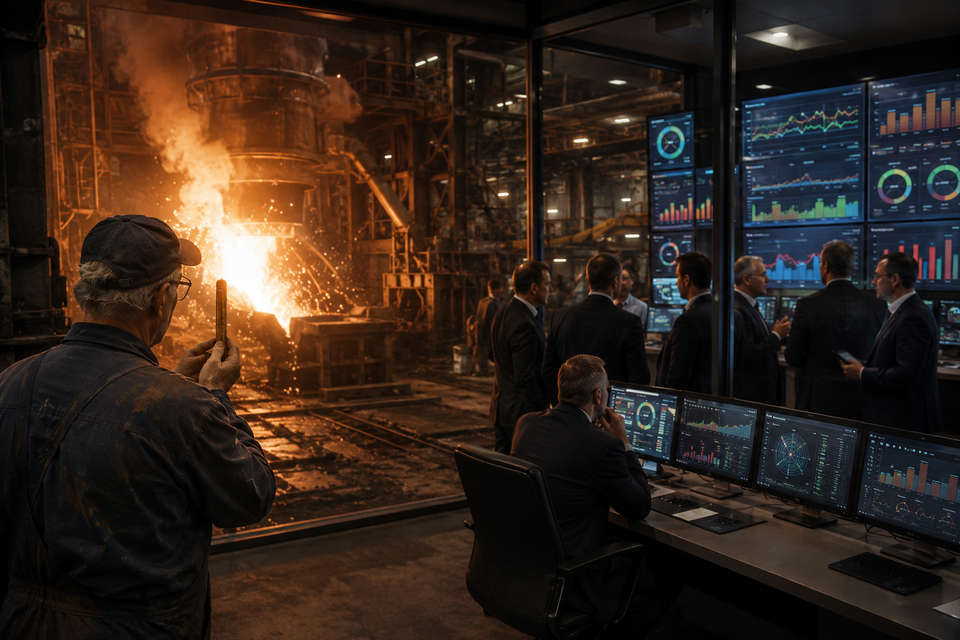
Wall-mounted displays stretched across the control room. Interactive dashboards refreshed continuously. Governance metrics flowed elegantly between departments. Every decision appeared traceable. Every process looked modern.
Hidden amongst the machinery stood an elderly engineer carrying a scratched brass thermometer whose calibration certificate had long since faded. Every morning he compared its reading against the furnace, adjusted the burners by a fraction and quietly walked away without attending a single governance meeting.
The furnace never thanked him.
It merely continued producing excellent steel.
There are systems that improve when more people discuss them.
Temperature has never belonged to that category.


Member discussion