Wednesday Reality :The Assembly Line Does not Care Who Worked Hardest
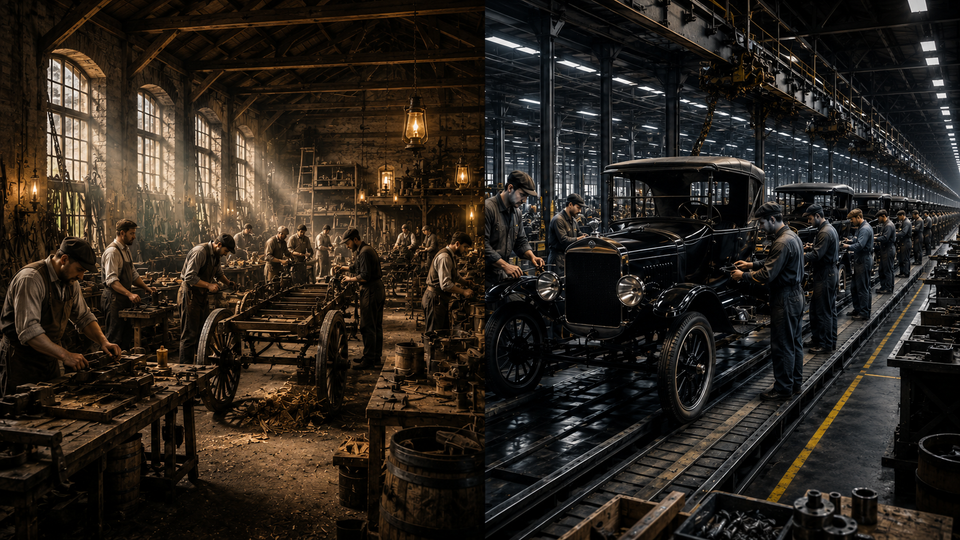
Before Factories Learned to Flow
Walk through a medieval shipyard, a nineteenth-century carriage workshop or one of the great armouries that supplied Europe's armies, and one characteristic quickly becomes impossible to ignore. The product scarcely moved. Men did.
Carpenters crossed the yard carrying tools from one hull to another. Blacksmiths wheeled glowing iron between furnaces and anvils. Apprentices searched for gauges, fasteners and templates. Master craftsmen walked continuously, inspecting, correcting and demonstrating. The workshop resembled a small village whose inhabitants happened to share the same project. Every completed product embodied not only skilled labour but also countless unnecessary journeys that nobody thought to question.
The arrangement survived for centuries because it appeared perfectly natural. Work belonged to craftsmen, and craftsmen travelled to wherever the work happened to be waiting. Better tools shortened individual operations. Steam engines powered larger machines. Precision engineering improved tolerances. Yet the underlying assumption remained remarkably stable. The product waited while the factory revolved around it.
The Industrial Revolution changed many things.
That assumption survived longer than most.
Detroit's Quiet Revolution
History remembers Henry Ford for the moving assembly line. The image has become so familiar that it almost obscures the discovery itself. A conveyor carrying half-built Model Ts through neat rows of workers has become shorthand for industrial efficiency, as though the conveyor somehow contained the secret.
It did not.
Ford inherited interchangeable parts, precision machine tools, production gauges and decades of engineering refinement. None of those inventions belonged to him. The conveyor itself was hardly revolutionary. Similar mechanisms already existed in slaughterhouses, flour mills and countless industrial settings.
Ford's contribution was almost embarrassingly simple. He asked a different question. Instead of wondering how workers could reach the work more efficiently, he wondered why the work remained stationary in the first place.
The answer altered the geometry of manufacturing. The automobile moved. The workers largely stopped.
That single inversion exposed costs that generations of craftsmen had accepted as unavoidable. Walking became visible. Searching became visible. Waiting became visible. Every unnecessary movement that had quietly disappeared into the rhythm of daily work suddenly acquired a measurable economic cost.
The assembly line did not merely accelerate production. It made invisible waste impossible to ignore.
The Engineers Became Suspicious
Visitors admired speed.
Production engineers noticed something altogether stranger. They became suspicious of unfinished work.
At first sight the suspicion seemed irrational. A half-built Model T represented obvious progress. The chassis had already been assembled. The engine perhaps already occupied its mounts. Wheels, steering and bodywork gradually appeared as the vehicle advanced through the factory. To anyone walking the line, every unfinished car looked reassuringly productive.
The engineers saw something else.
Every unfinished vehicle had already begun consuming resources long before earning anything in return. Steel had already left the warehouse. Rubber had already been purchased. Electricity had already powered the machinery. Labour had already earned its wages.
The factory had committed capital from the very first operation. The customer had committed nothing.
The uncomfortable conclusion emerged slowly. A partially assembled vehicle did not merely occupy space. It represented investment waiting for permission to become revenue.
The longer it waited, the more expensive that permission became.
Time Never Works for Inventory
Manufacturing gradually learned that unfinished work behaves rather differently from finished products.
Completed automobiles leave the factory. Unfinished automobiles remain inside it, quietly accumulating obligations.
They occupy floor space. They require handling. They complicate planning. They conceal defects beneath subsequent assembly stages where discovery becomes slower and correction becomes substantially more expensive. Suppliers continue delivering components while completed vehicles fail to leave at the same pace. Before long, yesterday's queue quietly creates tomorrow's congestion.
Then time begins doing its own work.
Designs improve. Components change. Suppliers evolve. Customers alter their expectations.
The factory discovers that the vehicle patiently waiting between two workstations no longer represents today's best solution but yesterday's assumptions frozen in steel.
Time rarely improves inventory. Time merely invoices it.
That observation transformed industrial thinking. Engineers stopped treating unfinished work as reassuring evidence of progress and started treating it as something much closer to trapped capital. The objective quietly shifted. The question no longer asked how much work had started.
It asked how quickly work escaped.
Water Already Knew
Curiously, another branch of engineering had solved almost exactly the same problem centuries before Ford organised his factories.
Hydraulic engineers rarely begin by discussing pumps. They begin with pipes. The reason has little to do with machinery and everything to do with physics. Water possesses a magnificent indifference towards effort.
Increase the power of the pump while leaving the narrowest section of the pipe unchanged and something deeply unintuitive happens. Pressure increases dramatically. Turbulence appears. Energy dissipates. Mechanical stress accumulates around the restriction. Every additional unit of effort simply compresses the problem against the bottleneck with greater determination.
The pipe remains entirely unmoved by the enthusiasm upstream. It recognises neither ambition nor commitment. It responds only to flow.
Factories eventually discovered exactly the same behaviour.
Suppose one workstation suddenly doubles its output while every downstream operation continues exactly as before. Production does not double. Vehicles accumulate between the stations. Material handlers work harder. Floor space disappears beneath growing queues. Defects travel further before discovery. Capital remains trapped for longer. The busiest workstation has become more productive only in the narrowest possible sense. The factory itself has become less productive because the system has simply exchanged movement for accumulation.
Different materials. Different centuries. Different engineering disciplines.
The same behaviour.
A Pattern Begins to Emerge
By the middle of the twentieth century this pattern had become increasingly difficult to dismiss as coincidence.
Factories distrusted inventory. Hydraulic engineers distrusted pressure.Both had reached their conclusions independently.
Neither discipline cared particularly about effort. Both cared deeply about what continued moving through the system. One measured vehicles leaving the production line. The other measured water leaving the pipe. Their instruments differed. Their mathematics differed. Their industries could scarcely have been further apart.
Yet they had quietly converged upon the same observation.
Systems possess no mechanism for rewarding effort. They reveal only what successfully passes through them.
That turns out to be a rather awkward observation, because most organisations still spend extraordinary amounts of energy measuring precisely the one thing mature engineering disciplines quietly stopped trusting generations ago.
Perhaps the assembly line never changed manufacturing as much as it changed the question manufacturing asked.
And perhaps the factory was never studying automobiles at all.


Member discussion