Friday Fun: The Order of the Sacred Meeting
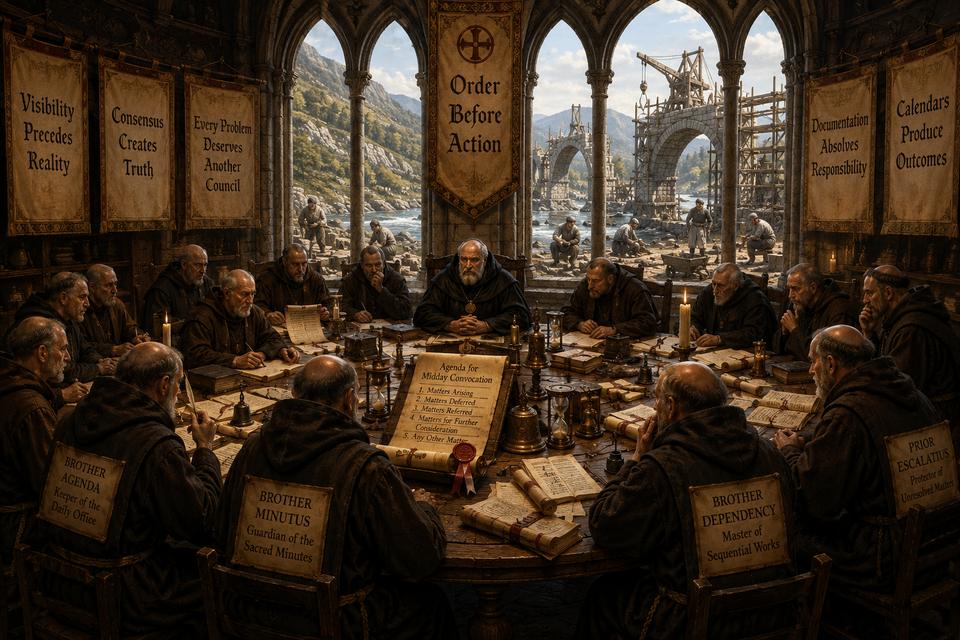
A curious account of an order whose discipline became legendary, though few could remember what it had once been founded to accomplish.
The Abbey on the Hill
Among the many religious orders that flourished across medieval Europe, few inspired as much admiration as the Brotherhood of the Sacred Meeting. Nestled high in the mountains, beyond the trade routes and sheltered by thick stone walls, the abbey acquired a reputation that reached far beyond its modest lands. Travellers wrote of its impeccable discipline, neighbouring abbots praised its remarkable organisation, and visiting nobles often returned home determined to imitate its methods.
Unlike other monasteries, which became renowned for brewing ale, illuminating manuscripts or cultivating vineyards, the Brotherhood devoted itself to a different calling. It pursued the perfection of order itself. Every activity had its appointed hour, every discussion its prescribed participants, and every decision its rightful sequence. Nothing was left to chance. The abbey's bells rang with mathematical precision, summoning the brothers from one solemn gathering to the next. To outside observers, it seemed impossible that such an orderly institution could produce anything less than excellence.
Visitors often remarked that the brothers never appeared hurried. There was no confusion, no contradiction and no visible conflict. Every uncertainty found its proper ceremony, every disagreement its appointed council and every decision its prescribed path. Predictability was so complete that many mistook it for effectiveness. Few questioned whether the two were, in fact, the same thing.
The Sacred Rituals
Life within the abbey followed a rhythm refined over generations. Before dawn, the First Alignment gathered the brothers to review the conclusions reached during the previous evening's Council of Reflection. Brother Agenda then revealed the programme for the day, carefully ensuring that sufficient time had been reserved to prepare for the Assembly of Preparations, whose principal duty was to establish the matters worthy of consideration during the Midday Convocation.
The afternoon belonged to the Council of Dependencies, where representatives from every cloister examined the possible consequences of actions that had not yet been authorised. Only after these solemn obligations had concluded could the brothers retire to copy the minutes onto fresh parchment, preserving every observation for future generations.
Nothing about these rituals seemed unreasonable in isolation. Visitors admired the consistency of the process. Every scroll followed the same elegant structure. Wax seals, coloured ribbons and carefully indexed ledgers transformed even the simplest discussion into an object of remarkable dignity. The abbey radiated competence.
The Brothers of the Order
The hierarchy of the Brotherhood reflected centuries of refinement. Brother Minutus served faithfully as Guardian of the Sacred Minutes, preserving every discussion with astonishing precision. Brother Dependency watched over the Sequence of Works, ensuring that no undertaking commenced before every preceding consideration had been fully explored. Prior Escalatius protected unresolved matters from premature conclusion, convinced that questions matured through contemplation. Above them all stood Father Consensus, whose blessing was sought before any meaningful undertaking could proceed.
The remarkable feature of these men was neither their titles nor their influence, but their sincerity. Brother Minutus genuinely believed that future generations would benefit from perfect records. Prior Escalatius regarded patience as the highest form of wisdom. Father Consensus considered disagreement less dangerous than haste. None sought prestige. None intended to obstruct. Each believed wholeheartedly that he was preserving the integrity of the Order.
That, perhaps, explained why the system endured for so long.
The Forgotten Workshop
Only those who wandered beyond the cloisters noticed details that rarely appeared in the chronicles.
Behind the eastern wall stood the monastery's workshop. The forge lay cold beneath a thin layer of dust. The carpenter's benches remained perfectly arranged, though the tools had long surrendered to rust. Beyond the orchard stretched an unfinished stone bridge whose foundations disappeared confidently into the river before stopping halfway across. Weathered scaffolding still clung to its incomplete arches like a monument to interrupted ambition.
The villagers explained, without bitterness, that construction had paused many years earlier while the brothers considered improvements to the process by which bridges ought to be built.
The quarry had likewise fallen silent. The masons still lived nearby and were frequently invited to observe important discussions concerning future construction. They attended respectfully, contributed thoughtful observations when invited and returned home each evening without having lifted a hammer.
No one could identify the precise year in which the bridge ceased to grow.
Everyone remembered when attendance at the Council of Dependencies became compulsory.
The Great Pilgrimage
Far from diminishing the abbey's reputation, these peculiarities only enhanced its prestige. Delegations arrived from neighbouring kingdoms eager to learn the Brotherhood's methods. Abbots marvelled at the elegance of its governance. Royal administrators copied its procedures into their own institutions. New monasteries proudly announced that they had adopted the celebrated practices of the mountain abbey, convinced that disciplined coordination would naturally produce superior craftsmanship.
Within a generation the ceremonies had spread across the kingdom. Bells rang with remarkable punctuality. Archives expanded at astonishing speed. Registers became more complete than ever before. Councils multiplied, each established to preserve the quality of decisions made by the last.
Travellers, however, continued to complain about broken roads, unfinished mills and bridges that seemed permanently one season away from completion.
The Chronicler's Observation
Generations later, historians attempting to understand the Brotherhood found themselves blessed with an extraordinary abundance of documentation. They knew who had attended every council, who had spoken, which matters had been deferred and which had been entrusted to further contemplation. Few institutions in medieval Europe left behind such an impeccable administrative record.
Yet among the thousands of preserved manuscripts, one detail remained curiously absent.
No chronicler could determine who had last completed a bridge.
Perhaps that was because the Brotherhood had never intended to abandon its purpose. Every ritual had once solved a genuine problem. Every new ceremony had emerged from an honest desire to improve the last. Over time, however, the rituals acquired a life of their own. The preservation of order quietly became more important than the work that order had originally been created to serve.
The bells continued to ring with perfect regularity. The attendance registers remained immaculate. The minutes faithfully recorded every discussion.
Only the bridges refused to participate in the discipline.
Member discussion