Friday Fun: A Visit to the Ministry of Organisational Progress
In 1970, British television audiences were introduced to one of the most remarkable institutions ever conceived: the Ministry of Silly Walks.
Created by Monty Python, its mission was simple: promote, regulate and fund increasingly absurd methods of walking. Officials reviewed applications, budgets were allocated, standards were maintained, and entire careers appeared devoted to advancing an activity that produced no obvious value whatsoever.
The brilliance of the sketch was not really the walking itself. It was the institution that surrounded it.
Audiences immediately recognised something familiar. The machinery of administration had become detached from purpose whilst preserving every appearance of seriousness. Forms were still completed, procedures were still followed and reports were still produced. Only the original reason for doing any of it had quietly disappeared.
Half a century later, one occasionally encounters organisations that evoke a similar feeling.
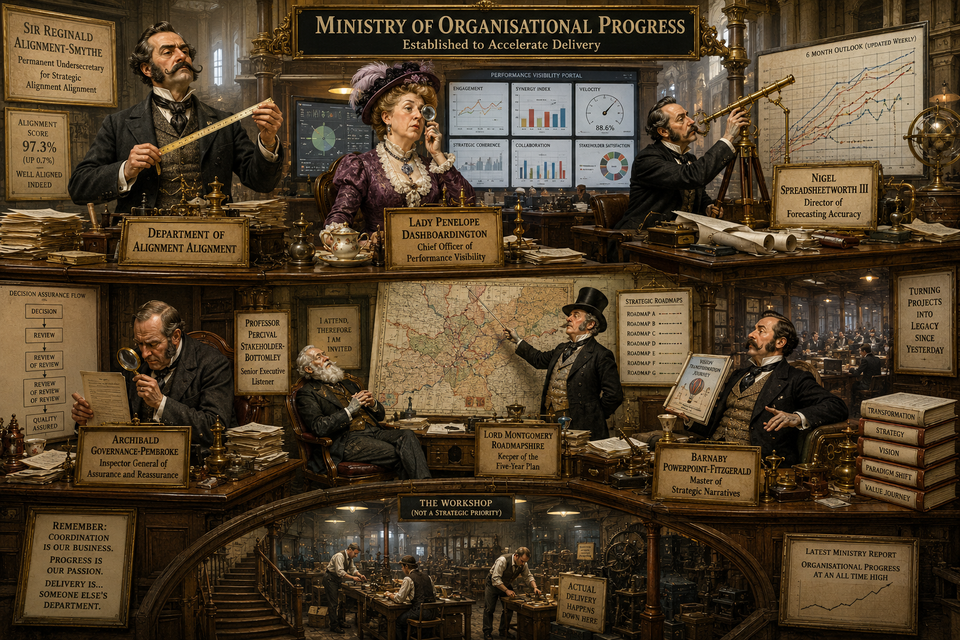
Recently, I was granted access to one such institution: The Ministry of Organisational Progress.The plaque above the entrance stated that its mission was to accelerate delivery.
What follows are my observations.
Sir Reginald Alignment-Smythe
My guide through the ministry was Sir Reginald Alignment-Smythe, Permanent Undersecretary for Strategic Alignment Alignment.
Sir Reginald explained that his department ensured all alignment activities remained aligned with the Strategic Alignment Framework for Alignment. The initiative had begun several years earlier after concerns emerged that certain alignment exercises were themselves insufficiently aligned.
The resulting programme generated workshops, steering committees, executive reviews and an impressive body of alignment documentation. Entire teams had devoted themselves to the question of how alignment could be improved through better alignment mechanisms.
Whether additional customer value had been produced as a result remained surprisingly difficult to determine.
Sir Reginald considered this a secondary concern and assured me that the ministry's alignment indicators had never been healthier.
Lady Penelope Dashboardington
The second floor belonged entirely to Lady Penelope Dashboardington, Chief Officer of Performance Visibility.
Rows of analysts sat before enormous screens displaying every conceivable indicator: velocity, engagement, strategic coherence, cross-functional synergy, delivery confidence and predictive alignment readiness.
Several dashboards appeared dedicated exclusively to monitoring other dashboards.
Lady Dashboardington proudly informed me that the ministry now tracked more than two hundred performance indicators every week. Considerable investment had been made in improving measurement maturity, and new dashboards were regularly introduced to ensure dashboard coverage remained comprehensive.
When I asked which metric represented customer value, she paused briefly before directing my attention to an exceptionally attractive heat map. The colours, admittedly, were magnificent.
As we left, I noticed an entire team dedicated to measuring dashboard utilisation. Another team had been formed to monitor the effectiveness of the dashboard utilisation metrics.
The ministry clearly took visibility very seriously.
Nigel Spreadsheetworth III
Nigel Spreadsheetworth III served as Director of Forecasting Accuracy.
His department specialised in predicting delivery dates months before work had actually begun. Complex models covered entire walls, probability distributions filled whiteboards and forecast confidence intervals extended across multiple quarters.
Although no forecast had achieved practical accuracy in recent memory, confidence in forecasting remained remarkably high.
Nigel explained that forecasting was difficult because reality consistently refused to follow the plan.
Fortunately, the ministry had launched a Forecasting Excellence Initiative intended to improve confidence in future forecasts through enhanced forecasting practices.
Several additional programmes had been created to monitor the effectiveness of the Forecasting Excellence Initiative.
Nigel showed me a chart demonstrating a seventeen percent increase in organisational confidence regarding forecasting. The chart was extremely convincing, although reality appeared somewhat less enthusiastic.
Archibald Governance-Pembroke
The Directorate of Assurance and Reassurance was overseen by Archibald Governance-Pembroke. His department occupied an entire wing of the building.
Teams reviewed decisions, while other teams reviewed those reviews. Specialist reviewers examined the review process itself, and a governance council assessed whether sufficient reviewing had occurred before authorising further review.
Archibald explained that these safeguards protected the ministry from poor decisions.
It was difficult to argue with the logic. After all, very few poor decisions appeared to emerge from his department. Equally, very few decisions appeared to emerge from it at all.
When I asked whether the system occasionally prevented good decisions as well, Archibald regarded the question carefully before opening an investigation into the matter.
The investigation remains under review.
Professor Percival Stakeholder-Bottomley
Professor Percival Stakeholder-Bottomley held the prestigious position of Senior Executive Listener.
His responsibilities were difficult to define yet impossible to challenge.
The professor attended every meeting conducted within the ministry, including strategic reviews, operational reviews, steering committees, planning workshops, executive updates and lessons learned sessions.
No one could remember when this arrangement had begun.
Several senior leaders considered his presence essential, although none could articulate precisely why.
An internal working group had recently been assembled to investigate the matter. Professor Bottomley attended every session.
The final report concluded that additional stakeholder consultation would be required before any recommendation could be made.
The professor welcomed the outcome.
Lord Montgomery Roadmapshire
Lord Montgomery Roadmapshire served as Keeper of Strategic Horizons.
His office contained seven strategic roadmaps.mEach roadmap depicted a different future, and none described the same destination.
This did not appear to concern him.
According to Lord Roadmapshire, strategy should inspire aspiration rather than constrain possibility. Predictability was useful, but vision mattered more. The purpose of a roadmap was not necessarily to describe where the organisation was going; it was to demonstrate that the organisation possessed destinations.
The maps were extraordinary works of craftsmanship and could be studied for hours.
Unfortunately, they appeared to bear only a passing resemblance to the territory.
Barnaby Powerpoint-Fitzgerald
Barnaby Powerpoint-Fitzgerald occupied perhaps the most influential office in the ministry.
As Master of Strategic Narratives, his role was to ensure that ordinary activities achieved appropriate strategic significance.
His talent was undeniable.
A software upgrade became a transformation programme. A process correction became an operational excellence initiative. A bug fix evolved into a customer-centric acceleration journey.
Replacing a printer required a vision statement, an executive sponsor and a three-year roadmap.
Barnaby possessed the rare ability to transform any practical undertaking into a strategic movement. No equivalent capability existed for transforming strategic movements back into practical undertakings.
The Workshop Beneath the Ministry
As the day progressed, a peculiar pattern became increasingly difficult to ignore.
Everyone worked hard, everyone cared and everyone appeared genuinely convinced they were helping. Yet each department seemed primarily occupied supporting another department.
Alignment supported governance. Governance supported reporting. Reporting supported strategy. Strategy supported forecasting. Forecasting supported alignment.
The circle was elegant, self-sustaining and remarkably resilient. The ministry was no longer expanding to support the work. Instead, it was expanding to support itself.
Late in the afternoon I asked what appeared to be a simple question. What exactly does the Ministry of Organisational Progress produce?
The answers varied.
People spoke of visibility, alignment, governance, confidence, strategic readiness and predictive capability.
No one mentioned customers. Eventually a janitor suggested I visit the basement.
There, hidden beneath the committees, dashboards, roadmaps and governance structures, I discovered a small workshop staffed by a handful of engineers, an operations specialist, a customer support representative and a product manager.
Together they built, operated and maintained the service that funded the entire institution above them.
Most ministry officials had never visited. Several departments appeared unaware the workshop existed. One steering committee was currently evaluating whether it should be integrated into the governance framework.
The workshop hoped not.
Lady Penelope's Greatest Achievement
As I prepared to leave, excitement spread throughout the corridors.
A major announcement had been made.
Lady Penelope Dashboardington had achieved a historic breakthrough.
After years of investment, eighteen committees, four transformation programmes and countless executive reviews, the ministry had successfully accelerated the measurement of organisational progress by forty-three percent.
Applause echoed through the building.
Sir Reginald declared the achievement fully aligned. Nigel forecast further improvement. Archibald initiated a review to validate the celebration. Professor Bottomley attended the celebration meeting. Lord Roadmapshire incorporated the milestone into next year's strategic horizon. Barnaby Powerpoint-Fitzgerald immediately transformed the announcement into a flagship success story.
The ministry had never appeared more confident.
Unfortunately, the workshop in the basement had stopped producing anything three months earlier.
No one had noticed.
A task force has since been established to understand why awareness of production declined. The task force will report to a steering committee, which will provide recommendations to a governance council, which will commission an independent review.
Professor Bottomley will attend all meetings.
... According to the latest dashboard, progress is expected to be excellent.



Member discussion