Wednesday Reality: Why More Reporting Creates Less Clarity
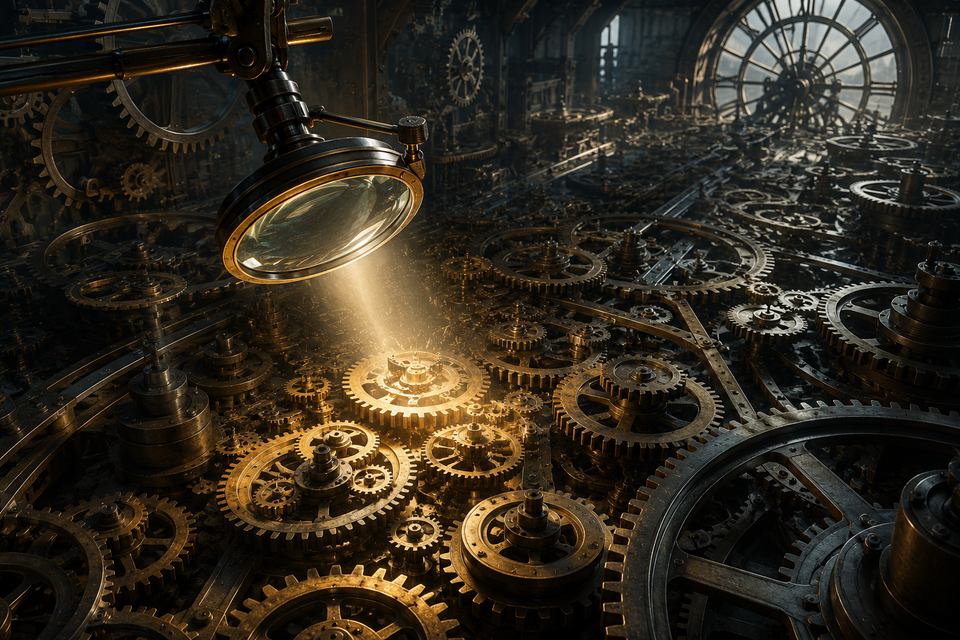
In 1927, Werner Heisenberg introduced a concept that would become one of the foundations of modern physics. The uncertainty principle is often presented as a limitation of measurement, as though scientists simply lacked sufficiently precise instruments. The reality was more profound.
The problem was not the quality of the instruments. The problem was that observation itself required interaction. To determine the position of a particle, one had to exchange energy with it. The act of observing could not be separated entirely from the thing being observed. Observation did not merely reveal reality; it altered it.
For physicists, this represented a fundamental shift in perspective. The observer was no longer standing outside the experiment, passively recording what already existed. The observer had become part of the system.
Although the scale could not have been more different, engineers had been wrestling with a remarkably similar problem for decades.
As industrial systems grew larger and more interconnected, understanding what was happening inside them became increasingly difficult. Every attempt to improve visibility carried a cost. Information had to be collected, transmitted, interpreted and reported. People had to interrupt productive work in order to explain productive work.
The challenge was never simply gathering information.
The challenge was gathering information without disrupting the system itself.
More than a century later, organisations continue to wrestle with the same problem. Faced with uncertainty, they often respond by demanding more reports, more dashboards and more oversight. The assumption is understandable: more visibility should produce better understanding.
Yet engineering history repeatedly suggests the opposite can happen.
When Industry Faced the Same Problem
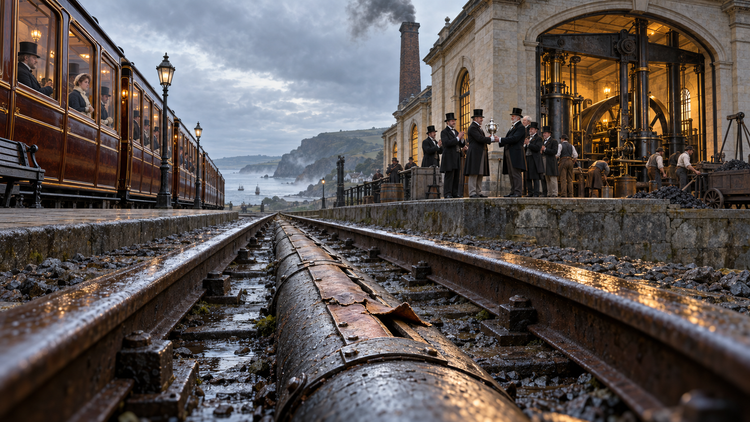
The early railway networks of the nineteenth century provide a useful illustration.
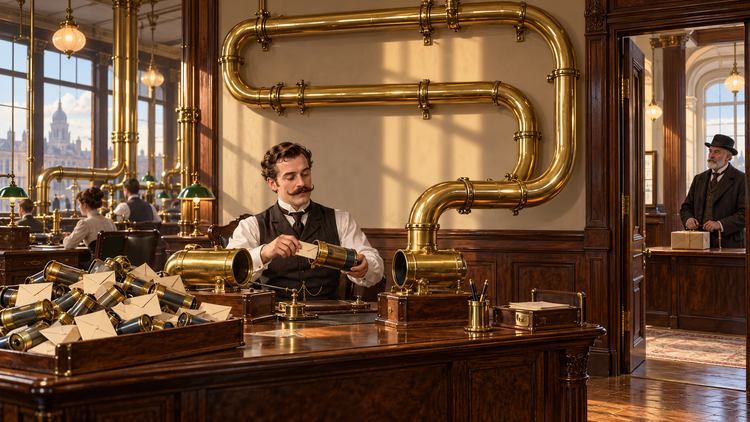
Before signalling systems, track circuits and centralised control centres, understanding the state of the network depended heavily on people. Station masters exchanged messages. Telegraph operators relayed information. Dispatchers attempted to construct a coherent picture of train movements from fragmented reports arriving at different times from different locations.
This worked while networks remained small.
As traffic increased, however, the limitations became obvious. More trains required more communication. More communication required more operators. More operators introduced additional opportunities for delay, misunderstanding and error.
The railway was discovering a fundamental truth: observation does not scale indefinitely through people.
At some point, observation itself must become engineered.
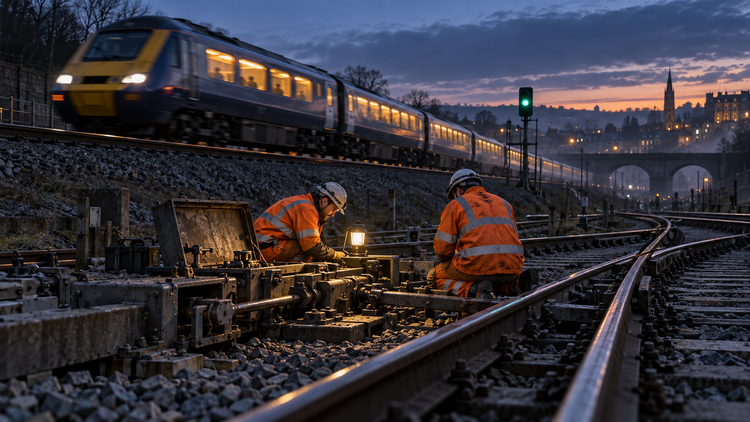
The solution was not to hire an ever-growing army of observers. The solution was to redesign the infrastructure so that information emerged naturally from the operation of the system. Signals indicated track status. Track circuits revealed occupancy. Control systems exposed network conditions continuously.
The railway increasingly knew what was happening because observation had become embedded within the infrastructure itself.
The same pattern appears repeatedly throughout industrial history. Power grids evolved from manual inspection towards continuous telemetry. Manufacturing evolved from supervisors counting output towards instrumented production systems. Aviation evolved from pilot judgement alone towards sophisticated sensor networks capable of monitoring thousands of parameters simultaneously.
The most advanced systems did not eliminate observation. They reduced its cost.
Observation Versus Instrumentation
This distinction is rarely discussed in organisations, yet it may be one of the most important.
Observation and instrumentation are often treated as interchangeable, but they are fundamentally different approaches to understanding a system. Observation relies on deliberate human effort. Instrumentation is designed into the system itself.
When a manager requests a weekly status report, the organisation is observing. When a deployment pipeline automatically exposes deployment frequency, lead time, rollback rates and failure rates, the organisation is instrumented.
The difference becomes increasingly significant as complexity grows. Observation consumes attention, introduces interruptions and depends upon interpretation. Instrumentation generates signals continuously and consistently as a by-product of operation.
Engineering disciplines have spent generations moving from observation towards instrumentation because manual observation becomes increasingly expensive and increasingly unreliable at scale.
Yet many organisations continue moving in the opposite direction.
The Feedback Problem
Every engineered control system depends upon feedback.
A thermostat requires temperature information. A fly-by-wire aircraft relies upon continuous sensor inputs. An electrical grid depends upon constant measurement of load, frequency and voltage.
Without feedback, these systems become blind.
Yet engineers also understand that excessive feedback can be just as problematic as insufficient feedback. Systems flooded with noise struggle to distinguish meaningful signals from irrelevant ones. Stability depends not merely on having feedback, but on having the right feedback delivered at the right frequency and with the right level of precision.
Organisations often overlook this distinction. When uncertainty appears, the instinctive response is to increase observation through additional reports, reviews, meetings, dashboards and governance structures.
Visibility may improve. Understanding does not automatically follow.
In many cases, the additional information introduces noise, increases cognitive load and diverts attention away from the signals that actually matter.
Why Common Language Matters More Than Metrics
There is another lesson embedded within industrial systems that organisations frequently ignore.
Before a system can measure consistently, it must describe reality consistently.
A volt carries the same meaning throughout a power grid. A millimetre retains its precision across a factory floor. A railway signal conveys identical instructions regardless of which station receives it.
Many organisational measurement systems fail not because the metrics themselves are flawed, but because the language beneath them is unstable.
Teams frequently disagree about what constitutes delivery, quality, technical debt, platform work or completion. When the definitions vary, measurement becomes little more than the systematic production of ambiguity.
No amount of reporting can compensate for a lack of shared meaning.
Platforms as Observation Infrastructure
This is perhaps where modern platform engineering becomes most interesting.
Platforms are often described as accelerators of delivery. They are. Yet this description overlooks a more fundamental role.
Platforms function as observation infrastructure.
Continuous integration systems transform software quality into observable signals. Deployment platforms transform operational activity into observable signals. Monitoring systems transform behaviour into measurable indicators of reliability, performance and stability.
A mature platform reduces both delivery friction and observation friction.
Instead of relying upon individuals to manually report what has happened, the system reveals its own condition through normal operation. Information is no longer something that must be requested and assembled after the fact. It becomes a natural by-product of the work itself.
In this sense, platforms perform a role remarkably similar to signalling systems within railways or telemetry systems within aviation.
They reduce the cost of understanding reality.
Why Organisations Choose Observers
This may be the most difficult lesson.
Instrumentation sounds attractive in principle, yet organisations repeatedly choose observation instead.
The reason is simple : Observation can be added immediately when Instrumentation requires redesign.
A dashboard can be created in a day. A reliable operational signal may require months of process redesign. A steering committee can be scheduled tomorrow. A shared operational language may take years to establish.
One approach treats the symptom. The other addresses the structure that produced the symptom.
Much of modern management can be understood as an attempt to compensate for weak instrumentation through stronger observation.
For this reason, organisations often accumulate observers faster than they improve the systems being observed. Visibility increases. Understanding does not necessarily follow.
When Organisations Start Observing Themselves
At first glance, additional observation appears harmless.
As organisations become more complex, they often respond by adding observers rather than improving instrumentation. New reporting requirements are introduced. Governance structures expand. Reviews multiply. Coordination layers emerge to manage dependencies.
Each change appears reasonable when viewed in isolation. Collectively, however, they begin to alter the behaviour of the system.
Engineers prepare updates. Managers consolidate reports. Teams assemble presentations. Committees review information and produce recommendations. Increasing amounts of organisational energy are directed towards producing evidence of work rather than advancing the work itself.
At that point, observation is no longer external to the system. It becomes part of the system.
Metrics begin influencing decisions directly. Reports become artefacts that must be maintained. Dashboards become objectives that teams optimise.
The measurement system gradually shifts from describing reality to shaping it.
The observer enters the system.
The lesson is precisely the one Heisenberg identified nearly a century ago. Observation is never entirely neutral. The act of measuring changes the thing being measured.
The Railway Still Exists to Move Trains
The history of engineering suggests that progress rarely comes from increasing observation indefinitely. Instead, it emerges from improving the infrastructure through which observation occurs.
Civilisations advanced when measurement became embedded within roads, railways, factories, aircraft and power grids. Observation became cheaper, faster and less disruptive because it became part of the system rather than an activity imposed upon it.
Many organisations pursue the opposite path. As complexity increases, they add observers. The resulting growth in visibility is often mistaken for growth in understanding.
Yet the two are not the same.
The timetable matters. The signalling matters. The control centre matters. None of these, however, exist for their own sake.
The railway still exists to move trains. The question is whether the trains are moving.

Member discussion