Monday Myth: Progress Requires Complexity
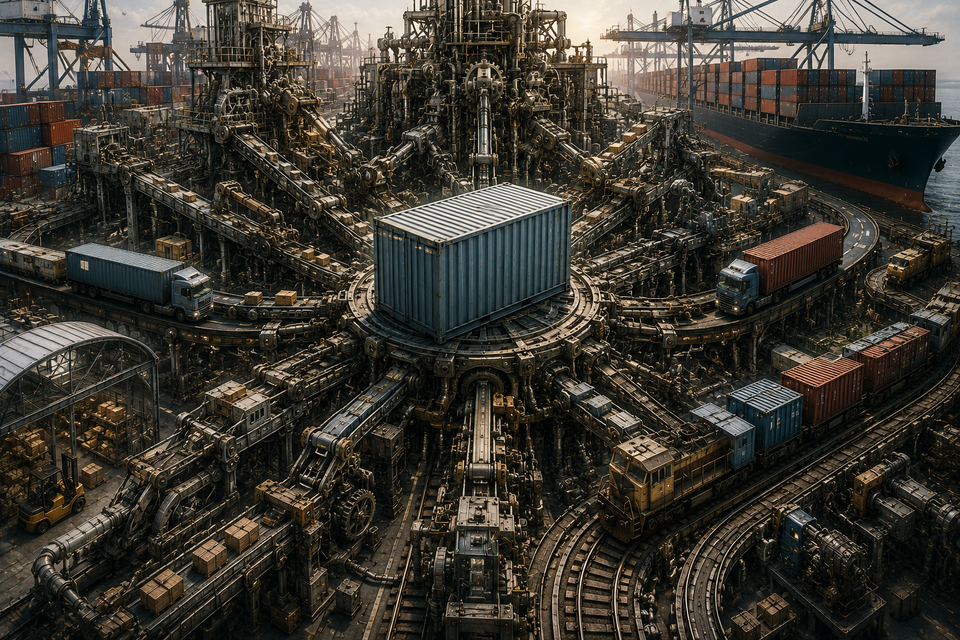
The Problem Nobody Could See
By the middle of the twentieth century, global trade appeared to be thriving.
Ships crossed oceans. Railways connected continents. Trucks delivered goods to factories, warehouses and cities. More products travelled further and faster than at any point in human history. To most observers, the trajectory seemed obvious. Larger ships, faster trains and expanding infrastructure signalled progress.
Yet beneath this impressive growth lay a persistent problem. Moving goods remained extraordinarily inefficient.
A shipment arriving in a port would often be unloaded piece by piece. Crates, barrels, sacks and machinery were handled individually, sorted manually, stored temporarily and loaded again for the next stage of the journey. Every transfer required labour. Every handoff introduced delay. Every interpretation created the possibility of error.
The world possessed ships, railways, trucks and ports, but it lacked a common language that allowed those systems to work together efficiently.
Most people focused on improving the visible parts of the system. They looked for better ships, more capable cranes, larger ports and faster railways.
The assumption seemed reasonable. After all, if each component improved, then the overall system would improve as well.
Malcolm McLean's Different Insight
A trucking entrepreneur named Malcolm McLean saw the problem differently.
He noticed that the greatest inefficiencies did not exist inside ships, trucks or railways. They existed at the boundaries between them.
Cargo moved through multiple systems, each with its own procedures, assumptions and constraints. Every transition created friction.
McLean's solution was almost disappointingly simple. Rather than redesigning transportation itself, he proposed standardising the cargo.
The idea was not to create a better ship or a better truck. It was to create a standard box that could move between ships, trains, trucks and warehouses without the cargo inside ever being touched.
The shipping container was born.
At first glance, the innovation seemed insignificant. A steel box lacked the romance of a steam engine, an aircraft or a computer. It hardly appeared capable of changing the world.
Yet it did exactly that.
Simplifying the Interface
The container did not standardise products.
Instead, it standardised the way different systems interacted with those products.
Electronics, machinery, clothing, food and raw materials could all travel inside the same structure. The contents remained diverse, but the interface became predictable.
That distinction changed everything.
Ports were redesigned around containers. Ships were redesigned around containers. Railway wagons were redesigned around containers. Warehouses were redesigned around containers. Over time, an entire logistics ecosystem reorganised itself around a single standard.
History repeatedly reveals the same pattern.
Railway networks expanded when gauges became standardised. Electrical systems expanded when plugs and voltages became predictable. The Internet expanded when communication protocols became universal.
The most transformative breakthroughs often emerge not when individual components become more sophisticated, but when the relationships between those components become simpler and more reliable.
The container belongs to this lineage.
Before containers, every transfer required interpretation and handling. After containers, entire categories of decisions disappeared. The crane operator no longer needed to understand the cargo. The railway operator no longer needed to handle individual goods. The truck driver no longer needed to care what was inside the box.
The system became more capable because it became more ordered.
The Entropy Peak
One aspect of the container revolution is often forgotten.
The container did not immediately simplify the world. It first made it more complicated.
Ports had to be rebuilt. Ships had to be redesigned. Equipment had to be replaced. Workers had to learn new skills. Existing operating models became uncertain.
For a period, disorder increased. This is the paradox of many structural improvements. Before entropy falls, it often rises.
People experience the disruption and assume the disruption is the destination.
What looked like growing chaos was, in reality, a system reorganising itself around a simpler and more stable structure. The difficulty is that future order is rarely visible while present disruption is.
The Resistance
Not everyone welcomed containerisation.
Entire professions had been built around loading, unloading and transferring cargo. Ports employed vast numbers of workers precisely because goods had to be handled repeatedly as they moved between systems.
The container removed much of that requirement.
Resistance emerged naturally. Labour unions feared job losses. Port authorities questioned the economics. Existing operators had invested heavily in infrastructure optimised for the old world. Communities understood that a more efficient system might reduce their importance within it.
From their perspective, the resistance was rational.
The mistake was not wanting to protect the present.The mistake was assuming that preserving the existing system would also preserve future prosperity.
History repeatedly demonstrates that these are not the same thing.
The people opposing containerisation could clearly see what would disappear. They could not yet see what would emerge. New logistics networks, new industries and new forms of economic activity remained invisible because they did not yet exist.
Humans are remarkably good at recognising immediate losses. We are far less skilled at recognising future possibilities.
The Organisational Parallel
The same pattern appears inside organisations.
Most companies pursue progress by improving visible components. New tools are introduced. Teams are reorganised. Processes are redesigned. Governance expands. Reporting structures multiply.
The assumption remains remarkably similar to that of the pre-container logistics industry.
If every component improves, the system must improve. Well, reality is often less cooperative.
Many organisations do not struggle because their people are incapable. They struggle because work changes shape every time it crosses a boundary. Information is reformatted. Priorities are reinterpreted. Ownership becomes ambiguous. Local optimisation creates friction elsewhere.
The result is an organisation that becomes increasingly sophisticated while simultaneously becoming more difficult to operate.
This is often mistaken for maturity. History suggests otherwise.
Many of humanity's most successful systems scaled by discovering structures simple enough to repeat. Their strength emerged not from the complexity of individual components, but from the consistency of the relationships between them.
Yet organisations frequently react to structural improvements in exactly the same way ports reacted to containers.
A common platform threatens established practices. A standard interface challenges local exceptions. A simplified process makes accumulated complexity appear unnecessary. Automation removes work that previously required manual intervention.
The resistance is often rational at the local level.
The consequences are often harmful at the system level.
Progress Through Simplification
The myth is that progress requires complexity. The history of engineering suggests the opposite.
Some of humanity's most transformative advances emerged from simplification.
Consider the railway gauge, which allowed networks to connect across regions. Consider the electrical socket, which made power accessible and predictable. Consider communication protocols, which allowed computers built by different organisations to exchange information. Consider the shipping container, which allowed goods to move seamlessly across oceans, railways and roads.
None of these became powerful because they introduced complexity. They became powerful because they removed it.
The steel box transformed global trade not because it carried cargo more effectively, but because it changed the relationships between ships, trains, trucks, ports and warehouses. The cargo remained largely the same. The interfaces connecting the system were redesigned.
Civilisations often remember the scale that followed. They rarely remember the simplification that made the scale possible.
Perhaps that is why complexity continues to masquerade as sophistication in so many organisations.
The most transformative ideas frequently look less like inventions and more like agreements. They establish a shared way of working that allows many different participants to coordinate without constant negotiation.
History suggests that progress often begins when enough people agree on a common standard, a common protocol or a common interface that makes cooperation dramatically simpler.
The breakthrough is not always the technology itself. More often, it is the decision to remove unnecessary complexity so that everything else can scale.



Member discussion