Wednesday Reality: Your Organisation Is Steering by Yesterday
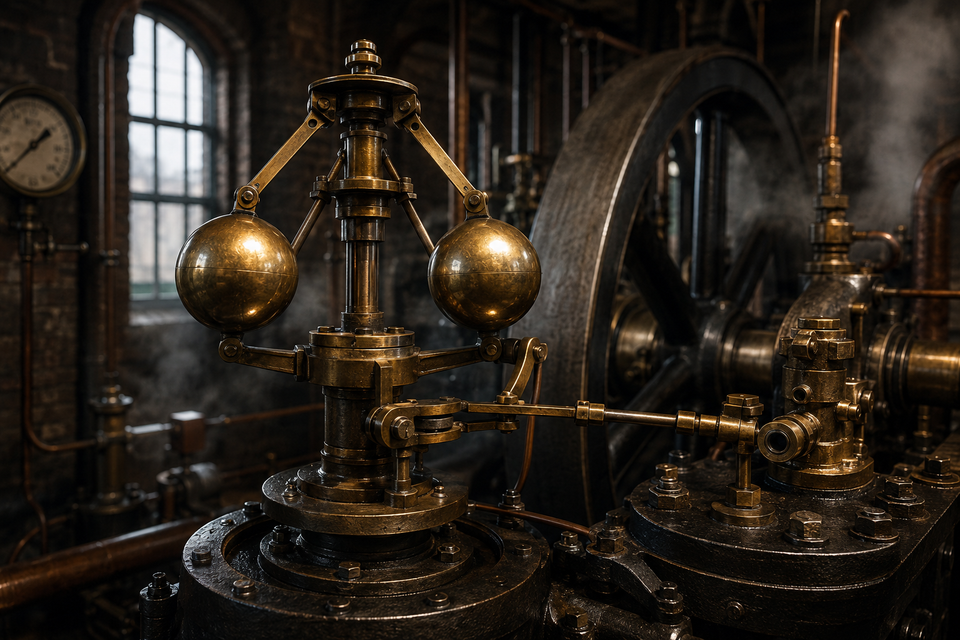
The Governor Nobody Notices
When James Watt refined the steam engine, the most important innovation was not producing more power. Steam engines already had power. Their problem was that power without control quickly became destruction.
His answer was remarkably simple.
A pair of spinning metal spheres mounted on a vertical spindle and mechanically connected to the steam valve. As the engine accelerated, centrifugal force pushed the spheres outward, gradually reducing the steam entering the engine. As it slowed, gravity pulled them back, opening the valve again. No engineer observed the engine. No committee debated the correct response. No report was generated. The machine continuously corrected itself because the mechanism responsible for correction remained physically connected to the machine itself.
The governor did not attempt to anticipate future conditions or interpret patterns over time. It did not rely on analysing trends or constructing representations of what might happen next. There were no dashboards, no summaries, and no abstractions standing between the machine and its response. Instead, it operated by continuously narrowing the gap between what was happening and how the system adjusted, ensuring that correction remained directly tied to reality.
That simplicity explains why the same principle still appears throughout engineering. Railway signalling continuously reacts to the position of trains. Anti-lock braking systems sample wheel speed hundreds of times every second. Modern aircraft monitor thousands of parameters while in flight, making countless tiny corrections that passengers never notice. Electrical grids constantly rebalance supply and demand. None of these systems waits for a monthly review before responding.
They remain stable because they never stop listening to reality.
Sampling Reality
There is another principle hidden inside these systems.
Every control system samples reality.
The faster the environment changes, the more frequently reality must be sampled. A thermostat checks the temperature continuously because the room does not wait politely for the next scheduled measurement. Aircraft flight computers sample their environment hundreds of times each second because air does not negotiate. Industrial robots continuously verify position because a millimetre of drift becomes a defective product.
Factories understand this instinctively.
Modern manufacturers regularly stress their own supply chains, not because they expect failure but because they refuse to confuse assumptions with facts. Suppliers are temporarily replaced. Logistics routes are altered. Components are sourced differently. Inventory levels are deliberately challenged. The purpose is not to create disruption. It is to verify that yesterday's understanding still matches today's reality.
A supply chain that is never exercised gradually loses its connection to the physical world and begins to exist primarily as a spreadsheet, where assumptions remain unchallenged and dependencies are treated as stable simply because they have not been tested.
An emergency procedure that is never rehearsed follows a similar path, slowly transforming from a practical capability into a set of instructions that appear complete on paper but have never been validated under real conditions. In the same way, a resilience plan that is never tested does not strengthen the organisation’s ability to respond to disruption. Instead, it reinforces a belief that preparedness exists without ever confirming it.
Over time, this creates a subtle but important shift. The system itself has not become more resilient in any meaningful sense. What has increased is the organisation’s confidence in its own assumptions, even though those assumptions have not been exposed to reality.
The Luxury of Distance
Organisations often travel in the opposite direction.
Every additional reporting layer is intended to improve visibility. Every dashboard promises greater transparency. Every governance forum exists to increase control. Yet something curious happens as organisations mature.
Reality slowly disappears behind its own representations as direct experience is gradually replaced by layers of abstraction. Customer conversations are translated into survey results, engineering work is reduced to delivery metrics, operational pain is condensed into PowerPoint slides, and production incidents are summarised into executive briefings.
Reality is no longer experienced directly. It is translated, condensed, colour-coded and sanitised before it reaches the people expected to make decisions.
The irony is that each layer is introduced with good intentions. Nobody deliberately designs an organisation that loses contact with reality. The detachment happens gradually because every abstraction appears to make the organisation easier to manage.
Until one day leaders discover they are no longer steering the organisation. They are steering reports about the organisation.
The larger an organisation becomes, the greater the temptation to replace experience with representation.
Distance feels efficient because it removes friction. It also removes sensation. Like a damaged nerve, the organisation eventually stops feeling the very signals that once allowed it to correct itself.
When the Roadmap Replaces the Road
Perhaps nowhere is this more visible than in the modern obsession with roadmaps. Roadmaps are valuable. They create direction, alignment and shared expectations. They are necessary because no complex journey begins without a map.
But every experienced engineer understands something equally important.
The map is not the road.
A road map cannot predict a bridge that collapsed overnight. It cannot reveal a landslide around the next bend, unexpected roadworks or an accident blocking the motorway. Drivers reach their destination because they continue observing the road itself rather than blindly defending the accuracy of the map.
Somewhere along the way organisations reversed this relationship.
Once approved, the roadmap becomes sacred. Teams spend months explaining why reality failed to respect the roadmap instead of asking whether the roadmap still reflects reality. New information is treated as an inconvenience. Unexpected customer behaviour becomes scope creep. Technical discoveries become delays rather than learning.
Eventually something subtle but dangerous happens.
The roadmap gradually takes on a weight that exceeds its original purpose. Instead of serving as a guide that adapts to changing conditions, it becomes a fixed reference point that teams feel compelled to defend. As new information emerges, it is often interpreted through the lens of how it affects the roadmap rather than whether it reveals something important about the system itself.
Over time, the representation begins to overshadow the reality it was meant to describe. Decisions are shaped by how well they align with the plan rather than how accurately they respond to current conditions. Adjustments become harder to justify, not because they lack merit, but because they disrupt the narrative that has already been agreed upon.
This is the point at which organisations begin to steer using an outdated understanding of their environment, continuing to follow a path that no longer reflects the terrain they are actually navigating.
Governance Without Contact
Governance suffers from the same disease.
Its original purpose was never to replace reality. Good governance existed to ensure that reality reached decision-makers quickly, honestly, and without distortion, so that action could follow while the information was still relevant.
Instead, many organisations have gradually transformed governance into a protective layer that separates leadership from operational truth. What was intended as a conduit has become a filter, and over time that filter has grown thicker and more complex.
Reports begin to stand in for conversations, removing nuance and context. Dashboards take the place of direct observation, reducing lived experience to a set of indicators. Risk registers catalogue potential issues without necessarily improving the organisation’s ability to respond to them. Steering committees convene regularly, yet often operate at a distance from the systems they are meant to guide.
As a result, the organisation becomes highly efficient at documenting reality while simultaneously becoming slower and less capable of responding to it. Information continues to flow, but it arrives later, more processed, and often stripped of the urgency that originally accompanied it.
The consequences follow a familiar pattern. As feedback loops lengthen, organisations attempt to compensate by adding more governance. Additional approvals are introduced to reduce uncertainty. More reviews are scheduled to increase oversight. Alignment meetings multiply in an effort to maintain coherence. Checkpoints are added to ensure nothing is missed.
Each of these additions is intended to increase control, and in isolation each appears reasonable. However, taken together they extend the distance between reality and the people expected to act on it. The organisation begins to rely more heavily on its representations of reality than on reality itself.
Over time, this creates a paradox. The organisation appears increasingly controlled, with more structure, more visibility, and more formal oversight, yet it becomes progressively less controllable in practice because its ability to respond in a timely and informed manner has been eroded.
The Physics Never Changed
Physics has never cared about organisational charts, and it has never adapted its behaviour to accommodate reporting cycles or governance structures. Systems that operate in the physical world must respond to conditions as they change, not as they are periodically reviewed.
Consider what would happen if a pilot only received updated instrument readings once every quarter. The aircraft would never leave the runway, because safe flight depends on continuous awareness of altitude, speed, and orientation. The same principle applies to an electrical grid. If supply and demand were balanced only once per week, the system would fail long before operators had time to convene and discuss the discrepancy. Railway signalling follows the same logic. Safety depends on constant awareness of train positions, not on a weekly review of where trains were expected to be.
No engineer would design systems in this way because the consequences are immediately obvious. Stability requires continuous feedback, and continuous feedback requires frequent sampling of reality.
Yet many organisations operate as though these constraints do not apply to them. They effectively sample their own performance on a quarterly basis, review strategy every six months, and reconsider priorities once a year. Between these intervals, they rely on assumptions that may already be outdated.
When competitors appear to move faster, the explanation is often framed as superior execution or better decision-making. In reality, the difference is frequently more fundamental. Competitors are not necessarily making better decisions. They are making decisions based on more recent information.
The Uncomfortable Reality
James Watt did not solve control by expanding oversight or adding layers of supervision. His solution worked because the mechanism responsible for correction remained inseparably connected to the engine itself, continuously responding to what was actually happening rather than what was reported.
Modern organisations often move in the opposite direction. With each passing quarter, they invest in more elaborate control structures, richer dashboards and increasingly sophisticated governance processes. These additions are intended to improve clarity and control, yet they gradually introduce distance between decision-makers and the reality they are meant to influence.
Over time, this distance becomes difficult to notice. Reports grow more polished, dashboards consistently signal stability, and roadmaps appear to progress exactly as planned. The organisation becomes highly effective at representing its own performance, while becoming less capable of sensing when that representation no longer reflects the underlying system.
By the time discrepancies become visible, they are often no longer small deviations but structural misalignments that have been developing unnoticed. The organisation has not lost control suddenly. It has slowly replaced direct contact with reality by increasingly refined interpretations of it.
And in that quiet substitution, control was never strengthened. It was gradually surrendered.


Member discussion