Friday Fun: The Corporate Archaeologist
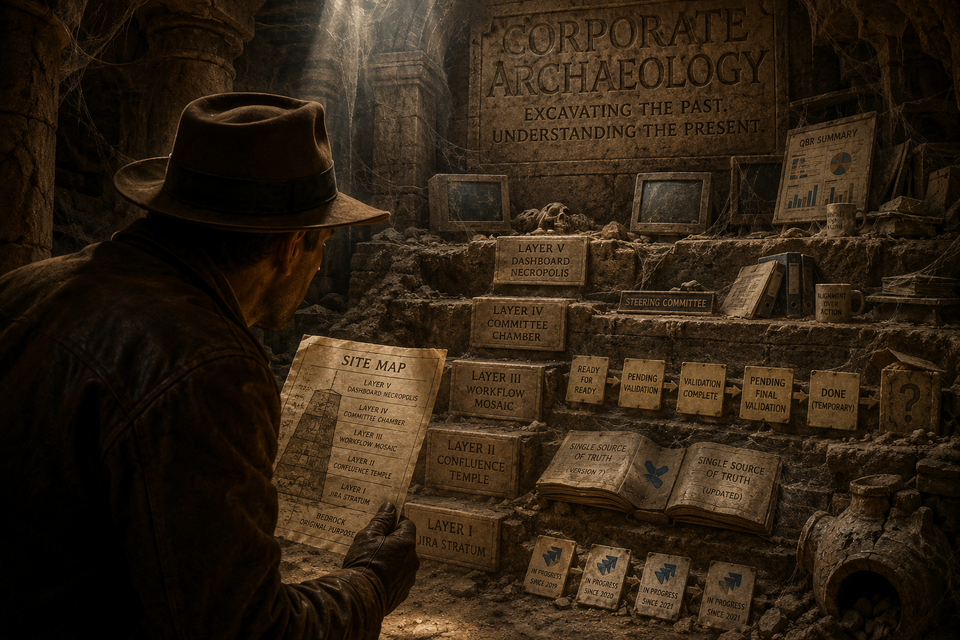
Excavating Civilisations
Archaeology is often misunderstood as the search for spectacular discoveries. Popular imagination expects hidden temples, golden masks and forgotten treasures waiting beneath centuries of dust. The reality is considerably less theatrical. Most excavations begin with fragments: a broken amphora, the remains of a workshop, a collapsed wall or the worn stones of an ancient road. From these ordinary objects, archaeologists reconstruct how entire civilisations lived, traded, governed and eventually disappeared. Every artefact matters, but none explains itself. Only when enough pieces are assembled does the system behind them begin to emerge.
One lesson appears repeatedly throughout history. Civilisations are not built in a single generation, and neither are they buried in one. Every generation inherits what came before, solves the problems immediately in front of it and leaves behind another thin layer for those who follow. A repaired wall remains standing after the threat has passed. A temporary road becomes permanent. A defensive structure survives long after the enemy has disappeared. Centuries later, archaeologists do not excavate individual decisions. They excavate accumulated history.
The same principle, I recently discovered, applies surprisingly well to technology companies.
The First Layer
The excavation began with what specialists identified as the Upper Agile Period. Hundreds of Jira tickets occupied the first layer, many preserved in the remarkably durable state known as In Progress. Carbon dating suggested several originated years earlier, although precise measurements proved difficult because ownership had survived multiple reorganisations, changing product strategies and successive engineering managers. Some tickets referred to services that no longer existed. Others depended upon colleagues whose names had become part of corporate folklore rather than the company directory.
The surrounding ecosystem revealed an equally sophisticated classification system. Work progressed through Ready for Development, Development Complete, Ready for QA, QA Complete, Pending Validation, Validation Approved, Ready for Deployment and several additional stages whose practical distinction had quietly disappeared over time. Like many ancient inscriptions, the language remained perfectly preserved while its original meaning had faded.
Nothing about this layer suggested incompetence. On the contrary, every additional state had almost certainly solved a real coordination problem when it was introduced. The interesting observation was simply that every solution had remained in place, long after the circumstances that justified it had disappeared.
Sediment had begun to form.
The Temple of Documentation
The next layer revealed an enormous library built entirely from Confluence pages. Nearly every document described itself as the definitive source of truth. Curiously, neighbouring documents expressed equal confidence while describing entirely different realities.
Architectural diagrams illustrated platforms retired years earlier. Operating procedures directed engineers towards teams that no longer existed. Onboarding guides carefully explained development environments abandoned during previous cloud migrations. Despite this, the library remained meticulously preserved. Nothing had been discarded. New knowledge had simply been deposited alongside old knowledge until both became equally difficult to distinguish.
Historians frequently encounter temples whose rituals outlived the beliefs that created them. Generations continued performing ceremonies because the ceremony itself became evidence that it must still matter. Looking around this remarkable archive, the comparison became increasingly difficult to ignore. Documentation had gradually shifted from enabling engineering to preserving its own history.
Another layer had quietly settled.
The Chamber of Deliberation
Deeper excavation uncovered a ceremonial complex dedicated to decision making. Successive generations had added steering committees, governance forums, architecture reviews, stakeholder alignments and executive checkpoints, each responding to a genuine challenge faced by the organisation at a particular point in its evolution.
The inscriptions proved particularly revealing. Needs Executive Visibility. Pending Stakeholder Alignment. Requires Cross-Functional Review. Awaiting Final Confirmation. Researchers debated whether these represented operational instructions or ritual phrases intended to reassure participants that progress was occurring somewhere beyond immediate observation.
What fascinated the expedition was not the existence of these governance structures. Growing organisations require coordination. Complexity inevitably demands communication. The surprising discovery was that every generation appeared to have added another layer of governance without removing the previous one. Coordination expanded in the same way ancient cities expanded: by building on top of existing foundations until nobody could remember where the original street plan had been.
The civilisation had not designed bureaucracy.
It had accumulated it.
The Dashboard Necropolis
The deepest layer reflected not how the organisation created value, but how it observed itself creating value. Dashboards summarised operational dashboards, which themselves aggregated metrics originating from smaller dashboards maintained by individual teams. Weekly reports generated monthly summaries that fed governance meetings before returning as new reporting requirements for operational teams.
The engineering behind these reporting systems was impressive. Considerable effort had been invested in collecting, transforming and presenting information. Yet the expedition repeatedly encountered the same question. Which measurements directly influenced customer outcomes, and which existed primarily because previous measurements already existed?
Ancient administrations often reached a point where managing the empire required more effort than expanding it. Records became increasingly sophisticated while roads deteriorated and trade slowed. Administration was no longer supporting production. It had become a system worthy of administration in its own right.
The same pattern appeared to exist here.
Reading the Sediment
It would be easy to laugh at these discoveries because every engineer has encountered forgotten documentation, obsolete workflows, mysterious approval chains and dashboards that nobody remembers creating. They make excellent stories precisely because they are so familiar.
The deeper lesson, however, is neither humorous nor accidental.
Geologists understand that mountains are rarely created by dramatic events alone. Most landscapes emerge because countless small deposits accumulate faster than erosion removes them. Organisations follow remarkably similar laws. Every approval reduced risk. Every workflow state reduced uncertainty. Every document preserved valuable knowledge. Every dashboard answered an important question. None of these decisions were irrational. Most reflected thoughtful leadership responding to genuine circumstances.
The difficulty is that organisations invest enormous energy in creating structure and remarkably little in dismantling it. Processes rarely disappear when the original problem disappears. Governance almost never contracts once risk has diminished. Documentation continues expanding long after the systems it describes have vanished. Every generation inherits the accumulated residue of previous generations before adding another layer of its own.
Eventually, engineers discover that they are no longer building upon foundations.
They are excavating them.
The Living Ruins
Museums preserve artefacts because civilisation has already moved beyond them. Roman roads deserve protection because modern transport no longer depends upon them. Steam engines belong in carefully maintained collections because industry found better ways to generate power. Preservation makes perfect sense once something has become history.
Technology companies often reverse the logic. They preserve workflows that solved forgotten problems, governance created for crises that no longer exist and reporting structures whose original audience has disappeared. Removing them feels risky. Adding one more layer feels safe. Over time, the organisation becomes increasingly sophisticated at preserving its own past while progressively less capable of adapting its future.
Archaeologists excavate ruins because they expect them to remain exactly as they are.
Organisations should never aspire to become that easy to study.
The moment your engineers require archaeological methods to understand how work gets done, history is no longer something beneath the company. It has quietly become the company itself.




Member discussion