Manufrance or When Theatre Replaces Reality
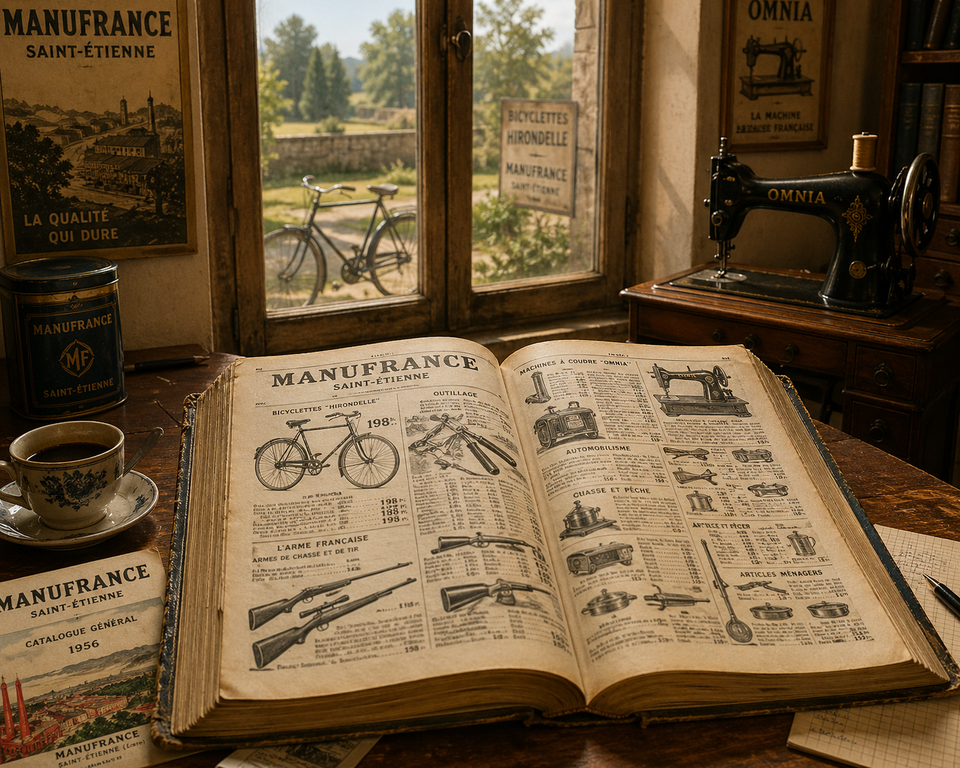
Some systems do not collapse. They get preserved until they become irrelevant.
Manufrance did not collapse when it was dismantled. By then, it had already been dead for years.
The dismantling remains visible, dramatic, easy to narrate. It fits a story of loss. It also distracts from the only part that matters: the long, silent drift that made the end inevitable.
What matters sits earlier, when the system worked.
I. A SYSTEM AHEAD OF ITS TIME
Manufrance did not resemble a fragile industrial actor that failed to keep up. It operated, in many respects, a century ahead of its time.
Long before the term existed, it had built a full direct‑to‑consumer model. It designed its products, manufactured them in‑house, distributed them nationwide through a catalogue, and owned the relationship with its customers.
This did not describe a factory. It described a fully integrated commercial and industrial platform where production, distribution, and demand remained tightly connected.
In modern terms, Manufrance stood closer to Amazon than to a traditional manufacturer, without digital infrastructure, global logistics networks, or venture capital. Yet unlike modern platforms, it cultivated a human bond: households treated it as a reliable partner, not a commodity supplier. Only engineering discipline, organisational clarity, and a coherent operating model, reinforced by trust, held it together.
That is the uncomfortable starting point: a powerful system that should have endured, and still disappeared.
II. HISTORICAL FOUNDATION : BUILDING A NATIONAL SYSTEM
A minimum of historical grounding clarifies the scale of what was achieved.
Manufrance emerged in Saint‑Étienne at the end of the 19tth century, in a region shaped by metallurgy, arms manufacturing, and industrial discipline. It was built under the leadership of Étienne Mimard, alongside Pierre Blachon, who transformed scattered capabilities into a single, coherent enterprise.
By the early twentieth century, the company had removed intermediaries. Through its catalogue, it reached customers directly across France. Orders, fulfilment, and delivery followed internal orchestration. Design, production, and distribution formed one continuous chain.
This did not amount to incremental progress. It represented structural innovation.
While most actors remained fragmented, producers here, distributors there, Manufrance integrated the entire system, reduced distance between demand and production, and established early feedback loops between the market and the factory.
At scale, the catalogue functioned as an interface with the market. It connected intent, demand, and delivery in a single channel.
At its height, reached in the mid‑20th century, broadly in the 1950s–1960s, Manufrance employed several thousand workers (on the order of 4,000–5,000) and served hundreds of thousands of customers across France. Its catalogue reached deep into households, becoming a reference point for access to quality goods.
The catalogue itself was an industrial artefact: hundreds of pages, tens of thousands of references, and a circulation that ran into very large national volumes over time. It was both a sales engine and a market interface.
This was not a marginal player. It was a national system with real economic and social weight.
III. A COHERENT ECOSYSTEM
At its peak, Manufrance operated as a coherent ecosystem rather than a collection of departments.
It aligned brand, product, supply chain, and distribution. It created an environment where employees developed craft, stability, and progression within a unified system. Work connected to outcomes; outcomes connected to the market.
It also built something rarer: a privileged relationship with its customers.
Across a large part of the country, people knew they could access high‑quality products at fair prices, delivered within a predictable and trusted timeframe, often around a week. Reliability, accessibility, and quality formed a consistent promise.
Volumes reflected that trust. Orders flowed continuously, and the system scaled to handle national demand long before modern logistics frameworks existed.
This was not just commerce. It was a culture. A Manufrance culture, shared between the company and its customers.
This coherence created strength. It also created the conditions for inertia.
Manufrance did not fail because it lacked capability. It failed because a capable system stopped evolving.
IV. THE BREAK : WHEN THE WORLD MOVED
The environment did not collapse. It shifted. And it shifted in ways that exposed Manufrance’s model.
Generalist catalogues lost ground to focused offers. Consumers moved towards clearer positioning, faster fulfilment, and sharper pricing. Cycle times shortened. Assortments tightened. Decision loops accelerated.
Actors such as La Redoute and 3 Suisses did not invent a new paradigm. They executed the existing one better: fewer categories, stronger curation, quicker turnover, and tighter coupling between demand signals and supply.
Manufrance held every structural advantage to respond: infrastructure, brand, and customer reach.
But its strength became its constraint. A heavy, integrated system optimised for breadth struggled to pivot towards focus and speed. What had once created leverage now imposed drag.
The missing element lay elsewhere: willingness to change the model.
This is the paradox. The founding mindset had been to make every individual inside the company a contributor and a differentiator, to give people the means and the responsibility to make a difference. Yet over time, that same system produced the opposite behaviour: resistance to change, defence of the status quo, and a gradual loss of initiative. A company built to empower ended up preserving itself. How that inversion takes hold remains difficult to pinpoint, but once it does, it spreads. And it spreads until contribution gives way to protection, and evolution becomes a threat.
Instead of using its position as leverage, the organisation chose continuity. It preserved structure, habits, and identity, rather than redefining them.
At that moment, the system began to decouple from reality, and competitors simply out‑executed it on its own terrain.
V. PRESERVATION OVER ADAPTATION
The failure did not start with crisis. It started with a decision.
Keep the model.
Keep the habits.
Keep the identity intact.
This decision was not isolated. It became broadly aligned, employees, executives, and even the main shareholder. In a peculiar financial setup where the city held a central stake, incentives blurred: the shareholder base overlapped with the workforce and voters. Preservation gained consensus. Challenge lost ground.
This often passes for respect of tradition. In practice, it marks the point where a system protects itself instead of adapting to its environment.
From within, this choice rarely faces opposition. It is reinforced.
Internal actors align around preservation. Narratives emerge to justify continuity. Warning signals are softened, reinterpreted, or ignored.
Even structures meant to protect the system like unions, governance bodies, internal stakeholders, can unintentionally accelerate the disconnect. By defending stability at all costs, they deepen the gap between the organisation and its environment.
The ecosystem that once enabled growth now generates resistance. The more successful the past, the stronger the attachment to it. Stability becomes an objective in itself, detached from relevance.
VI. THE COLLAPSE OF FEEDBACK LOOPS
As preservation takes hold, feedback loops degrade.
Customer signals surface but do not drive decisions. Operational constraints receive discussion without resolution. Strategic choices slow, fragment, or disappear.
The organisation continues to operate, yet loses its ability to adapt.
At this stage, the system does not fail visibly. It drifts, quietly, persistently, and without corrective force.
This pattern mirrors a known dynamic in evolutionary psychology: groups that over‑optimise for internal cohesion can become maladaptive. Alignment, stability, and shared identity increase, while responsiveness to the environment decreases. Selection pressure shifts from external reality to internal acceptance. The group becomes fit for itself, and progressively unfit for the world.
VII. WHEN THEATRE REPLACES REALITY
When reality becomes uncomfortable, organisations compensate rather than confront it.
Meetings multiply. Narratives strengthen. Positions harden.
At the same time, the denial becomes visible beyond the organisation itself. Social movements emerge, claiming the company will survive. National campaigns attempt to preserve parts of it through public support or small private investors, often drawn from the very customers who once trusted the brand.
These efforts do not signal recovery. They signal disconnection. Every warning sign is present, yet interpreted as proof that the system still holds.
Delusion does not replace reality. It delays its consequences. The objective shifts from solving constraints to maintaining coherence in the story.
Activity continues. Products ship. Roadmaps update. Decisions occur. None of it reconnects to reality.
At this stage, resistance is no longer passive. It can become active.
Even improvement efforts get absorbed by the system and distorted. Attempts to modernise, such as the digitalisation of order processing and shipping, are executed poorly, sometimes deliberately so. Instead of reducing friction, they amplify it. Delays multiply, often by a factor of three or four, and the company’s image degrades further.
The system protects itself by proving that change does not work.
This is not failure in the traditional sense. It is a system that continues to run after losing its capacity to respond.
VIII. THE MYTH OF DISMANTLING
By the time dismantling occurs, the outcome has long been decided.
The system no longer aligns with its environment. Internal mechanics no longer support meaningful trade‑offs. The market has moved beyond its operating model.
In that final phase, a second layer of theatre appears: the story of the collapse is rewritten. Employees, executives, and shareholders point to causes elsewhere like competition, policy, markets, while the internal drift remains unaddressed.
Dismantling does not cause the collapse. It exposes it. And the narratives built afterwards complete the delusion.
IX. MODERN PARALLELS : FRANCE AND STARTUPS
This pattern does not belong to history. It repeats.
Across many established French companies, the same illusion persists: the world has not fundamentally changed. Structures remain, habits endure, and reality receives negotiation rather than confrontation. Absorption or decline follows, often attributed to external pressure.
The cause remains internal: refusal to adapt while preserving the appearance of control.
At the opposite end of the spectrum, the IT startup and scale-up ecosystem mirrors the same mechanism through different inputs.
Funding replaces reality as the primary signal. Growth metrics expand. Narratives strengthen. Inexperienced teams operate within distorted feedback loops, optimising for perception rather than resilience.
The system appears successful, until constraints arrive.
When funding tightens or expectations shift, the gap between narrative and reality becomes visible. The organisation has built motion without substance.
Then it collapses.
Different context. Same mechanism.
Tradition protects the past.
Capital inflates the present.
Both disconnect the system from reality, and allow those involved to shift responsibility elsewhere, building narratives and legends to explain a failure they refuse to own.
X. THE REAL LESSON
Manufrance does not illustrate industrial decline or the loss of savoir‑faire. It shows something more uncomfortable: capability remained, but the will to use it eroded. Over time, the organisation replaced adaptation with preservation, and reality with theatre.
From that point, failure does not occur immediately. The system continues to operate, which creates the illusion of health. Work gets done, products ship, decisions are taken. Yet the essential link to the environment has weakened. Feedback no longer drives behaviour; it is filtered, softened, or ignored. By the time the failure becomes visible, the conditions required to reverse it have already disappeared.
This is why the end is so often misunderstood. Organisations are rarely destroyed by external forces alone. They drift into a state where internal alignment takes precedence over external fitness. Consensus forms around stability, incentives reinforce preservation, and the system becomes increasingly optimised for itself. In evolutionary terms, it remains coherent internally while losing its ability to respond to the world.
The consequence extends beyond efficiency. What ultimately breaks is trust, the same trust that once made customers treat the company as a partner rather than a commodity supplier. When reliability degrades, when change is performed rather than delivered, and when signals from reality are consistently overridden, that trust erodes. Once it is gone, no amount of internal optimisation can restore the system’s relevance.
Manufrance did not collapse when it was dismantled. It was protected into irrelevance long before, and it continued to operate anyway.

Member discussion