Friday Fun: The IT Department as a Medieval Kingdom
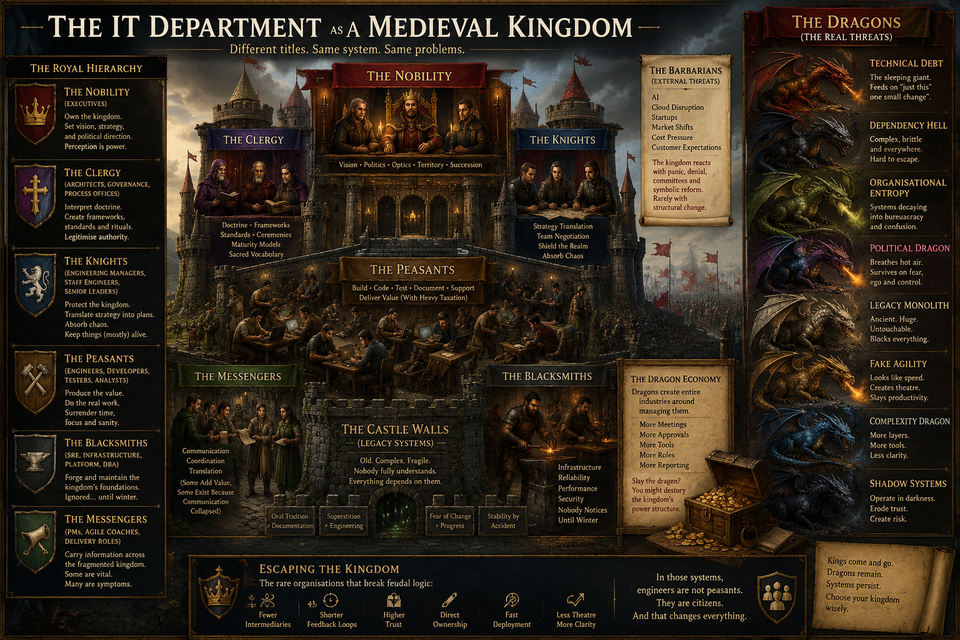
Modern IT departments often claim to operate like high-performance engineering organisations.
Most actually resemble medieval kingdoms.
Not metaphorically. Structurally.
Once you stop looking at org charts and start observing behaviour, the resemblance becomes difficult to ignore.
The castle still exists.
The hierarchy still exists.
The rituals still exist.
Even the language evolved without changing the underlying system.
We simply replaced crowns with job titles and swords with slide decks.
At the top sits the nobility.
Executives.
Their primary activity is not production. It is diplomacy, optics, territory management, and succession preservation.
Like medieval courts, perception matters as much as reality.
A failing quarter can survive with a strong narrative.
A healthy system can be destabilised by political insecurity.
A technically excellent leader can become dangerous simply because they expose structural weakness.
The court rewards confidence, symbolism, and coalition building.
Not necessarily competence.
Especially during unstable periods.
Then comes the clergy.
Architects, governance boards, transformation offices, process specialists.
Their role is to interpret doctrine.
They produce frameworks, standards, ceremonies, maturity models, and sacred vocabulary that ordinary engineers are expected to follow.
Few people fully understand the doctrine.
Nobody wants to openly challenge it.
Everyone pretends it creates order.
In reality, much of it exists to legitimise authority.
The medieval church sold indulgences.
Modern corporations sell “alignment”.
Both reduce anxiety while preserving hierarchy.
Below them sit the knights.
Engineering managers, staff engineers, senior product leaders.
This class actually keeps the kingdom functional.
They travel constantly between strategic fantasy and operational reality.
They translate impossible executive ambitions into vaguely survivable delivery plans.
They negotiate peace treaties between teams.
They absorb chaos before it reaches the throne.
Over time, many become exhausted.
Not because engineering is difficult, but because the organisational system continuously generates avoidable instability.
The knight class eventually splits in two categories:
- those who still protect the kingdom
- those who learned court politics is safer than battle
The second group usually gets promoted faster.
Then we arrive at the peasants.
The engineers.
Ironically, the only group directly producing value.
Modern companies love saying “engineers are our greatest asset” while simultaneously surrounding them with enough process overhead to recreate feudal taxation.
Status meetings.
Alignment meetings.
Pre-groomings before groomings.
Approval chains.
Ticket rituals.
Reporting rituals.
Story point theology.
A medieval farmer surrendered grain.
A modern engineer surrenders cognitive bandwidth.
The outcome is similar.
Production slows while administration expands.
Then there are the blacksmiths.
SREs, infrastructure engineers, platform teams, database operators.
The people nobody notices until winter arrives.
In stable periods, leadership questions their cost.
Their work appears invisible.
Their impact seems abstract.
Then a major outage happens.
Suddenly the kingdom remembers food, roads, water, and steel matter more than presentation slides.
The blacksmith class lives in permanent contradiction:
essential to survival,
rarely central to prestige.
The irony is that modern companies increasingly depend on complex distributed systems while culturally rewarding visibility over resilience.
The people maintaining stability often receive less recognition than the people narrating instability.
And of course, every kingdom has messengers.
Project managers, agile coaches, delivery coordinators.
Some are genuinely useful.
Others exist because communication collapsed so completely that entire professions emerged to compensate for organisational fragmentation.
This is one of the clearest signs of systemic entropy.
Healthy systems reduce translation layers.
Diseased systems multiply them.
At some point, organisations create people whose sole purpose is coordinating the coordination mechanisms created to manage previous coordination failures.
The bureaucracy becomes self-sustaining.
Like medieval taxation systems, it survives regardless of productivity.
Then comes the most fascinating parallel of all:
the castle walls.
Legacy systems.
Every kingdom inherits infrastructure built by previous generations.
Nobody fully understands it anymore.
Documentation disappeared long ago.
The original builders are either gone or mythologised.
Yet the entire kingdom depends on these foundations continuing to hold.
So organisations develop strange superstitions:
“Never touch this service.”
“Only Jean-Michel understands that database.”
“We deploy only on Thursdays.”
“Restarting fixes it somehow.”
This is not engineering anymore.
This is oral tradition.
And then there are the dragons.
The problems everybody knows exist, everybody fears, everybody feeds indirectly… and nobody truly wants to confront because the kingdom quietly reorganised itself around their existence.
Technical debt.
Dependency hell.
Organisational entropy.
Political executives.
Legacy monoliths.
Toxic top performers.
Shadow systems.
Fake agility.
Runaway complexity.
A good dragon is not merely dangerous.
It reshapes the behaviour of the kingdom around it.
Villages stop expanding.
Roads get rerouted.
Taxes increase.
Fear becomes normalised.
Entire professions appear to “manage the dragon situation”.
Modern companies do the same.
One unstable legacy system suddenly creates:
- governance boards
- CAB meetings
- deployment freezes
- release managers
- extra approvals
- risk committees
- manual QA armies
The dragon is no longer a problem.
It became part of the economy.
And then comes the darkest part:
some kingdoms secretly need the dragon.
Because slaying it would also destroy:
- political influence
- budget empires
- specialist monopolies
- managerial justification
- entire organisational layers
Which is why some companies spend 10 years “addressing technical debt” without reducing any.
The dragon became institutionalised.
Startups often begin as dragon slayers.
Over time, successful startups frequently become kingdoms breeding new dragons themselves.
That transition is almost a law of organisational gravity.
Eventually barbarians arrive at the gates.
Usually called:
AI,
cloud migration,
digital transformation,
cost optimisation,
or “startup disruption”.
The kingdom reacts exactly like medieval societies reacted to external threats:
panic,
denial,
symbolic reform,
internal blame,
and emergency committees.
Rarely structural simplification.
Because simplification threatens existing power structures.
And this is the real lesson.
Most organisational dysfunction does not survive because people are stupid.
It survives because the system protects itself.
Feudal systems were not inefficient by accident.
They were stable power-distribution mechanisms.
Modern corporate structures often behave the same way.
Which explains why companies can simultaneously:
- hire smart people
- buy modern tooling
- adopt agile frameworks
- launch transformation programmes
- create platform teams
…and still move slower every year.
The kingdom modernised its banners.
Not its operating model.
The truly interesting organisations are the rare ones that escaped feudal logic.
You can usually recognise them quickly.
Fewer intermediaries.
Shorter feedback loops.
Higher trust.
Direct ownership.
Faster deployment.
Less theatre.
Less symbolic process.
More operational clarity.
In those systems, engineers are not peasants.
They are citizens.
And that changes everything.





Member discussion