Monday Myth: You Cannot Declare a Start-up Nation into Existence
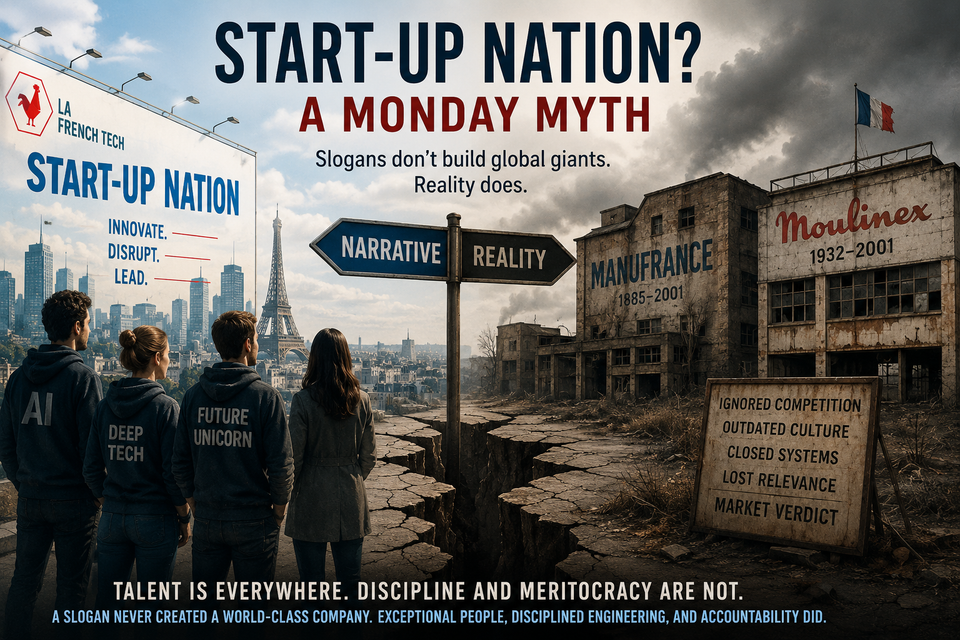
A slogan never created a world-class company.
France has produced some of the finest engineers, mathematicians, and scientists in the world.
From aerospace to nuclear energy, high-speed rail to luxury manufacturing, the country has repeatedly demonstrated its ability to design and build systems of extraordinary sophistication. The technical foundations exist, the intellectual capital remains exceptional, and the entrepreneurial energy is very real.
Yet one uncomfortable question persists. Why does a country with such depth and capability produce comparatively few technology companies with lasting global impact?
The answer does not lie in a shortage of talent. It lies in the structures, incentives, and cultural habits that too often reward appearance over execution.
The Myth of the Start-up Nation
When the expression "Start-up Nation" entered the political vocabulary, it carried an attractive and ambitious vision. The phrase suggested a France that would embrace entrepreneurship, risk-taking, speed, and innovation.
The aspiration was legitimate. The assumption behind it was flawed.
Innovation does not emerge because a nation adopts the right language. It does not appear because incubators multiply, subsidies increase, and conferences celebrate disruption. Nor does it materialise when consultants produce increasingly elaborate slide decks describing how transformation should occur.
Innovation emerges when exceptional people solve meaningful problems within systems that reward competence, ownership, and disciplined execution.
France Has Everything Required
France possesses remarkable advantages. Its education system continues to produce world-class engineers and mathematicians. Its research institutions remain strong, its infrastructure sophisticated, and its access to both public and private funding substantial.
On paper, the ingredients are all present. History confirms that the country can build complex and enduring systems when engineering discipline and industrial ambition align.
Yet ingredients alone do not guarantee outcomes. A watchmaker and a bureaucrat may possess the same parts. Only one assembles a functioning mechanism.
Closed Systems and the Illusion of Mastery
The French technology ecosystem often reproduces the very bureaucratic habits entrepreneurship was meant to escape. Hierarchy displaces ownership, credentials overshadow competence, consensus dilutes accountability, and process gradually takes precedence over outcomes.
This tendency becomes especially visible in certain founder-led and family-controlled businesses. Long tenure and strong loyalty can create stability, but they can also produce closed ecosystems in which the same individuals reinforce one another's assumptions for years. Familiarity begins to masquerade as expertise, and internal consensus acquires greater authority than external evidence.
A broader cultural pattern can deepen the problem. Some organisations remain surprisingly inward-looking, engaging only marginally with international practices and operating with limited confidence in English. Rather than comparing themselves with the strongest organisations in the world, they benchmark against their immediate surroundings. Confidence grows as external awareness declines.
Such systems may preserve the comforting belief that they understand their market better than anyone else. That belief can survive for years, until global competition, technological change, or rising customer expectations expose the gap between internal narratives and external reality.
History Has Already Delivered This Lesson
French industrial history offers several sobering examples. Manufrance and Moulinex once stood as symbols of national capability and technical excellence. Both built respected brands, loyal workforces, and powerful identities.
Neither failed because of a lack of intelligence or commitment. Both struggled because historical success gradually replaced external awareness. Assumptions that had served well in earlier decades remained largely unchallenged while markets, competitors, and customer expectations evolved.
Their decline illustrates a broader lesson. Past achievements deserve respect, but they provide no protection against complacency. When organisations spend too long validating their own beliefs rather than confronting changing realities, the eventual correction rarely arrives gently.
Progress Is Real, but the Gap Remains
To be fair, France has made substantial progress over the past decade. Venture capital expanded rapidly, dozens of companies reached unicorn status, and programmes such as the French Tech Next40/120 now showcase 120 scale-ups identified as potential global leaders. The 2025 cohort alone generated roughly €10 billion in revenue, employed more than 42,000 people, and reported extensive international activity.
These achievements deserve recognition. France has moved far beyond the fragmented ecosystem of a decade ago and has produced genuine success stories, including companies such as Doctolib, Qonto, Back Market, and Mistral AI.
Yet perspective remains essential. Venture funding peaked at approximately €13.5 billion in 2022 before declining to around €7.8 billion in 2024, while investors increasingly shifted their focus from growth at any cost to sustainable profitability. More importantly, despite clear progress and significant public support, France has not yet produced a technology company with the global scale and enduring dominance of Amazon, Google, Microsoft, or NVIDIA.
The point is not to deny the progress. The point is to recognise the distance between encouraging momentum and the ambition implied by the Start-up Nation narrative. Activity has increased dramatically, but the ultimate test remains unchanged: can the system consistently transform exceptional talent into companies that shape global markets rather than merely participate in them?
Subsidies and Narratives Cannot Replace Execution
Public support can accelerate promising initiatives, and France has invested heavily in entrepreneurship and innovation. These efforts have undoubtedly created opportunities.
What subsidies cannot do, however, is manufacture excellence. No tax credit, incubator, or strategic programme can substitute for exceptional talent, strong technical leadership, rapid decision-making, and relentless customer focus.
A company survives because customers use and value what it builds. Everything else remains secondary.
Meritocracy Remains the Ultimate Advantage
The most innovative ecosystems share a common trait: they reward competence. The best ideas prevail regardless of hierarchy, high performers receive greater responsibility, and weak decisions face direct challenge.
Results matter more than titles. Ownership matters more than consensus. Reality matters more than narrative.
When organisations protect comfort, politics, and appearances, talented people eventually leave. When talent leaves, innovation usually follows.
Final Thought
France does not lack intelligence, ambition, capital, or engineering capability.
What often holds it back is a recurring tendency to confuse intention with execution, loyalty with merit, and internal conviction with external truth.
You do not build a Start-up Nation by declaring one. You build it by rewarding competence, confronting reality early, and removing the bureaucratic friction that suffocates execution.
Slogans can attract attention. Subsidies can create momentum. Conferences can generate enthusiasm. None of them can substitute for exceptional people, disciplined engineering, and direct accountability.
Nations, like companies, do not become great by announcing what they intend to be. They become great when reality repeatedly confirms what they have built.
And in the end, reality always wins.





Member discussion