Friday Fun: The Museum of Modern IT
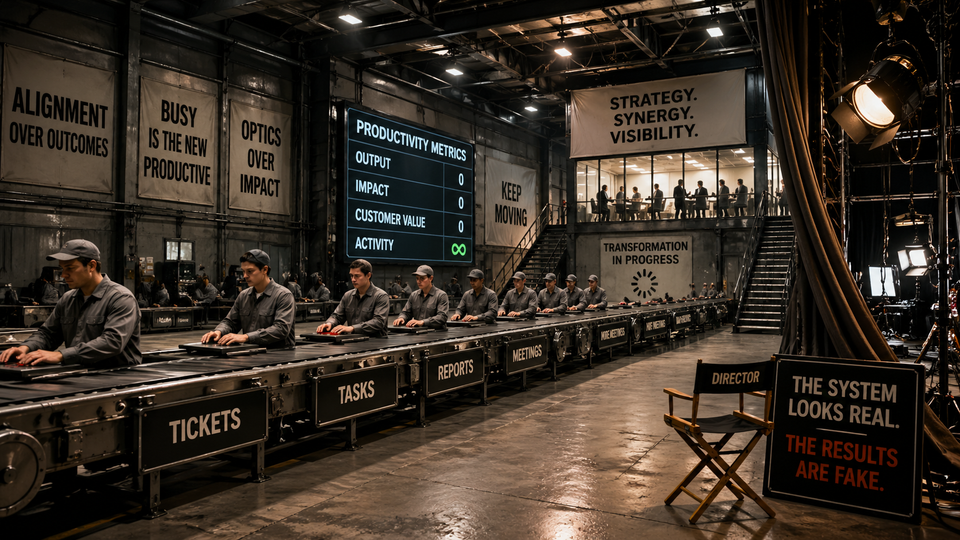
There is a place you probably know.
It looks busy. Very busy.
People walk fast. Screens glow. Meetings overlap. Words like alignment, velocity, innovation bounce off the walls like rubber bullets.
Nothing ships.
Welcome to the Museum of Modern IT.
Entry is free. Exit is complicated.
The first room is impressive.
A massive wall of dashboards. Everything is green.
Deployment frequency: green
Lead time: green
Team happiness: green
Customers? Nowhere to be seen.
In the corner, a quiet screen shows churn creeping up, conversion slipping, costs rising. No one looks at it. It is not part of the official exhibit.
This is the Watermelon Room.
Green outside. Red inside.
Next room.
A group of very serious people debate a roadmap.
Q1 priorities. Q2 bets. Strategic initiatives. Re-alignment sessions.
Someone asks a simple question: “What problem are we solving?”
Silence.
Then someone replies: “We need to move forward.”
Forward to where?
No one knows. But the roadmap looks excellent.
This is the Motion Without Direction Gallery.
Turn left.
You enter a beautifully organised backlog.
Tickets everywhere. Labels. Priorities. Subtasks. Comments. Reactions.
It feels productive just standing there.
Engineers move tickets from left to right with surgical precision.
At the end of the board, a feature emerges.
It solves nothing.
But it is “done”.
This is the Feature Factory Exhibit.
You can almost hear the machines.
Further in, a more experimental section.
Platform team.
Their mission: enable everyone.
Their reality: answer tickets.
“Can you create a schema?”
“Can you set up RBAC?”
“Can you deploy this service?”
They respond fast. Very fast.
SLA met. Tickets closed.
Nothing reusable. Nothing scalable. Everything fragile.
This is the Ticket Ops Installation.
Touch nothing. It breaks easily.
A new wing opened recently. Very popular.
The AI Showcase.
Demos everywhere. Assistants. Copilots. Smart pipelines.
Slide decks promise acceleration, automation, transformation.
Someone asks: “Where does this change our core business outcome?”
Awkward pause.
Then: “We are exploring opportunities.”
Translation: expensive prototypes, no integration, zero impact.
This is the Innovation Theatre Pavilion.
Looks like the future. Delivers the present.
Upstairs, things get philosophical.
A workshop on culture.
Slides about psychological safety. Empathy. Communication. Trust.
All valid. All necessary.
Meanwhile, deployments fail, priorities shift daily, no one owns outcomes, and teams depend on five other teams to do anything.
But the workshop went well.
This is the Culture Will Save Us Hall.
Spoiler: it will not.
Now the final room.
The executive floor.
From here, everything looks under control.
Reports are clean. KPIs are stable. Risks are “being managed”.
Someone suggests a deeper look at delivery friction, dependencies, or system design.
The answer comes quickly:
“We need more predictability.”
So they add more process.
More approvals. More gates. More reporting.
Predictability improves.
Reality gets worse.
This is the Control Illusion Chamber.
At this point, you might laugh.
You should.
Because this place is absurd.
But here is the uncomfortable part.
It works exactly as designed.
The Museum of Modern IT is not a failure.
It is the natural outcome of a few very consistent decisions:
Optimise for activity over outcomes
Reward reporting over reality
Split ownership until no one owns anything
Confuse movement with progress
Treat engineering as execution, not thinking
You do that long enough, and you do not get chaos.
You get a perfectly organised museum.
Now the useful part.
If you want to shut this place down, you do not need a transformation programme.
You need to break a few exhibits.
Start simple, but do it for real.
Replace activity metrics with outcome signals. If customers do not feel it, it does not count. Tie everything to one or two hard business indicators and let the rest justify itself.
Collapse dependencies aggressively. If a team needs three others to ship, you do not have a team. You have a coordination problem disguised as structure.
Kill ticket-driven platforms. A platform that requires constant human intervention is just a slow service desk. Real platforms remove work, they do not attract it.
Force problem clarity before solutioning. No clearly framed problem, no roadmap, no sprint, no debate. This alone eliminates half the noise.
Measure friction, not sentiment. Where time is lost, where work stalls, where rework happens. That is your system speaking. Listen to it.
None of this is revolutionary.
It is just inconvenient.
Because it removes the museum.
And the museum is comfortable.
So next time you walk into a “busy” organisation, ask one question:
Is this a factory… or an exhibition?
If it is an exhibition, enjoy the visit.
Just do not expect anything to leave the building.
Friday fun.
But you know exactly which room you are in.




Member discussion