Wednesday Reality : The Right to Draw a Sample
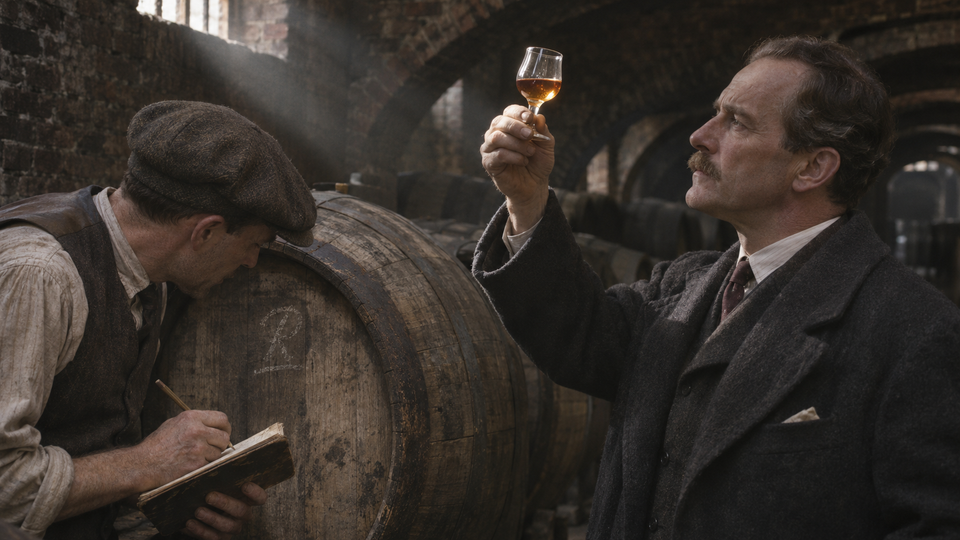
On 29 March 1933, A. G. Linney photographed men checking casks at the London Dock in Wapping. His caption records precisely what they were doing. They were tallying the casks against their marks and numbers. A merchant with wine somewhere in those vaults had good reason to care whether a number had been copied correctly. So did a man who had come to buy it. Yet a buyer could follow the marks all the way to the right cask, put his hand on the wood and still have travelled across London to answer a question the men in the photograph had no means of settling. [1]
The dock had opened in 1805. Near its main entrance lay the North Quay Gauging Ground, where casks could be laid out in their thousands for inspection, measurement and sampling. Below the warehouses, wine and spirits occupied a network of vaults. In between lay a considerable amount of skilled work. A cask had to survive being landed, moved and stowed. Someone had to recognise a defect in the wood, judge whether the vessel would bear another movement and know what to do with the contents if it would not. The dock employed coopers. The Treasury had business there too. [1, 2]
What the wood could tell you
A cask offers an awkward object to anyone charged with collecting a tax by volume. Its ends are narrower than its middle, its sides curve, and the depth of liquid inside it has no simple proportional relationship to the quantity remaining when the vessel lies on its side. A small fall in level near the widest part represents more wine than the same fall close to the top. Counting vessels would have made the arithmetic agreeable and given a considerable commercial advantage to whoever supplied the largest ones.
London Museum holds a wood-and-metal gauge made by Dring & Fage for HM Customs. Dating from the first half of the twentieth century, it measured the circumference of a cask, one of the dimensions from which officials could calculate volume. Consider the economy embodied in that instrument. A revenue officer could establish a quantity without having the whole consignment decanted into vessels of known capacity, then poured back again, with all the labour and loss that the exercise would invite. A measurement taken on the outside could answer a question about the inside because the geometry supplied a dependable relationship between the two. [3]
There were limits to what geometry could do for a prospective buyer. Two casks with identical dimensions could contain wines of very different character. This presented no difficulty for the gauge maker. Nobody had commissioned an instrument for detecting a disappointing sherry through oak staves. Merchants issued tasting orders, and visitors who held the requisite permission could enter the vaults and sample what they had come to consider. The arrangements were sufficiently formal for forged tasting tickets to find their way into circulation. Even the privilege of finding out what something tasted like had acquired a market value. [2, 4]
There is a small distinction worth dwelling on down there in the cellar. The sample could settle a dispute that no amount of further care on the gauging ground could resolve. A second officer might check the first officer’s arithmetic. A better instrument might narrow the margin of error. Neither development brought the buyer any closer to knowing whether his customers would want another glass. For that, somebody with an interest in the answer had to be allowed to disturb the stock.
Twelve of what?
Imagine a software company selling an order-management platform to wholesalers. Its first customer wants to retire a shared mailbox. Shops email spreadsheets to a depot, clerks retype the orders and somebody spends Friday afternoon sorting out the errors. During discovery, a product manager watches a clerk enter an order. She reads twelve against a product code, selects one case on her screen and moves to the next line. To somebody watching for the cost of rekeying, the interesting observation is how long the operation took. To an engineer designing the import, the interesting observation is that the clerk read one number and typed another. Which observation survives the meeting will determine what the company builds.
Suppose the first one survives. The product brief promises to remove manual entry. Engineering builds an importer that accepts a customer reference, a product code and a quantity. In the platform’s catalogue the item sells by the case, so twelve means twelve cases. The test suite includes a file containing twelve and checks that the warehouse receives an order for twelve. It also checks malformed files and repeated submissions. These are worthwhile tests. Nobody supplies the shop’s original spreadsheet, in which the column heading reads Bottles, because the engineering team has already been given a sample file in the agreed format. Somewhere between a buyer’s desk and a developer’s test, the most informative word in the transaction has disappeared.
At Wapping the gauge maker knew what relationship entitled an officer to draw an inference about wine from a measurement of wood. At the software company there is an equally consequential inference hidden in an unremarkable field called quantity. The people on either side of the interface can agree on the product code, the number twelve and the fact that the message arrived intact. Ask them what should come off the van and their answers differ by eleven cases.
What passed in production
The first morning goes well. Orders appear in the warehouse within seconds and the engineers can follow each one from upload to acknowledgement. Before the pickers start, the depot clerk opens the list. She knows the shop barely has room for a case behind the counter, rings the buyer and changes twelve to one. From the engineer’s side of the screen, the change looks like any other authorised amendment. Customers amend orders all the time. Without the telephone conversation, the history of this transaction offers no way to distinguish a buyer changing her mind from a clerk correcting the software company’s understanding of the buyer.
That distinction matters a fortnight later, when the product manager asks whether the importer is ready for general release. Engineering can account for every file. Support has received no complaints. The customer confirms that its shops received the goods they wanted. All three accounts are true. The phone on the clerk’s desk belongs to the customer, and nobody on the release call has heard it ring. What reaches the meeting is the order after she corrected it. What the meeting has to decide is how the order would have fared in her absence.
At the dock, the customs officer and the wine merchant could stand beside the same cask and ask different things of it. In the depot, the act of checking goes a step further. The clerk can change what the customer receives. The more reliably she catches mistakes, the less often a wrong delivery disturbs the shopkeeper, and the less evidence travels back to the people who designed the importer. By the end of the pilot, the vendor has learned something genuine about a depot where an experienced clerk reads the morning list. The release decision quietly extends that finding to a depot where nobody reads it.
Even giving the engineers another dashboard would do little to resolve this particular uncertainty. They could count amendments and find that the figure had fallen, only to discover that a busy depot had stopped checking orders before dispatch. One investigation available to them would have been quite modest. Sit with the clerk for a morning, choose one amended order and follow it backwards until somebody could explain why twelve had become one. The equivalent of the tasting order is the permission and time to make that journey. In a software company those belong to different people. An account manager controls access to the customer, an engineering manager has committed the team to the next release, and the clerk whose morning would repay the visit works for the customer.
The second customer buys the first customer’s result
Now the sales team has a reference customer. Implementation lasted six weeks, the importer handles the volume and the depot no longer employs anyone to rekey every order. The second wholesaler asks what staffing it will need. The vendor estimates the implementation from its own time sheets. The first customer’s clerk, who still checks the morning list alongside her other duties, appears on none of them. Her contribution crosses from one company to the next as a promise about the capabilities of the product.
At the second depot, orders go straight to picking. The first evidence of the missing unit arrives as a request for credit after a delivery. Finance records a commercial adjustment, the depot arranges collection and the shop starts telephoning to confirm quantities. Weeks later a support ticket reaches the vendor asking for a warning when someone orders more than ten cases. By then a problem in the product’s model of an order has acquired the appearance of a feature request from a particularly demanding customer. Its prospects on the roadmap will depend on how many other customers ask for the same warning. Those still paying clerks to catch the discrepancy are unlikely to vote for it.
There is real engineering judgement to exercise here. Adding a unit to the order line looks straightforward until an engineer asks what an omitted unit should mean for existing integrations. Defaulting it to cases preserves the behaviour on which some customers depend and silently preserves the error for others. Making it compulsory immediately could interrupt customers whose orders have always been correct. A warning above ten would catch this shop’s mistake while allowing a smaller one through, and a shop buying for the village fête might genuinely want twelve cases. A morning with the original spreadsheet would have cost the company very little before release. Once several customers have built integrations around that field, the same discovery carries a migration cost. Every successful sale has made the original question more expensive to ask.
Back in the vault, the prospective buyer had an advantage worth considering. He could ask to examine one cask before committing himself to the parcel. The software company had an equally good specimen on its first morning at the depot. A woman looked at a sheet of paper, read twelve and typed one. The observer beside her had come to find out how much time the company could save by removing that step. The notebook records how many seconds it took.
[1] London Museum, London Dock and A. G. Linney’s 1933 photograph
[2] Thames and Docklands History Group, London’s Dock Coopers
[3] London Museum, HM Customs cask measuring gauge
[4] London Picture Archive, Warehouse Cellar in Pennington Street



Member discussion