Monday Myth : The Cable Was Already Laid
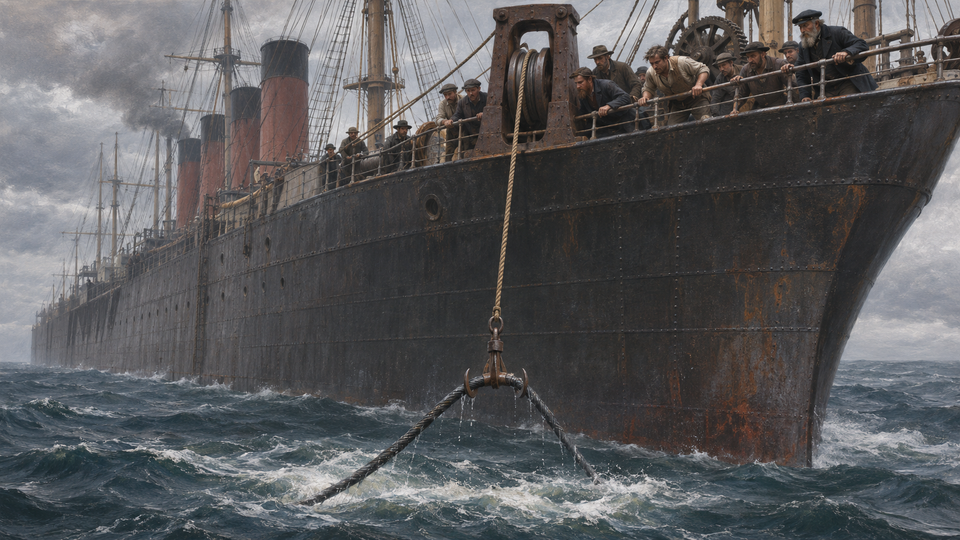
In August 1866, a cable rose out of the Atlantic close enough for the men aboard the Great Eastern to see it. They had hauled it from more than two miles down. There was a cheer as it appeared, and then the cable slipped out of the grapnel and went back into the sea. The crew had spent hours lifting it. They had come within sight of the thing they had gone looking for. By the end of the manoeuvre, the distance between the ship and the cable was once again measured in miles.[1]
This was the cable the same ship had been laying from Ireland the previous summer. An electrical fault had forced the crew to interrupt the laying and haul part of the cable back for examination. During the attempt, it parted and sank. Most of the length already paid out remained connected to the Irish shore. Its copper, insulation and armour still represented a great deal of manufacture and a substantial part of an ocean crossing. The expedition had lost its working end, the point from which all that material could be made to do anything.[2]
The work changes direction
Laying cable meant paying it out in a controlled descent while the ship advanced. Drums and brakes controlled the rate of payout, with enough slack to accommodate the route and the shape of the seabed. The suspended length between ship and seabed put the machinery under load, but the crew could feed more cable from the tanks as the ship moved. At the point of failure, the problem reversed. The ship had to retrieve a line whose position on the bottom it could only reconstruct from the track of the earlier voyage. It had to reach the line with a hook at the end of another long, heavy line, in water deep enough for each lowering and hauling cycle to consume hours.[3]
A grapnel dragged across the presumed route. A dynamometer showed the strain on the grappling rope. An increase could tell the crew that something had resisted the hook, and the way that strain developed helped them judge whether they had caught the cable. Then came the lift. A hook catching the middle of a cable raises a bight, a loop whose two sides descend towards the bottom. As the suspended portion lengthens, more weight comes onto the gear. The movement of the ship adds changing loads. Even a convincing reading on the way up leaves open the question of what the hook will still be holding when it reaches the bow.[3]
The expedition had already laid a fresh cable to Newfoundland before it went back for the old one. It could afford to approach the recovery as a separate operation, with several ships and a way to lift and buoy parts of the cable rather than asking a single hook to bring the whole bight to the surface. One part of the operation deliberately broke the cable on the side towards the lost end so that the long section connected to Ireland could be recovered. There was a certain precision in deciding where the cable should part. A break had ended the previous expedition. A break made under the conditions the crew had arranged now helped bring the line back into service.[2][3]
When the end finally came aboard, the electricians put it to a different test. The apparatus in the ship’s electrical room registered signals from Ireland, establishing that the recovered length still worked. The crew could splice on fresh cable and pay out the rest of the crossing. By September there were two working Atlantic lines. The second came into existence because enough of the work done in 1865 could be reached, tested and used again.[2][4]
The size of the thing you have to move
An aircraft engine offers a more deliberate arrangement for reaching something already in service. In the Pratt & Whitney PW4000, for example, access ports let a technician guide a borescope to specific areas inside the engine. The small opening changes the scale of the operation. The engineer can examine a surface with the engine still attached to the aircraft. Some findings will still require removal and shop work, and the access port can only reveal what lies within reach of the instrument. Its value lies in allowing one maintenance decision to be made while the much larger assembly stays where it is.[5]
An opening of that kind has to be there when the technician arrives. It occupies space in a design whose designers already had demands on every surface. Its future value depends on where it leads, what the instrument can see and whether the observations support a decision. The Atlantic expedition had to improvise its access from above, with ships, rope and a good enough reconstruction of the route. In the engine, part of that expense has moved forward in time. A drawing made before the first engine enters service determines how much of the aircraft a maintainer will have to disturb to look at a particular piece of metal.
A comparable choice occurs when a retailer installs a new order service. Under normal conditions, the service accepts orders and sends instructions to the warehouse. If the warehouse acknowledges some orders and the connection then fails, the retailer has to work out which instructions actually took effect. An unacknowledged order may already have produced a picking ticket or a parcel. Resending everything can produce duplicate shipments. Restoring the application database to an earlier point may remove the retailer’s own record of orders whose parcels are already on the loading dock. The screen can return to an earlier state. The afternoon’s work in the warehouse has a different history.
At acceptance, the retailer sends a test order, receives the warehouse’s acknowledgement and watches the order get picked. Each team signs off on work it has seen happen. Now run the same test and drop the acknowledgement after the warehouse accepts the order. The order system shows a timeout while, across the warehouse, a picking ticket is already printing. To establish what happened, someone needs an order reference that appears in both systems and access to the warehouse record. The teams can then try a replay and see whether the warehouse recognises the original reference or opens a second job. If two picking tickets appear, someone still has to decide which one the warehouse should act on, and who can hold it while they check. A test designed to end at the first successful delivery gives the programme every reason to sign off before that decision has an owner.
The price of reaching it again
The economics of the Atlantic recovery depended on what remained down there. The money spent in 1865 had gone either way. What mattered in 1866 was the prospect of turning the surviving length into a second working connection without manufacturing and laying a second complete replacement. That prospect had to justify ship time, equipment and the repeated chance of hauling up an empty hook. The electricians’ test had economic force precisely because the cable’s condition was uncertain. Once they could exchange signals with Ireland, they knew what the remaining work would connect to.[2][3]
Inside a company, costs of this kind can turn up in entirely different accounts. The programme that installs the order service sees an immediate saving when it defers work on selective replay. The warehouse later pays for recounts and cancelled shipments. Customer service explains why the customer received two parcels. Finance reconciles the refunds. A full day of repair can pass through several departments before anyone compares its cost with the deferred engineering work. If those departments get better at handling the aftermath, the original decision can look cheaper with each passing quarter. The labour that makes it appear economical belongs to other people.
Who can release the order?
When the connection comes back, infrastructure can report that messages are flowing again. The order team can show what it sent. The warehouse team can show what it picked. The carrier has a record of the parcels it received. Among hundreds of orders with missing acknowledgements, consider one the warehouse has already packed. The customer has paid and the carrier has yet to scan the parcel. The incident lead can bring the relevant people into the same conversation. The decision still falls somewhere between them. Holding the parcel may miss the last collection. Resending the order may release a second one. Refunding it may leave the customer with both the goods and the money. The answer depends on facts held in several places and a decision that none of the teams routinely makes on its own.
There are good reasons for distributing the work this way. The warehouse team understands which actions it can reverse after picking. The payment team knows when a transaction can still be voided. The order team can change how the service retries a request, while the warehouse system determines whether receiving the same order reference twice creates a second job. A shared reference is useful only if it survives the passage between those systems and both sides agree what a repeat means. The recovery procedure also has to reach across that boundary. A team may have permission to replay a message while the authority to release a held parcel sits with the warehouse supervisor. If the replay creates a fresh picking job while the supervisor releases the original parcel, both teams can follow their own procedures and still send two parcels.
The same incident also has several plausible endings. Infrastructure sees traffic flowing. The application team sees the queue drain. The warehouse still has a list of orders whose physical status someone must check. If the incident clock stops when the queue drains, the people who close the ticket can record a shorter recovery while the warehouse spends longer recovering. The next morning, a proposal to reconcile orders automatically competes for engineering time using a record that describes a brief interruption. For the warehouse, the event ended when the last order could be released with confidence. That time may never enter the record from which the next investment decision is made.
Robert Charles Dudley painted the recovery expedition’s electrical test. In his picture, the men have moved indoors, into the Great Eastern’s electricians’ room. Beneath them hangs the cable they have spent weeks trying to get aboard. In Ireland, someone has to answer. No one in the room can see the length of copper between them and the Irish coast. For the moment their attention rests on a galvanometer, and on whether a spot of light will move.[4]
Sources
- The St John’s Daily News, 9 October 1866, contemporary account of the failed lift
- David Lindley, Degrees Kelvin, “Cable”, National Academies Press
- Diary of the Atlantic Telegraph Expedition, 1866 and contemporary description of the paying-out and picking-up machinery
- The Laying of the Atlantic Cable, Metropolitan Museum Journal, vol. 41
- Federal Aviation Administration, Visual Inspection for Aircraft, Appendix D





Member discussion