Thursday Reality: Excellence Requires a Relationship with Time
The Strange Paradox of Modern Organisations
Few words enjoy greater prestige in modern business than innovation. Executives demand it, investors fund it, conferences celebrate it, and entire departments exist to promote it. Organisations compete fiercely to appear innovative, transformative, disruptive, and forward-looking. Every year introduces a new collection of frameworks, methodologies, and technologies that promise to reshape industries and redefine the future.
Yet despite this obsession, many organisations struggle to perform remarkably ordinary tasks with consistency. Projects miss deadlines, products degrade over time, customer experiences become fragmented, technical debt accumulates, and teams repeatedly solve the same problems their predecessors solved years earlier. The paradox deserves attention because it appears almost everywhere. The more we speak about transformation, the less capable many organisations appear of preserving excellence.
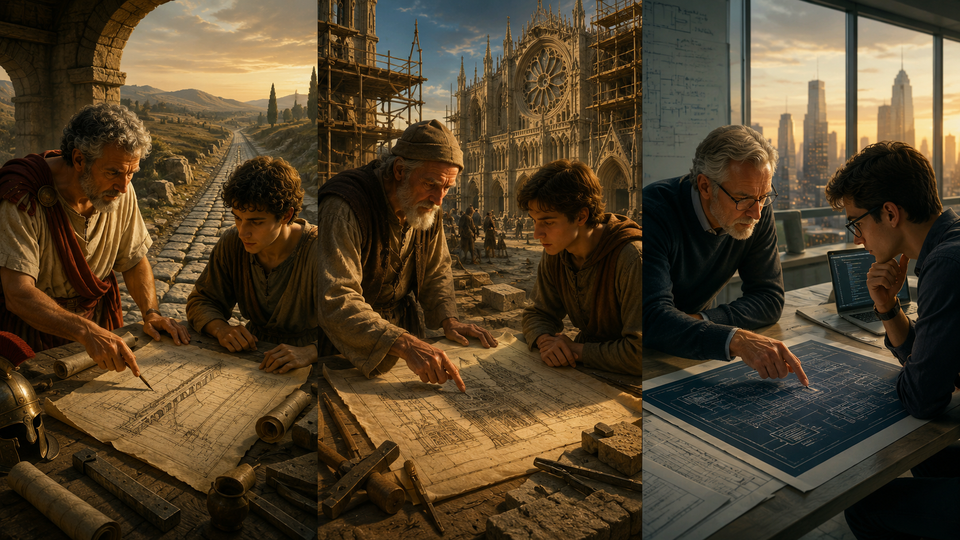
The contradiction becomes sharper when viewed through history. Humanity built aqueducts that still stand after two thousand years. Cathedral builders committed themselves to projects that would not finish within their lifetimes. Railway engineers coordinated vast networks before the existence of modern computing. Industrial craftsmen achieved extraordinary levels of precision with tools that modern engineers would consider primitive. None of these achievements emerged from quarterly planning cycles or endless transformation programmes. They emerged from craftsmanship, discipline, apprenticeship, institutional memory, and a willingness to think beyond the immediate horizon.
The question therefore becomes uncomfortable. If previous generations achieved such remarkable outcomes with fewer tools and less technology, why do modern organisations struggle to sustain excellence despite possessing unprecedented resources?
Excellence Requires a Relationship with Time
The answer may lie in our changing relationship with time.
For most of history, human beings accepted that many of the things they built would outlive them. Roman engineers constructed roads for future generations. Cathedral builders spent entire careers working on structures they would never see completed. Master craftsmen invested decades refining techniques that would eventually be passed to apprentices. Their lives were finite, yet their thinking extended beyond themselves.
In many respects, legacy represented a response to mortality. People confronted the certainty of ageing and death by creating things designed to endure.
Modern society appears to have inverted the equation. We live longer, enjoy greater prosperity, and benefit from levels of safety unimaginable to previous generations. Yet culturally we seem increasingly uncomfortable with ageing itself. We celebrate youth, speed, disruption, immediacy, and perpetual reinvention. The horizon keeps shrinking. The next quarter becomes more important than the next decade. Visibility becomes more important than permanence. Momentum becomes more important than mastery.
This shift carries consequences. Craftsmanship requires patience. Trust requires patience. Expertise requires patience. Excellence requires patience. A society that becomes uncomfortable with time inevitably becomes uncomfortable with the mechanisms that produce excellence.
When Age Stopped Representing Wisdom
One of the clearest symptoms of this transformation appears in the way modern organisations treat experience.
Historically, age carried a very specific meaning. The older physician, builder, engineer, watchmaker, or military officer possessed something that could not easily be taught through books alone. Years of experience had accumulated into judgement. They had seen failures, recognised patterns, navigated trade-offs, and learned to distinguish signal from noise.
Knowledge can be documented. Judgement cannot.
Judgement emerges through exposure to reality over long periods of time. It develops through mistakes survived, crises managed, systems built, and consequences observed.
Yet many organisations increasingly treat senior professionals as costs rather than assets. Salary appears on a spreadsheet. Judgement does not. Experience becomes difficult to quantify. Knowledge transfer receives less attention than immediate productivity. In the process, organisations quietly erode their capacity to learn across generations.
The irony is striking. The more complex our systems become, the more valuable accumulated judgement becomes. Yet complexity grows while respect for experience declines.
Excellence Predates Innovation
One of the great misconceptions of contemporary business thinking lies in the assumption that innovation creates excellence.
Historically, the opposite often proves true. Excellence frequently creates the conditions that make innovation possible.
Aviation provides a useful example. Popular imagination celebrates the Wright brothers, the jet engine, supersonic flight, and space exploration. Yet modern aviation does not primarily depend upon breakthrough moments. It depends upon millions of routine actions executed consistently every day. Maintenance procedures, operational discipline, engineering standards, investigations, checklists, and feedback loops collectively produce one of the safest transportation systems humanity has ever created.
The same pattern appears in manufacturing. Toyota did not become exceptional because it discovered a secret formula. It became exceptional because it institutionalised continuous improvement. Thousands of small refinements accumulated over decades. Observers often search for the breakthrough while overlooking the compounding effect of disciplined practice.
Railways, medicine, watchmaking, and military logistics tell remarkably similar stories. Their achievements rest not upon isolated moments of genius but upon sustained cultures of craftsmanship.
Software and the Cult of Immediacy
Software introduced something historically unusual. It allowed human beings to modify complex systems at an unprecedented speed and cost.
A bridge cannot be redesigned every week. A railway network cannot be reconfigured every sprint. An aircraft cannot receive hourly updates. A cathedral cannot be rebuilt after every retrospective.
Software can.
This extraordinary flexibility generated tremendous value. Unfortunately, it may also have taught us a dangerous lesson. We began assuming that every system should behave like software. We became impatient with stability. We started treating constant change as evidence of progress. Iteration gradually transformed from a tool into an ideology.
The result appears throughout modern management. Organisations repeatedly reorganise before previous structures mature. Teams abandon processes before understanding them. Leaders launch transformations before diagnosing the underlying problems. Movement becomes confused with progress.
The Age of the Barbarians
Alessandro Baricco described a cultural shift in which movement increasingly replaces depth. The barbarian does not dig a deep well. He moves quickly between many wells. Surface becomes more important than depth, connection more important than understanding, exploration more important than mastery.
One can recognise elements of this phenomenon throughout modern professional life. We consume more information than any generation in history while often internalising less of it. We switch jobs more frequently. We celebrate adaptability more than expertise. We reward disruption more readily than continuity.
None of these developments are inherently negative. Exploration matters. Adaptability matters. Cross-disciplinary thinking matters.
Problems emerge when depth disappears altogether.
The master craftsman represents depth. Apprenticeship. Memory. Transmission.
The barbarian represents movement. Discovery. Novelty. Constant motion.
Healthy societies require both. Yet many organisations appear to have lost the balance. Institutional memory disappears through layoffs, reorganisations, and rapid turnover. Lessons learned vanish alongside the people who learned them. Teams repeatedly rediscover solutions that previous generations already paid to acquire.
From a distance this can look like innovation. Up close it often resembles amnesia.
Craftsmanship as Civilisational Memory
Christopher Alexander understood something that many modern organisations seem to forget. Good forms rarely emerge fully formed from isolated acts of genius. They emerge through adaptation, refinement, correction, transmission, and time.
A city contains lessons from previous generations. A railway network contains accumulated operational wisdom. A cathedral contains centuries of architectural learning. Even a well-designed software platform often embodies years of hard-won experience encoded into standards, interfaces, and practices.
Craftsmanship therefore extends beyond individual skill. It represents civilisational memory expressed through systems.
When societies stop valuing transmission, they lose more than expertise. They lose continuity. They lose context. They lose their ability to compound knowledge across generations.
The Leadership Challenge
The challenge for leaders lies in the fact that excellence rarely produces immediate visibility. Capability building occurs gradually. Trust accumulates slowly. Quality compounds over time. The most valuable investments often remain invisible until years later.
Launching a transformation programme attracts attention. Preserving institutional memory does not. Announcing a new strategy generates visibility. Developing judgement across generations does not.
Yet the latter activities often determine whether organisations endure.
The strongest leaders understand that their role extends beyond delivering quarterly outcomes. They act as custodians of capability. They protect the mechanisms through which knowledge, judgement, and craftsmanship pass from one generation to the next.
Conclusion
Modern organisations do not suffer from a shortage of ideas. They do not suffer from a shortage of ambition. They do not even suffer from a shortage of innovation.
Increasingly, they suffer from a weakened relationship with time.
The cathedrals, railways, aircraft, bridges, factories, institutions, and systems that shaped the modern world point towards the same conclusion. Enduring excellence emerged when human beings accepted delayed gratification, invested in future generations, respected accumulated wisdom, and committed themselves to outcomes they might never fully enjoy themselves.
Perhaps excellence appears boring only because we have become impatient.
Perhaps the deeper challenge is that we have become so focused on immediacy that we struggle to recognise the value of things that compound slowly.
Excellence is not merely a matter of quality. It is a relationship with time.





Member discussion