Friday Fun: The Enterprise Zoo
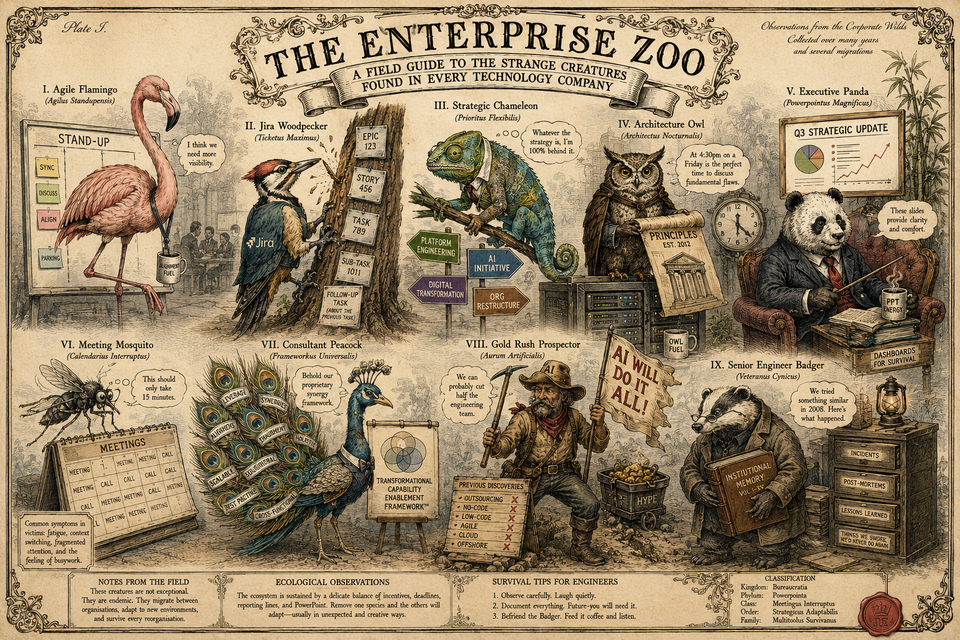
A Field Guide to the Strange Creatures Found in Every Technology Company
Naturalists once travelled to distant continents in search of rare species. Modern engineers do not need to leave the office. Every technology company already contains a remarkably diverse ecosystem.
Years of observation have allowed researchers to identify a number of recurring species. Curiously, these creatures appear regardless of company size, industry, country, or technology stack. Whether one visits a startup of twenty people or a multinational employing thousands, the same animals emerge.
For the benefit of future generations, this field guide documents some of the most common specimens.
The Agile Flamingo (Agilus Standupensis)
The Agile Flamingo spends much of its day standing in carefully organised circles. It thrives during stand-ups, retrospectives, planning sessions, backlog refinements, alignment workshops, and synchronisation meetings. During these rituals, it displays remarkable enthusiasm and often contributes extensively to discussions around collaboration and visibility.
Researchers have observed a curious behavioural pattern. As delivery work begins, the Agile Flamingo gradually becomes more difficult to locate. Attempts to engage it frequently result in invitations to additional discussions intended to prepare for future work.
While some observers criticise the species, its role remains important. Left unchecked, organisations can drift into chaos. The Flamingo's challenge lies not in creating process but in occasionally forgetting that process exists to support delivery rather than replace it.
The Jira Woodpecker (Ticketus Maximus)
The Jira Woodpecker remains one of the most industrious creatures in the enterprise ecosystem. A healthy specimen can generate dozens of tickets in a single day and often appears deeply satisfied when presented with a freshly organised backlog.
Unlike ordinary birds, however, the Jira Woodpecker does not build nests. It builds workflows.
Its habitat consists of increasingly sophisticated structures containing epics, stories, sub-tasks, dependencies, linked items, tracking tasks, follow-up tasks, and occasionally tasks created solely to monitor other tasks.
Over time, entire project boards can emerge that resemble modern cities, complete with roads, districts, and zoning regulations. Yet visiting customers occasionally struggle to identify what has actually been delivered.
The species remains vulnerable to a single question:
"Which customer problem did this solve?"
No reliable defence mechanism has yet been documented.
The Strategic Chameleon (Prioritus Flexibilis)
The Strategic Chameleon possesses an extraordinary ability to adapt its colour to the surrounding executive environment.
On Monday it champions platform engineering. By Wednesday it advocates artificial intelligence. By Friday it supports a complete organisational redesign. The following week it may return to platform engineering with renewed conviction.
Scientists initially interpreted this behaviour as adaptability. Further observation suggested a simpler explanation. The Chameleon instinctively migrates towards whichever topic currently receives the greatest executive attention.
As a result, historical positions often become difficult to recover. Entire strategic documents have been known to vanish into the undergrowth.
Despite this, the species remains highly successful and continues to flourish in organisations undergoing frequent transformation programmes.
The Architecture Owl (Architectus Nocturnalis)
The Architecture Owl rarely appears during project inception. It rarely participates during implementation and seldom emerges during testing.
Instead, it prefers to remain hidden until shortly before launch.
At this precise moment, the Owl descends from above and calmly explains that the entire solution violates principles established several years earlier and should therefore be reconsidered.
Engineers often react with frustration, but experienced observers recognise the Owl's ecological role. Without its periodic interventions, many organisations would eventually forget that architecture exists altogether.
The challenge lies not in the wisdom of the Owl but in its timing.
The Executive Panda (Powerpointus Magnificus)
The Executive Panda survives almost entirely on presentations.
Unlike ordinary mammals, it converts slide decks directly into strategic energy. Researchers estimate that a mature Panda can consume hundreds of PowerPoint slides each quarter while producing only a handful of observable decisions.
The species demonstrates a particular attachment to dashboards. Colourful charts, trend lines, and executive summaries provide essential nutrients. When deprived of metrics, the Panda becomes restless and may commission transformation initiatives in an attempt to restore balance to its environment.
Although frequently misunderstood, the Panda occupies a critical position within the food chain. Entire populations of consultants depend upon it for survival.
The Meeting Mosquito (Calendarius Interruptus)
Individually, the Meeting Mosquito appears harmless. A single meeting rarely causes significant damage.
Problems emerge when the species gathers in large numbers.
A handful of meetings fragments an afternoon. A sufficiently mature swarm can quietly consume an entire sprint while leaving little visible evidence behind. Victims typically experience symptoms including fatigue, reduced concentration, context switching, and a growing sense that they spent the week working without accomplishing anything.
The species reproduces at an extraordinary rate, usually through a phrase that sounds both reasonable and harmless:
"This should only take fifteen minutes."
The Consultant Peacock (Frameworkus Universalis)
The Consultant Peacock remains one of the most visually impressive creatures in the enterprise ecosystem.
Its feathers feature colourful diagrams, frameworks, matrices, capability maps, operating models, transformation roadmaps, and occasionally several layers of overlapping circles connected by arrows.
During courtship displays, the Peacock introduces increasingly sophisticated terminology designed to demonstrate expertise and sophistication. Audiences frequently leave impressed, inspired, and slightly confused.
While nobody can clearly explain what a transformational capability enablement framework actually accomplishes, the beauty of the presentation often secures additional workshops, follow-up sessions, and strategic alignment exercises.
The Peacock therefore continues to thrive.
The Gold Rush Prospector (Aurum Artificialis)
A relatively recent arrival, the Gold Rush Prospector has spread rapidly throughout executive populations.
The Prospector becomes convinced that every major technological breakthrough has finally eliminated the need for expertise. Previous generations confidently declared that outsourcing, no-code platforms, Agile methods, cloud computing, automation, or offshore development would dramatically reduce the need for skilled engineers.
Today, the Prospector has discovered artificial intelligence.
Within days of reading several articles and attending two conferences, it begins proposing dramatic workforce reductions. Delivery capacity, system complexity, maintenance requirements, and operational realities rarely influence these conclusions.
Researchers have documented a fascinating historical pattern. The technology itself often succeeds. The prediction almost never does.
The same organisations that enthusiastically announce engineering reductions frequently discover several months later that someone must still integrate systems, secure infrastructure, maintain platforms, review outputs, manage incidents, understand customer needs, and solve problems when technology behaves unexpectedly.
The Prospector therefore remains one of nature's most optimistic creatures.
The Senior Engineer Badger (Veteranus Cynicus)
No field guide would be complete without the Senior Engineer Badger.
Having survived multiple technology waves, acquisitions, reorganisations, digital transformations, framework adoptions, cloud migrations, leadership changes, and strategic pivots, the Badger possesses a level of institutional memory rarely found elsewhere in the organisation.
When confronted with a revolutionary new idea, the Badger often responds by calmly explaining that something remarkably similar already existed fifteen years ago.
This behaviour occasionally frustrates younger species eager to embrace novelty. Yet further investigation frequently reveals that the Badger is correct.
Far from being cynical, the Badger serves as one of the ecosystem's most valuable knowledge repositories. It remembers why certain decisions were made, which experiments succeeded, which failed, and which fashionable concepts have already completed several cycles through the industry.
Unfortunately, many organisations only discover the value of the Badger shortly after encouraging it to retire.
Conclusion
The Enterprise Zoo may appear chaotic, but every ecosystem eventually finds a fragile balance.
The Flamingos create process. The Owls preserve principles. The Badgers maintain institutional memory. The Pandas consume strategy. The Peacocks create frameworks. Even the Woodpeckers serve a purpose, although researchers continue debating exactly what that purpose might be.
Most organisations spend enormous energy searching for perfect structures, perfect methodologies, and perfect operating models. Yet beneath the changing terminology, the same collection of creatures continues to populate every company on Earth.
Technology evolves. Job titles evolve. Buzzwords evolve. The inhabitants remain remarkably consistent.
Perhaps that explains why every experienced engineer eventually develops the strange feeling that they have worked for the same company several times under different logos.
Happy Friday. Welcome to the Enterprise Zoo. 🦩🦉🐼🦚🦡📊





Member discussion