When You Are Stuck, You Are Thinking in the Wrong System

The Illusion of Progress
Most organisations do not look broken.
They ship, report, dashboards stay green, while friction rises and progress stalls.
If you are stuck, it is not effort. It is the wrong system.
The Trap: Solving from Inside the Frame
The trap is subtle and widespread: local optimisation.
A delivery issue triggers more tracking. A coordination issue creates more meetings. A quality issue adds more validation. Each move makes sense in isolation; together they increase resistance.
The system becomes dense. Throughput drops. Dependency chains lengthen. And then, performance is maintained artificially.
Senior people compensate. They unblock, connect, translate, and absorb ambiguity. They become the glue. Heroics keep the system moving while hiding its failure.
This is not improvement. It is compensation around structural limits.
Treat this as a law:
Adding control to a misaligned system increases friction. It does not restore coherence.
Step Back: Change the Lens
Stepping back is not a luxury. It is the move.
Information technology is an artificial construct, yet we confine ourselves to its vocabulary when it fails. That is unnecessary.
Other domains have solved these problems for centuries: flow, resilience, scaling, adaptation. Physics, biology, and engineering provide clearer models because they are grounded in constraints.
Change the lens and the problem changes shape.
Reframing Through Other Systems
Flow (fluid dynamics)
This behaves as a flow system.
Flow is governed by pressure, resistance, and constraints. When it slows, you do not push harder; you reduce friction and remove obstructions. Turbulence is structural, not a coordination issue.
In delivery systems, latency, excess work in progress, and dependencies are resistance. Meetings do not remove resistance. Structure does.
Biology (organisms and cells)
A healthy organism is composed of autonomous cells within a coherent system. Each cell has a boundary, a function, and local adaptability.
When coordination becomes constant and centralised, the system is unstable. Teams that require continuous external control are not cross-functional units. They are fragments of a misconfigured whole.
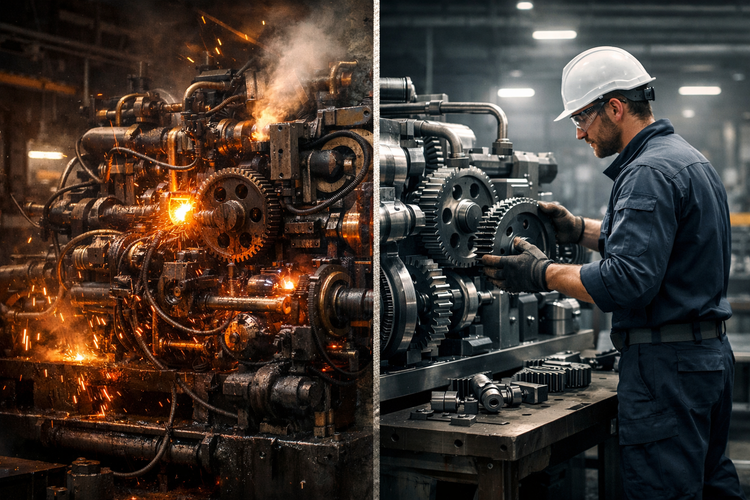
Mechanics (gearboxes)
Throughput depends on alignment.
A misaligned gear reduces transmission and propagates loss across the system. In organisations, poor interfaces, unclear ownership, and hidden coupling create loss at every hand-off.
Adding coordination layers does not fix misalignment. It amplifies loss.
Tectonics (pressure and release)
Misalignment accumulates pressure. For long periods, nothing appears to happen. Then it releases.
What is labelled a crisis is accumulated tension becoming visible.
Organisations follow the same pattern. Failure is rarely sudden. It is delayed visibility.
The Shift: From Optimisation to Reframing
Most leaders are trained to optimise within a system: refine processes, improve execution, drive efficiency. Useful skills ... with limits.
When the system is flawed, optimisation accelerates the wrong outcomes.
The shift is to question the frame, not the parameters. Ask whether the model used to interpret the problem is appropriate at all.
Reframing does not remove complexity. It makes it intelligible.
This is the foundation of a more fluid organisation: not a framework, not another layer of process, but a system that follows the same laws, flow over accumulation, alignment over control, structures that adapt rather than resist.
Seen through that lens, many “problems” become predictable consequences of a system not designed to handle them.
Borrow better laws.
Flow behaves like flow. Friction behaves like friction. Misalignment accumulates pressure. These are constraints, not opinions.
In Essence
When an organisation struggles, the instinct is to do more within the existing system: more structure, more coordination, more control.
Sometimes the most effective move is the opposite. Step back. Change the lens. Redesign the system.
Because if your system requires constant heroics to function, it is already failing.
You are not early in the fix.
You are early in the collapse.




Member discussion