Wednesday Reality: Strength Comes From Imperfection
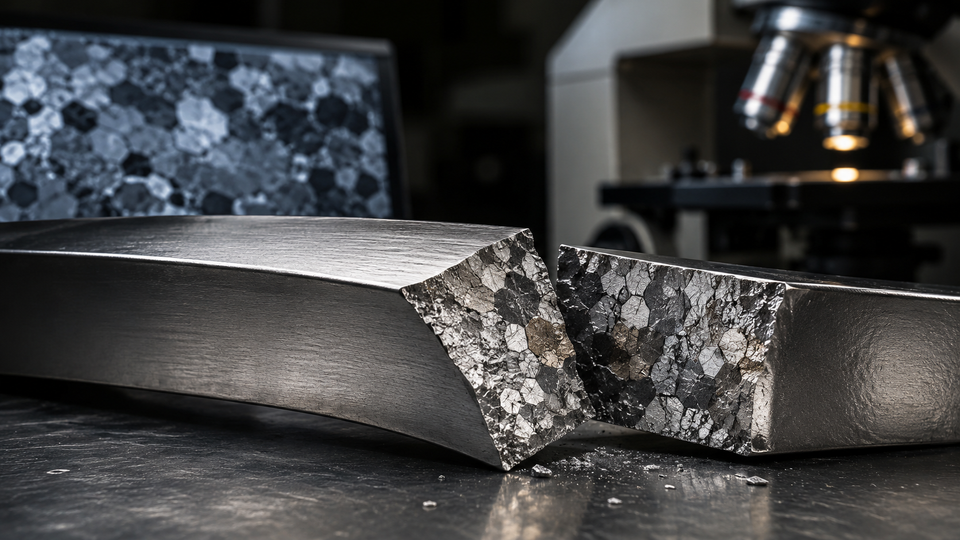
For much of human history, making better metal appeared to mean removing what did not belong there. Ore came from the ground contaminated with rock, sulphur, phosphorus and countless other compounds. Smelting separated metal from mineral. Refining removed unwanted elements. The progression seemed obvious: the more completely the metallurgist could eliminate impurities, the better the material ought to become. Purity looked like progress.
Yet modern metallurgy eventually arrived at a much stranger understanding. Pure iron is not particularly useful when strength matters. The extraordinary properties of engineering steels come partly from things that disturb their internal order: carbon atoms sitting where the crystal lattice would rather they did not, alloying elements changing its behaviour, boundaries separating crystals pointing in different directions, dislocations interacting with obstacles inside the material.
Metallurgists learned that the useful question was no longer how to eliminate imperfection, but which imperfections to create, preserve and control.
That distinction changed what engineers could build.
The Problem Inside the Crystal
A piece of steel looks continuous to the naked eye, but its internal structure tells another story. Its atoms organise themselves into crystalline arrangements divided into grains, each with its own orientation. Within those crystals lie defects known as dislocations. Under sufficient stress, these dislocations move through the lattice, allowing the material to deform.
This matters because preventing deformation does not require making every atomic bond individually stronger. Engineers can instead make movement through the structure more difficult.
Carbon provides one mechanism. Carbon atoms occupy spaces within the iron lattice and distort it, interfering with the movement of dislocations. Alloying elements create further obstacles. Grain boundaries interrupt the continuity through which deformation might otherwise travel. Metallurgical processes manipulate these mechanisms to change how the material responds when force reaches it.
The apparent imperfections become part of the engineering.
Grain refinement provides an especially interesting example. A material made from many smaller grains contains more grain boundaries. Those boundaries obstruct dislocation movement, which can increase strength. The material does not become stronger because its internal structure becomes simpler or more uniform. It becomes stronger because carefully distributed discontinuities make deformation harder to propagate.
The same principle appears repeatedly throughout materials engineering. Engineers introduce precipitates into alloys to obstruct movement. They work-harden metals by deforming them so that dislocations multiply and interfere with one another. They combine materials whose properties differ because the resulting structure can perform better than either constituent alone.
At microscopic scale, strength often emerges not from eliminating internal complexity but from arranging it.
Yet even this does not solve the engineering problem.
When Stronger Becomes Weaker
Suppose strength alone mattered. Metallurgy would become relatively straightforward: manipulate the material until deformation becomes as difficult as possible.
Real structures do not enjoy that luxury.
A component may need hardness to resist wear, strength to carry load, ductility to deform before failure, toughness to absorb energy, fatigue resistance to survive repeated loading and sufficient manufacturability that somebody can actually produce it economically. Improving one property can damage another.
Heat treatment makes this trade-off brutally visible.
Steel heated and then rapidly quenched can form martensite, an extremely hard microstructure. For certain applications that hardness proves invaluable. But martensitic steel can also become dangerously brittle. A material that resists deformation magnificently may fail suddenly because it has lost the capacity to accommodate it.
So the metallurgist tempers it.
Tempering reheats hardened steel under controlled conditions. Some of the hardness deliberately disappears. Internal stresses reduce. Toughness improves. The finished material may measure worse on one dimension precisely because engineers have made it better as a system.
This would look peculiar on a simplistic performance dashboard. One process increased hardness. The next process reduced it. If hardness constituted the KPI, tempering would resemble regression.
Nobody competent in metallurgy would manage the process that way because nobody competent believes a useful material can be understood through a single desirable property.
Engineering begins when optimisation stops being one-dimensional.
The Seduction of Organisational Purity
Organisations have their own ideas about impurities.
One team uses a different process. Another maintains an unusual architecture. An experienced engineer refuses to follow a fashionable practice because she remembers where it failed fifteen years earlier. Two departments overlap slightly in capability. Someone asks uncomfortable questions during planning. Another team insists on maintaining spare operational capacity rather than filling every sprint.
From sufficiently high above the organisation, these things resemble disorder.
Management naturally tries to remove it.
Common tooling replaces local choices. Standard processes replace different ways of working. Central platforms absorb duplicated capabilities. Career structures define common expectations. Governance establishes common decision mechanisms. Metrics make teams comparable. Planning creates alignment. None of these actions is inherently foolish. Many solve genuine problems, just as refining ore removes substances that genuinely weaken metal.
The mistake begins when standardisation changes from a means into an objective.
Once uniformity itself becomes evidence of organisational maturity, every deviation starts looking like something waiting to be corrected. The organisation gradually removes differences whose function nobody has bothered to understand.
Some of those differences were waste. Others were grain boundaries.
A team with deep local knowledge can interrupt the propagation of a poor central decision. Overlapping expertise may look inefficient until one group disappears or becomes overloaded. An engineer who repeatedly challenges consensus can slow decisions while simultaneously preventing assumptions from becoming invisible. Architectural diversity creates integration costs but can also prevent a single technical mistake from becoming universal. Spare capacity reduces utilisation while providing somewhere for unexpected work to go.
The difficulty lies in distinguishing accidental disorder from functional heterogeneity.
Metallurgy cannot solve that problem by declaring all impurities beneficial. Sulphur can cause serious problems in steel. Inclusions can initiate fatigue cracks. Voids and uncontrolled defects can destroy structural integrity. Engineers do not celebrate imperfection indiscriminately. They learn which discontinuities strengthen the material and which ones provide a place for failure to begin.
Organisations face the same, much harder, problem.
Hardness Is Not Toughness
Corporate transformation programmes often pursue properties analogous to hardness.
Processes become explicit. Responsibilities become sharper. Tooling converges. Reporting becomes consistent. Teams adopt common operating models. Performance becomes increasingly legible from the centre.
Under familiar conditions, the organisation may genuinely improve. Decisions move predictably. New employees encounter recognisable structures. Dependencies become easier to identify. Executives gain a cleaner representation of what happens below them.
Then the load changes.
A market disappears. A supplier fails. A major customer behaves unexpectedly. Regulation changes. A technology assumption collapses. An acquisition introduces incompatible systems. A competitor changes the economics of the product. Suddenly the question no longer concerns how efficiently the organisation performs its normal movements. It concerns how far the organisation can deform without fracturing.
This is where hardness and toughness stop looking like synonyms.
A highly standardised organisation may resist small deviations exceptionally well while possessing surprisingly little capacity for large ones. Local decisions require escalation because local discretion disappeared during standardisation. Teams cannot absorb unfamiliar responsibilities because specialisation made boundaries efficient. Managers wait for reliable information because the reporting machinery trained them to expect it. People hesitate to improvise because previous improvisation was classified as non-compliance.
The organisation has not necessarily become weak. It has become strong in a narrower range of conditions.
That distinction remains almost invisible while the environment cooperates.
The Economics of Removing Variation
There is a reason organisations repeatedly drift towards uniformity: variation has visible costs while resilience often has invisible benefits.
Two teams using different technologies create obvious expenditure. Skills cannot move seamlessly between them. Tooling must support both. Security teams inspect two systems. Procurement negotiates two contracts. Managers cannot compare output quite as neatly.
Consolidation produces savings that can be entered into a spreadsheet.
The value of retaining diversity appears differently. Perhaps one technology suffers a catastrophic vulnerability while the other does not. Perhaps one team discovers a radically better approach precisely because it was allowed to work differently. Perhaps duplicated knowledge allows the company to reorganise quickly when priorities change.
Those benefits live mostly in counterfactuals. Finance can count the licences removed through consolidation. It cannot easily count the crisis that never became a crisis because two parts of the organisation did not share the same failure mode.
This creates a persistent economic bias towards removing heterogeneity.
The same thing happens with people. Deep experience often contains knowledge that cannot easily be represented in a competency matrix. Someone has seen three generations of architectural fashion arrive carrying different vocabulary and remarkably similar assumptions. Someone else remembers why an apparently irrational operational constraint exists. Another engineer knows which customer behaviour invalidates the elegant abstraction everyone else loves.
Such people occasionally look awkward inside highly standardised systems because experience creates exceptions.
Removing those exceptions can make the organisation look cleaner while quietly deleting memory.
The New Homogeniser
AI adds an interesting force to this process because it can reduce variation without anyone consciously deciding to standardise.
Engineers increasingly consult similar models trained on overlapping bodies of knowledge. Organisations generate specifications, code, documentation, tests and architectural proposals through systems optimised to produce plausible solutions from accumulated patterns. This can remove enormous amounts of mechanical effort.
But acceleration and homogenisation can arrive together.
If ten engineers once explored ten imperfect approaches before converging, and ten engineers now ask similar models similar questions, the organisation may reach a competent solution dramatically faster while exploring a narrower portion of the solution space. The immediate productivity gain remains easy to measure. The lost variation remains almost impossible to observe because nobody sees the alternatives that were never considered.
AI did not create this tendency. Organisations have always copied successful companies, imported fashionable methodologies and hired from the same talent pools. AI merely gives imitation extraordinary bandwidth.
The interesting question therefore does not concern whether AI makes engineering better or worse. It concerns what happens to a system when the cost of producing conventional answers approaches zero while the value of unconventional experience remains difficult to quantify.
Metallurgy encountered a related problem long ago. Uniformity at the wrong level does not necessarily produce strength. What matters is the internal structure through which stress must travel.
Where Failure Begins
There is another reason metallurgists care about microscopic structure: failure rarely distributes itself evenly.
Cracks begin somewhere.
A tiny inclusion, surface defect, sharp geometric transition or concentration of stress can become the origin of failure. Repeated loading extends a microscopic crack until a component that survived thousands or millions of cycles suddenly cannot carry another one.
The final fracture attracts attention because it is visible. Its history may have started much earlier.
Organisations fracture in similarly misleading ways. A failed release, departed executive, lost customer or exhausted team becomes the event everyone investigates. The visible failure receives a date and an incident report. Yet the system may have accumulated damage through hundreds of smaller decisions: expertise removed because it looked redundant, local authority centralised because inconsistency looked untidy, operational margin consumed because unused capacity looked inefficient, disagreement discouraged because alignment looked productive.
None of those decisions necessarily caused the eventual failure. Together they changed the material.
That may be the most uncomfortable property of strong systems. Their resilience often resides in features that look inefficient, inconsistent or imperfect when inspected individually. Remove them one by one and nothing immediately breaks. The organisation may even improve according to every available measure.
A metallurgist can polish a piece of hardened steel until its surface reflects light perfectly. The geometry can remain exact. The hardness measurement can exceed specification. Nothing visible needs to announce that the material underneath has become too brittle for the forces it will eventually encounter.
It still looks perfect when someone bends it.
Member discussion