The Tao of Agile
Agile receives plenty of criticism these days.
Some deserved. Some fashionable. Framework inflation. Certification factories. Cargo‑cult stand‑ups where everyone repeats yesterday's status like a ritual offering to the Jira gods.
Yet behind the theatre, something important remains true.
Agile introduced one of the healthiest ideas modern engineering rediscovered: value rarely emerges from grand plans. It emerges from small, continuous steps taken close to reality.
At its best, Agile restored humility to product development. Markets move. Customers learn. Technology evolves. No roadmap, however beautiful, survives contact with reality for very long.
In that sense Agile resembles something much older than software engineering.
It resembles the Tao.
The Tao, often translated as the Way, suggests that systems possess their own dynamics. Force them too aggressively and they resist. Observe them carefully and they begin to reveal a natural flow.
Oddly enough, that sounds very familiar to anyone who has experienced a healthy product team.
The Trap of the Past
Many teams struggle because they live in the wrong place in time.
Some live in the past.
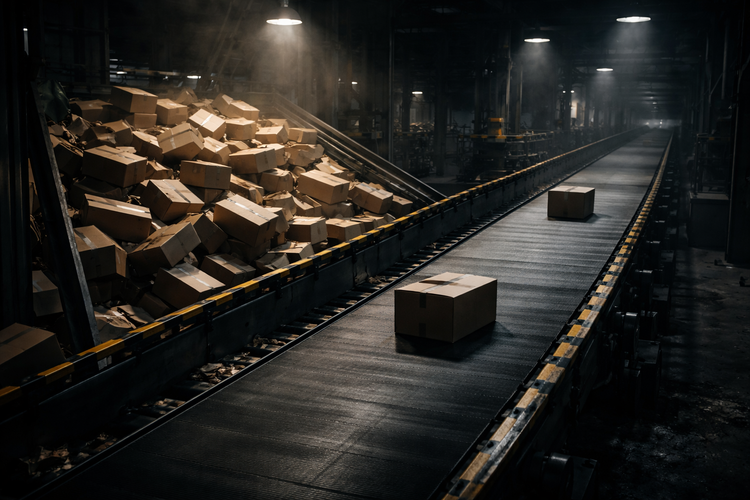
They carry memories of painful releases, heroic weekend deployments, migrations that aged everyone by three years, and the legendary "Big Platform Rewrite" that consumed two roadmaps and a small village of engineers.
Those experiences slowly become beliefs:
- "This part of the system cannot change."
- "We tried that already."
- "Do not touch this service unless you enjoy pager duty at 3 a.m."
The past becomes a heavy backpack nobody remembers packing.
Experience matters, of course. Wisdom grows from scars. But when yesterday's failures dictate today's decisions, organisations slowly lose their ability to evolve.
The Tao would say the same thing more elegantly: The river never flows backwards.
The Illusion of the Future
Other teams make the opposite mistake.
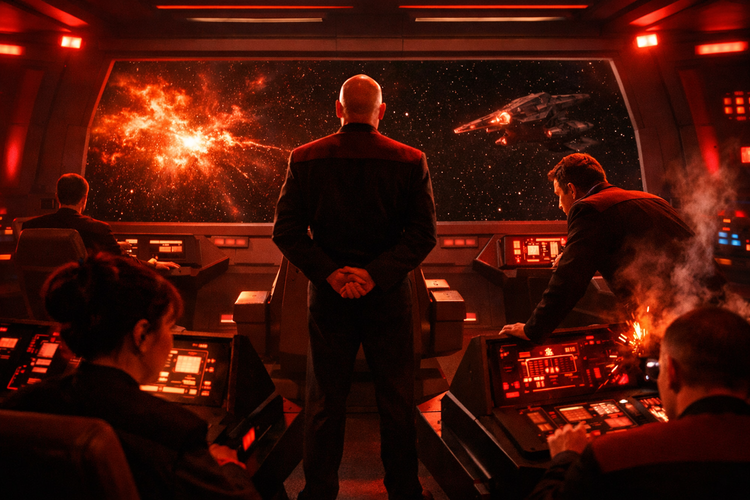
They live entirely in the future.
There is always a magnificent release waiting somewhere ahead.
The architecture will finally become elegant. The platform will stabilise. The product will reach its full vision. Documentation will exist. Tests will cover everything. The roadmap will align with the stars.
This mythical release always arrives next quarter. Roadmaps grow longer. Deadlines move gently to the right. Progress becomes theoretical.
Taoist philosophy calls this attachment to imagined outcomes.
Engineering usually calls it big‑batch delivery.
The irony is that many organisations claiming to practise Agile secretly hope for the same thing: the perfect release that fixes everything at once.
It rarely arrives.
The Present Moment of Delivery
The Tao of Agile proposes something simpler.
Focus on the present.
Every iterative system, whether Scrum, Kanban, or simply a disciplined delivery culture, asks a very quiet but powerful question:
What is the most valuable thing we can deliver now?
Not after the platform migration. Not once the architecture becomes perfect.
Now. Just Now.
That perspective changes behaviour in subtle ways.
Large ambitions shrink into smaller deliverables. Architectural improvements emerge incrementally. Feedback arrives earlier, while change still remains inexpensive.
Work stops revolving around hypothetical launches and starts revolving around observable progress.
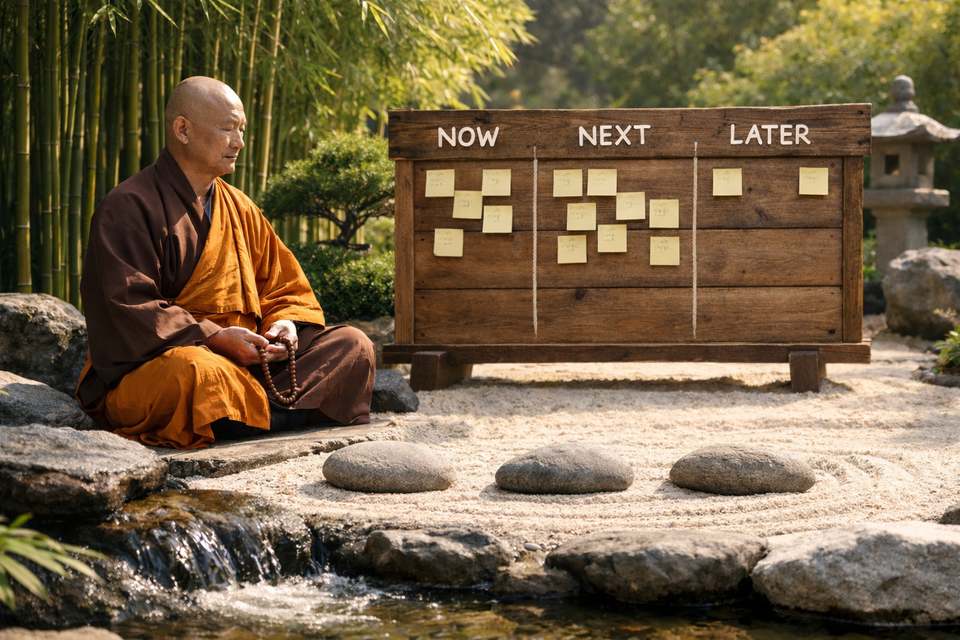
In Zen this might be called presence. In engineering it simply means shipping useful things regularly. Now, Next, Later
Many mature product organisations eventually converge toward a surprisingly simple planning model:
Now. Next. Later.
Now represents the work currently delivering value.
Next prepares the immediate future without pretending to predict everything.
Later remains intentionally vague, acknowledging that markets change faster than PowerPoint slides.
This model creates something rare inside modern organisations.
Calm focus.
Teams stop juggling twenty competing priorities. They stop promising everything to everyone. Instead they concentrate on moving one meaningful step forward.
And strangely enough, progress accelerates.
Following the Flow
The Tao never advocated passivity. It advocated alignment with reality.
Healthy engineering organisations behave in much the same way.
- They observe signals from customers.
- They adjust based on feedback.
- They deliver improvements continuously rather than waiting for the perfect moment.
Over time this rhythm produces something far more powerful than a heroic release.
It produces flow.
Delivery stops feeling like a sequence of crises. Progress becomes steady. Teams spend less time firefighting and more time improving the system.
There is another image from Taoist tradition that captures this idea well: Tai Chi.
In Tai Chi, the practitioner does not fight force with force. The movement absorbs, redirects, and continues. Balance replaces tension. Motion remains continuous.
Healthy Agile organisations behave in a similar way.
They let go of the illusion of total control and start moving with the system. They observe the direction of the system, the market, the users, the technology, and adjust their movement accordingly.
Instead of forcing the system, they move with it.
Which, if we are honest, feels suspiciously close to engineering happiness.
The Way
Perhaps that is the real teaching hidden inside Agile.
Do not carry the burden of yesterday's delivery.
Do not chase the illusion of tomorrow's perfect release.
Deliver value today.
Then do it again tomorrow.
Step by step.
Iteration by iteration.
Simply follow the Way.
As an old Agile master might say:
The novice asks when the release will finally be perfect. The master asks what can ship today.



Member discussion