The Russian Dolls of Real Engineering
Most organisations lose track not because people lack discipline, but because the work lacks a centre of gravity. Teams optimise for tasks, not concepts. They produce fragments, not systems. They move fast, but without structure, so speed becomes noise.
Real engineering begins elsewhere. It begins with the concepts that give shape, continuity, and coherence to everything that follows. Without them, an organisation drifts into detail-chasing, rework, and architectural entropy.
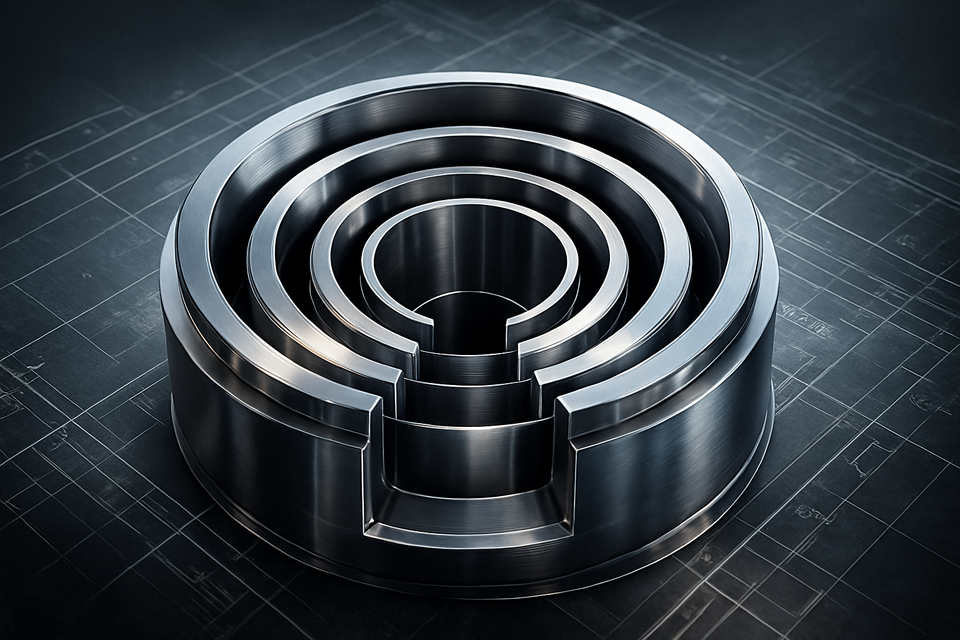
This article introduces a simple model: concepts are Russian dolls. Each conceptual layer encloses the next. Implementation sits at the smallest doll, where it belongs.
When You Lose the Concept, You Lose the Plot
Modern tech culture has normalised execution without understanding. Teams sprint into ceremonies, tooling, and user stories with no shared map. Predictably, they end up with:
- duplicated work,
- incoherent systems,
- dependency webs,
- constant rewrites,
- and burnout disguised as productivity.
Once the concept disappears, the organisation forgets its own intent. Memory collapses. Each team improvises its own logic. Nothing aligns or compounds.
Concepts stop this drift. They give every team a stable frame within which decisions make sense.
The Russian Doll Model of Conceptual Work
Real engineering starts at the outermost, most stable concept. Everything inside can evolve. The outer shell cannot.
- Domain Concept (DDD) – the business reality, invariants, and boundaries.
- Interaction Model (CQRS) – how the system behaves: reads versus writes, consistency, and intent flow.
- Information Flow (EDA) – events, contracts, propagation, and timelines.
- Implementation – local, disposable detail.
Each inner doll depends on the outer one. Never the reverse.
If your system’s identity lives in events (EDA), contracts remain stable while brokers, services, and projections can evolve freely.
If your system’s identity lives in the CQRS model, write consistency and read separation define your world, regardless of the technology underneath.
DDD, CQRS, and EDA are not frameworks. They are conceptual anchors. Choose the highest level that must remain stable and let the layers beneath remain fluid.
Why Organisations Avoid Conceptual Work
Concepts demand clarity. They expose weak reasoning. They force difficult choices.
Many organisations avoid this discomfort and hide inside:
- task lists,
- rituals,
- local optimisation,
- delivery theatre,
- cargo-cult architecture.
It feels safer in the moment, but it destroys coherence long-term. This is why transformations stall, migrations fail, and platforms decay while producing nothing durable.
Avoidance of conceptual work is one of the most expensive liabilities in modern engineering.
Concepts: Your Only Defence Against Entropy
As organisations scale, entropy rises:
- memory fades,
- ownership blurs,
- behaviours diverge,
- systems fragment.
Concepts act as the long-term memory of the organisation. They reduce cognitive load because teams share a stable mental template. They make autonomous decisions safe because everyone operates within the same boundaries and invariants.
Without concepts, nature fills the void with politics, accidental complexity, and hero culture.
Concepts Accelerate Delivery, They Do Not Slow It Down
Conceptual work is not a retreat into abstraction. When done well, it accelerates delivery.
Teams lose speed when they talk about implementation before understanding the model. They spend weeks debating handlers, pipelines, and configuration while the real architectural questions remain unanswered.
Concepts accelerate because they:
- filter noise,
- focus discussion,
- shape shared vocabulary,
- allow more people to contribute safely,
- ensure every decision compounds rather than fragments.
When sizing work, ignore the mundane implementation weight. That part is predictable. Prioritise by conceptual challenge: boundaries, invariants, contracts, and flows.
Once the conceptual frame is clear, engineers at different levels can contribute without damaging coherence.
At the right altitude:
- DDD discussions explore aggregates, boundaries, and invariants.
- CQRS discussions focus on consistency and read/write separation.
- EDA discussions focus on event identity, lifecycle, and projections.
Nobody cares about Kafka configuration in an architecture conversation.
Nobody should debate boilerplate when event identity remains unresolved.
Work at the conceptual altitude where decisions endure. Implementation will follow.
Implementation Is Never Your Identity
Identity lives in the concept, not the tool.
A strong conceptual layer allows you to rewrite everything beneath it without destroying the system.
This is how aerospace modernises airframes.
This is how railways evolve signalling.
This is how medicine updates critical equipment.
Engineering disciplines with real stake in the physical world start with concepts.
IT collapses whenever it attempts to improvise systems from implementation details upward.
Choose Your Doll, or the System Will Choose It for You
The Russian-doll metaphor is simple and relentless:
- If your top doll is wrong, everything inside collapses.
- If your top doll is right, everything inside becomes replaceable.
Working from concepts is not a stylistic preference. It is the only way to achieve:
- autonomy,
- clarity,
- stability,
- safe evolution,
- and real acceleration.
Engineers who master conceptual work build systems that outlive tools, trends, and noise. Everything else is temporary.




Member discussion