The Kobayashi Maru of Modern Tech: Winning the No-Win Scenario
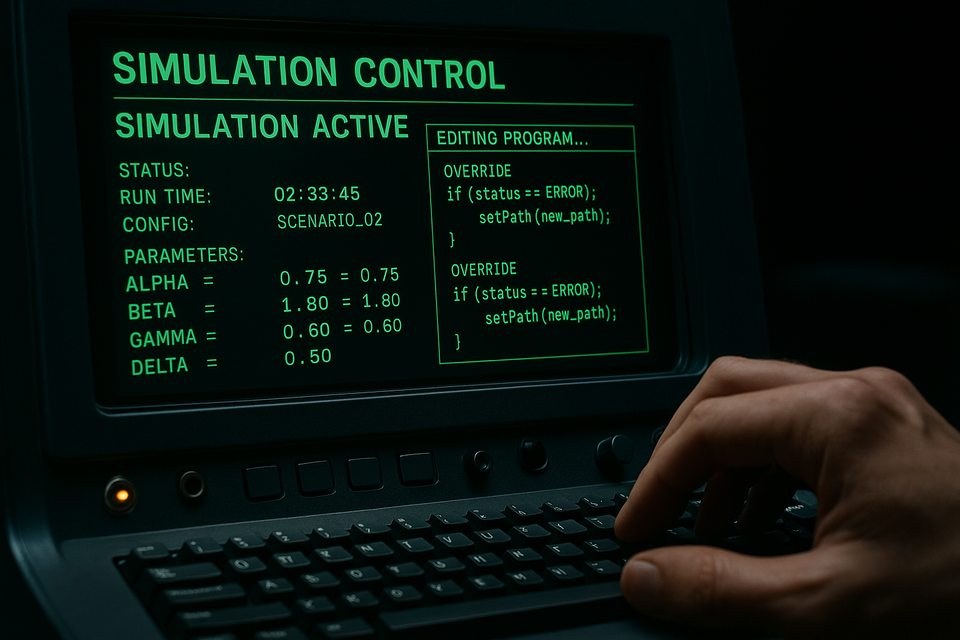
In the Star Trek universe, the Kobayashi Maru is a legendary test given to Starfleet cadets. It presents a no-win scenario: a civilian ship calls for help in enemy territory, and any attempt to rescue it triggers a devastating conflict. The simulation is rigged and there is no way to succeed. The point is not to win, but to observe how a future commander handles failure.
Except one cadet did win. James T. Kirk famously reprogrammed the simulation to make victory possible, declaring that he did not "believe in the no-win scenario." It was not cheating, but a refusal to be bound by a rigged frame. In fact, it is the exact opposite of Goodhart's Law: instead of gaming the metric, he restored the context required for meaningful action. He did not fake success. He created the conditions for real efficacy and agency.
This story has become more than science fiction. It is a lens through which we can examine the dysfunctions of modern tech organisations, where engineers, leaders, and teams often find themselves stuck in impossible loops. The real Kobayashi Maru is not a simulated space battle. It is the daily grind of pushing delivery through broken processes, misaligned language, and a culture that rewards illusion over impact.
No-Win Scenarios in IT
In today’s technology landscape, many organisations are caught in a loop of semantic decay, process theatre, and disconnected delivery:
- Words like "platform", "MVP", or "autonomy" have been drained of meaning. They are used to justify incoherent bets or low-quality delivery. In the process, we lose our sense of craft and lose sight of foundational engineering practices.
- Metrics are weaponised. Success is declared on dashboards while systems rot underneath. We create Goodhart’s Law traps, where the moment a metric becomes a target, it ceases to be a good measure. Instead of improving reality, we optimise the signal, breaking the very feedback loops we need to evolve.
- Roles drift from reality. Engineers are excluded from strategy. Product managers push projects without ownership. Leadership celebrates output over outcomes.
You are told to deliver faster, but dependencies are unresolved.
You are told to innovate, but you lack architectural agency.
You are told to scale, but the language guiding you has collapsed.
This is the Kobayashi Maru of IT. The test is real. And it is rigged.
The Wrong Responses: Coping Instead of Leading
Most people respond like the cadets who fail the test with honour. They try their best within a broken game:
- They build slideware strategies disconnected from actual team constraints.
- They deploy rituals to simulate control: OKRs without teeth, standups without focus.
- They stay silent when language is misused, because challenging it is political.
Others cope through cynicism:
- They joke about "vibe-driven development" or "platform theatre."
- They overuse AI tools to fake velocity.
- They detach emotionally, becoming passive executors.
But coping is not leading. And neither strategy prevents the organisation from becoming a Sisyphus machine, pushing the same rock up the same hill, watching it fall again. It builds a spiral of doom, where teams get increasingly trapped in bloated tactical routines that leave less and less space for reflection, re-architecture, or true fixes.
Change the Rules: Rewriting the Simulation
These companies illustrate what happens when you accept the rigged test, or choose to rewrite it. History offers us clear contrasts: companies that sank under their own bloated inertia, and others that rewrote their trajectory entirely.
- Yahoo serves as a warning. Once a tech giant, it became a maze of incoherent bets, strategic drift, and internal decay. It failed to prioritise, misused language like "portal" or "media strategy," and ultimately lost the plot.
- Nokia, too, stumbled. Though it had engineering brilliance, it lost sight of platform relevance and became trapped in tactical loops, where speed and compromise replaced focus and architectural clarity.
- Apple, by contrast, rewrote its own Kobayashi Maru test. When Jobs returned in 1997, he killed most of the product line, restored internal coherence, and reconnected design, engineering, and leadership. He rejected the bloated scenario and built a platform empire by doing less, better.
The only meaningful way forward is to act like Kirk: reject the premise, change the game.
In practice, this means:
- Restore Semantics
Words are not overhead. They are infrastructure. If your team cannot agree on what "platform" means, it cannot build one. If "impact" becomes a euphemism for internal optics, trust collapses.Leaders must protect the integrity of language. Demand precision. Stop using corrupted terms. Create alignment through shared vocabulary. - Reconnect to Reality
Every strategic decision must touch ground. This means closing the gap between slides and code, between ideas and interfaces. No more abstract transformations. No more cargo cult ceremonies.Systemic change requires architectural awareness, technical fluency, and cross-functional empathy. Otherwise, it is a fantasy. - Reject the No-Win Setup
Refuse to operate inside broken constraints that everyone knows are broken. Push for structural changes:You cannot escape the Kobayashi Maru by trying harder inside it. You have to dismantle the scenario.- Realign team missions.
- Kill zombie projects.
- Simplify cross-team dependencies.
- Stop metrics theatre.
- Lead from Any Seat
You do not need the rank of captain to rewrite the rules. Influence can come from any role, whether in a 5-person startup or a 5,000-person enterprise, because Leadership is not a title. It is a posture.- A senior engineer who challenges fake MVP definitions.
- A product leader who starts drafting actual problem statements instead of chasing illusions.
- An EM who says no to velocity theatre in order to preserve team integrity, reclaim time for true engineering, and prioritise outcomes over appearance.
Winning by Refusing to Lose
The Kobayashi Maru was never about victory. It was about agency. The test was rigged. But Kirk's answer was not to protest. It was to change the system so that people could be saved.
In IT, we face the same challenge. The systems we inherited are often broken. The language we use is often corrupted. The metrics we chase are often fake. But that does not mean we must play along.
The myth of Sisyphus is the fate of those who accept the no-win game.
The lesson of the Kobayashi Maru is the courage of those who rewrite it.
Do not just play the game. Rewrite it.




Member discussion