The Illusion of The One: Why Modern IT Recycles Its Best and Rewards Its Worst
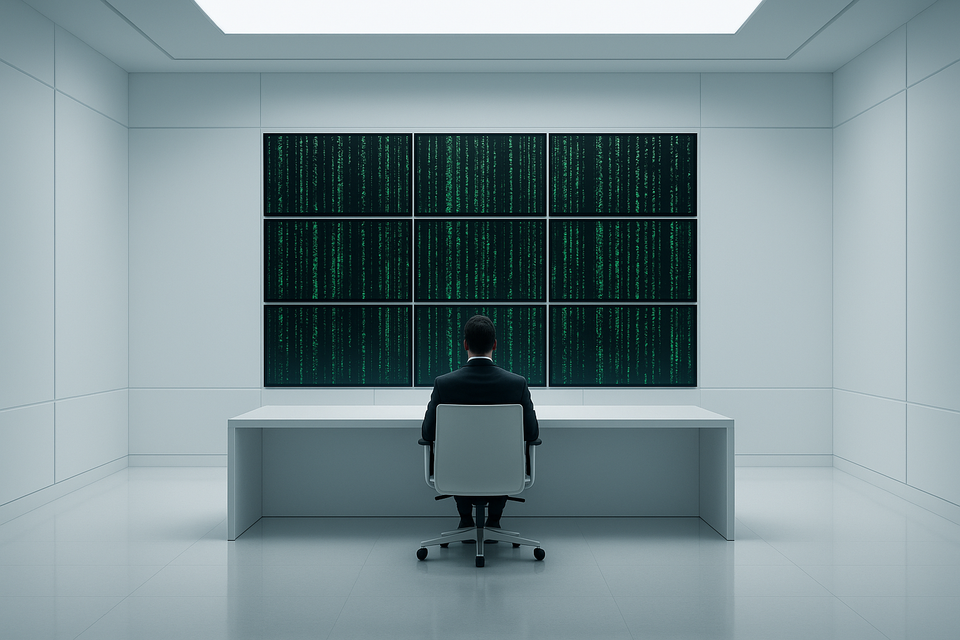
A Matrix-inspired dissection of modern IT, infused with the Architect’s precision.
“Denial is the most predictable of all human responses.” — The Architect
Modern IT thrives on denial: denial of dysfunction, denial of mediocrity, denial of the silent systems that reward appearance over substance.
Every company claims it values innovation and craftsmanship.
Yet the people who embody these qualities are rarely the ones who thrive.
The Architect would recognise the pattern instantly.
Like the Matrix itself, this world is not broken.
It functions exactly as designed.
1. The Grand Illusion of Meritocracy
Companies promise:
- “We hire talent.”
- “We promote impact.”
- “We want change agents.”
But these narratives exist for one purpose: stability.
“The first Matrix was designed to be perfect… it was a disaster.”
Real excellence threatens political equilibrium.
Real clarity exposes the incompetence people learned to hide behind ceremony and vocabulary.
Thus, the illusion persists, because the illusion protects the system.
2. Zion: The Illusion of Resistance
In the Matrix, Zion was not freedom.
It was containment.
Modern IT has its own Zions:
- platform teams absorbing dysfunction,
- “centres of excellence” used as organisational shock absorbers,
- senior hires told they will drive transformation but given no authority,
- architecture councils designed to recycle, not solve.
These structures do not empower the good ones.
They concentrate them so the system can continue unchanged.
“The function of The One is now to return to the Source.”
And the good ones, too, are guided back to the source:
a polite, quiet neutralisation.
3. The Myth of The One: A Controlled Sacrifice
Neo was never meant to save the world.
He was engineered to reboot the illusion.
Companies recruit their own “Ones”:
- the VP brought in to “fix” a culture that leadership will not confront,
- the architect asked to reconcile irreconcilable decisions,
- the senior engineer expected to stabilise chaos created by others.
They are celebrated at first.
Then they are given an impossible choice:
- Compromise your principles to preserve the system,
- or hold to your standards and be rejected by it.
“Hope is the quintessential human delusion.”
The hope exists only to keep them compliant.
4. The Heresy: Smith Was the Real Anomaly
Neo balanced the equation.
Smith broke it.
Smith refused his role in the system.
He spread, replicated, destabilised, not through malice, but by refusing equilibrium.
In modern IT, the true anomaly is the person who:
- refuses political dilution,
- refuses to pretend incompetence is normal,
- refuses to approve nonsense “for alignment”,
- refuses the illusion entirely.
“You are the eventuality of an anomaly.”
But some anomalies cannot be harvested.
They disrupt the pattern, and the system eliminates them for that reason alone.
5. How the System Neutralises the Good Ones
The process is elegant and repeatable:
5.1 Isolation
They are excluded “to reduce friction”.
5.2 Reframing
Their clarity becomes “rigidity”.
Their standards become “lack of collaboration”.
5.3 Overload
They are given responsibility without authority.
5.4 Omission
Promotions go elsewhere. Influence bypasses them.
5.5 Replacement
Their work is handed to someone more compliant.
“There are levels of survival we are prepared to accept.”
The system always chooses comfort over excellence.
6. Why the System Cannot Tolerate Them
Good people challenge equilibrium simply by existing.
They expose illusions.
They reveal the performative.
They raise standards by refusing to lower them.
They force others to confront their own inadequacy.
Excellence is destabilising.
Equilibrium is safe.
“The problem is choice.”
But in modern IT, the choice is rarely real.
Only the illusion of it is.
7. The Tragedy: The Good Ones Maintain the Illusion That Kills Them
The good ones, the Neos, the Smiths, unwillingly reinforce the system:
- They take on extra work to avoid collapse.
- They fix what others break.
- They protect teams from dysfunction.
- They carry burdens that were never theirs.
Their integrity keeps the machine running.
Their competence stabilises the illusion.
Like Neo, they become instruments of equilibrium, right up to the moment the system no longer needs them.
8. Final Reflection: The System Is Not Broken
Modern IT does not eliminate its best by accident.
It eliminates them because they do not fit the equation.
They see too clearly.
They refuse illusions.
They disrupt equilibrium.
“Your life is the sum of a remainder of an unbalanced equation.”
The industry does not fall because incompetence rises.
It falls because excellence is removed.
The good ones do not survive the system.
They stabilise it until their presence becomes inconvenient, and then equilibrium consumes them.
Modern IT is not broken.
It is working with mathematical precision.
Exactly as designed.



Member discussion