The Asimov Paradox: How Certainty Destroys Predictability
Why Product and Engineering Circle Each Other Instead of Building Anything
Summary: The Asimov Paradox describes a system in which Product and Engineering enter a self‑reinforcing loop of false certainty, eroded craft, and misaligned incentives. Each discipline believes it operates correctly. Each waits for the other. Neither generates information. As in Asimov’s Runaround, contradictory mandates cause endless circling rather than progress. The only way out is to restore a hierarchy of organisational laws, beginning with Law 0: each piece of work must bring information.
The Paradox That Eats Organisations
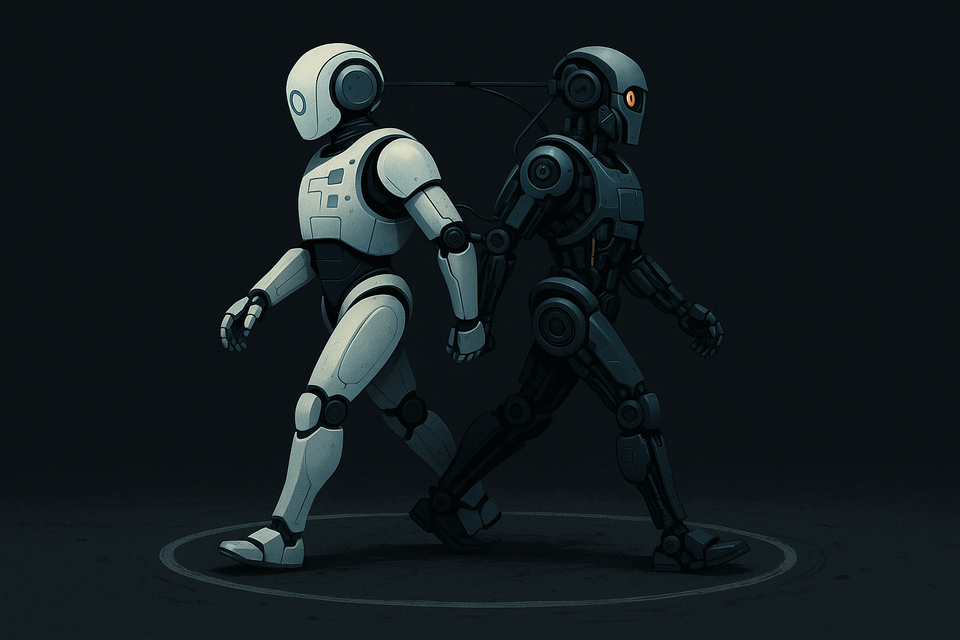
The Asimov Paradox occurs when teams demand clarity they cannot produce and refuse to advance without it. In Asimov’s story Runaround, the robot Speedy loops endlessly around a selenium pool because the Three Laws of Robotics pull with near‑equal force. No dominant rule breaks the tension, so the robot moves without progress.
Modern product organisations recreate this failure. Product and Engineering operate under incompatible expectations, degraded craft, and a missing unifying principle. The result is predictable: motion without progress.
The Perfect Spec Paradox: The Illusion of Certainty
The Perfect Spec Paradox emerges from the belief that clarity must precede action.
Product demands perfect specifications and often prescribes implementation details instead of defining the problem, the intent, or the constraints. It confuses documentation with understanding.
Engineering demands the same perfect specifications, convinced that full comprehension must exist before any action. This mindset is a quiet return to waterfall, packaged as prudence.
Both sides hide behind the same insecurity: a lost ability to think structurally. In attempting to create certainty, they destroy predictability. Momentum collapses. Teams freeze.
Loss of Craft: How Both Disciplines Declined
Craft erodes when organisations reward noise rather than judgment and rituals rather than thought.
Product
Product no longer models systems or articulates constraints. It produces wishlists and prescriptive solutions, often handing engineers a proof‑of‑concept built through superficial experimentation. This behaviour signals a lack of respect for professional engineering craft.
Engineering
Engineering no longer decomposes ambiguity. It retreats into process, avoids accountability, and seeks refuge in overly detailed planning. The deeper loss is intellectual: weakened system thinking, diminished confidence, and a fixation on implementation rather than outcomes.
Fear‑driven development replaces iterative discovery. Teams stare at the finger rather than the conceptual moon.
The Asimov Parallel: When Conflicting Mandates Paralyse Teams
Speedy circled because the laws constrained it in incompatible ways. Product and Engineering behave similarly. Each protects what it believes is essential, yet the mandates conflict.
- Product protects delivery.
- Engineering protects integrity.
- Neither protects understanding.
The organisation generates movement but not progress. The blame cycle begins. Each side insists on its correctness and fails to recognise its own role in the collapse. Trust dissolves. Knowledge evaporates. Senior talent leaves. The system decays.
The Mutual Delusion Loop
Each side constructs a hero narrative. Product believes prescriptive solutions represent leadership. Engineering believes defensive process represents quality. Both are wrong.
As the loop tightens:
- fear replaces judgment;
- certainty replaces discovery;
- rituals replace thinking;
- noise replaces outcomes.
This self‑sustaining loop prevents corrective action. No individual can escape it without systemic change.
The Psychological Fallout
The Paradox damages individuals. It produces insecurity, resentment, withdrawal, chronic stress, and the loss of professional confidence. People optimise for survival rather than contribution. They stop proposing ideas, stop exploring, and hide behind process.
Organisational entropy becomes culture.
Cultural Contamination
The dysfunction spreads rapidly:
- QA becomes defensive
- Design becomes territorial
- Stakeholders escalate unnecessarily
- Leadership reverts to micromanagement
- Teams operate through fear rather than clarity
The Asimov Paradox becomes the default operating mode.
How Leadership Enables the Deadlock
Leadership rarely triggers the Paradox but consistently strengthens it. Leaders:
- refuse to prioritise
- treat all work as equally urgent
- dilute ownership across functions
- avoid making structural decisions
- rely on alignment rituals instead of clarity
When leaders refuse to choose, the system defaults to chaos.
The Organisational Laws (Inverting Asimov)
The solution requires an explicit hierarchy of organisational laws, beginning with a Zeroth Law.
Law 0: Each piece of work must bring information.
Work is a learning vector. Each task must reduce uncertainty or reveal constraints. Work that generates no information is waste.
Law 1: Do not damage long‑term system integrity.
Law 2: Deliver continuous value to users and the business.
Law 3: Respect the boundaries and craft of each role.
Dysfunctional organisations invert these laws and therefore collapse.
Breaking the Paradox: Working Under Law 0
Law 0 is a design constraint for how Product and Engineering operate.
Clarity emerges from progress. Each slice of work must reveal something new about the user, the system, or the feasibility. Product defines testable constraints. Engineering structures increments that expose unknowns. Feedback, not speculation, drives alignment.
Work that does not generate information is treated as waste, irrespective of how active it appears.
What Good Looks Like
High‑performing teams:
- frame problems before imagining solutions
- treat constraints as design tools
- build incrementally and validate continuously
- use shared surfaces, not alignment meetings
- focus on outcomes rather than activity
- practise systems thinking rather than prescriptive thinking
- prioritise craft over theatre
A Fictional Example: The Seven‑Month Feature
A team receives a request for an onboarding enhancement. Product writes a ten‑page spec filled with imagined flows and prescribed technologies. Engineering estimates several months and requests further clarity.
Seven months and nineteen meetings later, nothing has been built. The spec has been rewritten four times. Two engineers have resigned. A designer has been reassigned. The original problem remains undefined.
This is the Asimov Paradox in practice.
The Real Danger
The danger does not lie in disagreement. It lies in intellectual decline.
Product and Engineering orbit the work, convinced they protect it, while progress remains impossible. Organisations escape the Asimov Paradox only when they prioritise principles over fear, craft over theatre, and learning over illusion.
The opposite of progress is not failure. It is motion without learning.
When teams rediscover how to think together, they stop circling.




Member discussion