Strategy Is a Compass, Not a Map: Stoic Lessons for Building Antifragile IT
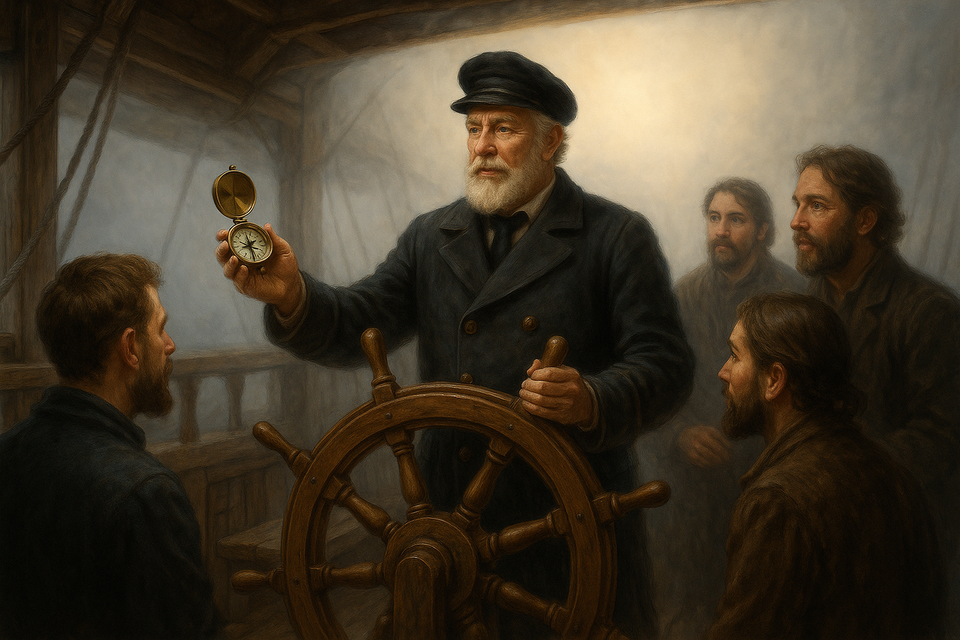
In the world of software, too many teams mistake the strategy for the destination. They hold tightly to plans, milestones, and projections as though they could predict the sea ahead. They treat delivery like a railway timetable, not a voyage across volatile waters. The result is fragility. When conditions change, as they always do, the strategy buckles, morale dips, and reactive decision-making takes over.
Seneca, one of the clearest voices of Stoic thought, warned us centuries ago:
"If a man knows not to which port he sails, no wind is favourable."
Strategy matters. Direction matters. But strategy is not a map. It is a compass useful for orientation, and useless for prediction. What matters is not rigid adherence to a route, but purposeful movement guided by principle.
This is not rhetorical philosophy. Seneca did not speak to impress, but to prepare. His ideas were tools for life, meant to be applied. Likewise, this is a practical call for engineering leadership. Systems fail. Priorities shift. Competitors seize the gap. Customers lose patience. Talent walks away. What protects a team is not clairvoyance, but antifragility.
Movement Over Perfection
To build antifragile systems, teams must remain in motion.
Not chaotic, frantic motion. But steady, mindful, deliberate progress. Work should flow like a healthy current. A backlog untouched for months is not a sign of clarity, but a symptom of decay. Code unshipped gathers entropy. Ideas untested become obsolete.
Being in motion does not imply delivering at all costs. It means never stalling under the illusion of certainty. It means keeping small iterations alive, even during large refactors. It means maintaining visibility, technical and organisational, through continuous feedback. A moving system learns. A static one deludes itself.
Frugality as a Form of Strength
Frugality is not about austerity. It is about precision. Engineering teams become fragile when they expand scope without clarity, or add resources without focus. The best teams work with clear boundaries and disciplined constraints. They reuse. They refactor rather than rebuild. They decline work that does not matter.
In Seneca’s terms, wealth does not lie in abundance, but in sufficiency. Though personally wealthy, he advocated travelling light, materially and mentally. This allowed him to remain mobile, resilient, and focused on what truly mattered. The same holds for engineering. Enough is often better than more. Build the smallest thing that works. Choose clarity over complexity. Strip your systems, and your plans, of ornamental excess. When the storm hits, bloated strategies sink first.
Expect Surprise, Design for It
Surprise is the default state of any real-world system. Hardware fails. Dependencies change. Regulations tighten. A team that only plans for the expected is already on borrowed time.
Antifragile organisations do not avoid surprise. They absorb and grow from it. This demands redundancy, observability, and decoupled design. But it also demands humility. Pride builds brittle architectures. Thoughtful engineering builds buffers, rollback plans, and mechanisms to pause and redirect safely.
In leadership, this translates into flexible roadmaps and decisions made close to the field. Central planning collapses under volatility. Distributed decision-making, anchored in shared principles, prospers.
Fear-Driven Teams vs Disciplined Motion
In any meaningful delivery effort, not all work carries the same weight. The Pareto principle holds: a small fraction of work typically delivers the majority of impact. Yet in practice, teams often lose this sense of asymmetry. Worse, some teams hide behind the supposed complexity of their domain as a shield against accountability. They fail to deliver value iteration after iteration, citing constraints instead of solving them. This often reflects a lack of ambition, limited experience, and an unwillingness to leave the comfort zone. It is a regression to the doom and dumbness of waterfall, where effort replaces outcome, and activity masks inertia.
Antifragile leadership means knowing where to place pressure. But it also means confronting a harder truth: many teams stall not because of complexity, but because of fear. Fear of not being ready. Fear of judgement. Fear of failure. They wait for perfect data, full alignment, complete certainty. They rehearse scenarios instead of delivering value. These are fear-driven teams.
In contrast, disciplined teams move with intent. They take small bets. They run short loops. They own trade-offs and ask: What few actions unlock the most value for users? What technical decisions protect us from rework later? What elements, if done well, enable everything else to follow?
Strategy must focus on leverage, not coverage. When all work is treated as equal, decision-making becomes noise. Impact vanishes in the fog of false equivalence.
Strategy as Frame, Not Cage
Rigid plans do not survive contact with change. What felt true a quarter ago often no longer holds a quarter later. Markets shift. Technology evolves. Competitors exploit delays with ruthless efficiency. But this does not mean teams should drift. Strategy still plays a vital role, but only when it acts as a frame for judgement, not a cage for activity.
A good strategy provides orientation. It sets the principles, the values, the engineering ethos. It reminds the team who the customer is, what quality means, and why the work matters. These are constants. But the tactics must evolve. Routes will shift. Projects will be paused or redirected. This is not failure. Just responsible navigation.
Seneca believed in constancy of character, not constancy of circumstance. In engineering, this means holding fast to quality, integrity, and customer value, even as deliverables change.
Conclusion: Build Like a Stoic
The Stoic mindset is not passive. It is fiercely active, but focused on what lies within one’s control. In engineering, this means delivering value without illusion, adapting without panic, and leading with quiet strength.
To build antifragile systems and teams, embrace uncertainty. There will never be enough data. Alignment will never be perfect. Readiness is an illusion. When we wait for all conditions to align, we surrender to fear. Fear-driven development paralyses. It prevents learning, blocks progress, and crushes ambition.
We must dare because we have a compass. Better to move and adjust than to stall in pursuit of perfection. In IT, stalling is not neutral. Stalling means death. Move. Deliver. Refactor. Listen. Change course if needed. But never lose sight of the compass: sound engineering, frugal choices, and a clear sense of direction.
In a world of endless change, it is not the team with the best forecast that wins, but the one that learns fastest, moves wisely, and stays true to what matters.
Let the waves come. Let the map fade. Check your compass. Adjust. Move.
Above all: dare. And keep moving. The only team that never delivers the wrong thing is the one that delivers nothing at all.
“Difficulties strengthen the mind, as labour does the body.” — Seneca




Member discussion