Starfleet Does Not Replace Agile. It Makes It Work
Most organisations claim to be agile.
They run ceremonies.
They track velocity.
They talk about empowerment.
And yet, under pressure, everything slows down.
Decisions stall.
Ownership blurs.
Execution fragments.
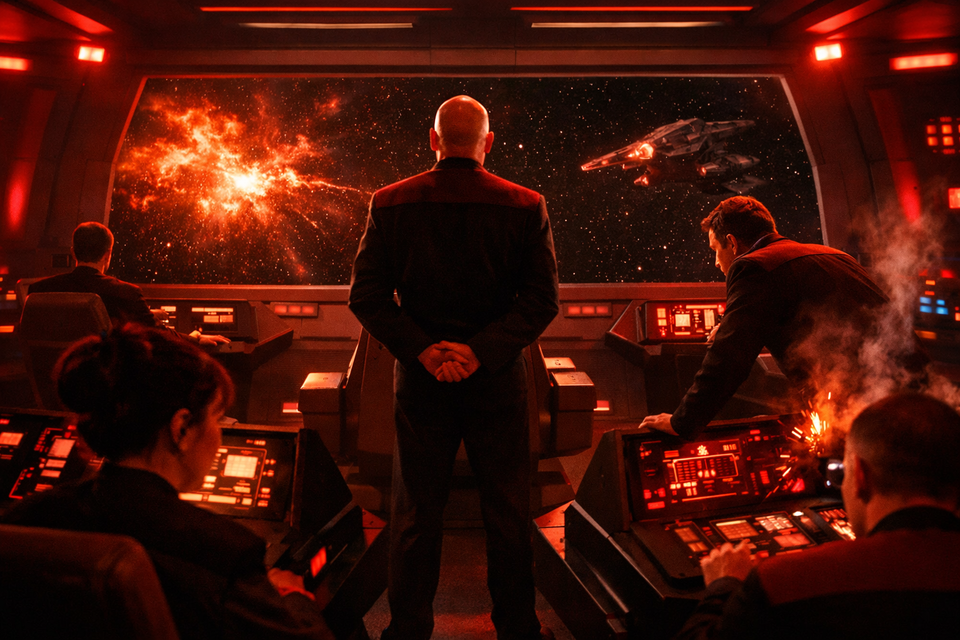
Now take something fictional.
Take Star Trek: The Next Generation.
A ship.
A crew.
A mission.
They align regularly, share context, challenge each other, and decide the next move
And somehow, it works.
Not because it ignores agility.
But because it embodies what agility was supposed to become.
1. Clarity creates autonomy
On the Enterprise, nobody asks:
“Who owns this?”
It is already clear.
- Picard frames the what and the why, gathers input when needed, then decides when required.
- Riker turns intent into execution and drives it forward
- Data analyses
- Geordi engineers
That clarity does not reduce autonomy. It enables it. Because when roles are explicit, individuals do not wait.
They act.
Most organisations dilute ownership in the name of collaboration. Which creates the opposite effect: hesitation, escalation, delay
Agility does not start with freedom. It starts with clarity.
2. Structure enables flow
The Enterprise does not improvise when things go wrong.
It relies on:
- protocols
- escalation paths
- defined responsibilities
These are not rigid constraints. They are pre-aligned decisions.
Which means that when something happens, energy goes into solving the problem. Not organising the response.
Many teams treat process as overhead. Until they face real pressure.
Then they realise too late that: lack of structure is the real bottleneck.
Agility is not the absence of structure. It is the presence of the right one.
3. Competence fuels speed
Nobody debates whether Geordi can fix the engine.
Nobody asks Data to justify every step.
Competence is assumed because it has been built and proven. This changes everything.
Because speed does not come from cutting corners. It comes from trust in capability.
In many organisations, everything becomes negotiable. Which leads to:
- longer discussions
- slower decisions
- diluted accountability
True agility depends on something simple: the right people, in the right roles, trusted to act.
4. Feedback is immediate
On the Enterprise, failure is visible.
- systems fail
- shields drop
- impact is instant
There is no ambiguity. Outside is the void. Absolute zero. Raw danger that does not forgive mistakes.
Reality speaks directly. This creates tight feedback loops.
The system adapts quickly because it cannot ignore consequences.
Modern organisations often rely on abstract metrics. Which delays understanding.
And sometimes hides the problem entirely.
Agility requires fast feedback, a direct line to reality, like an Andon cord or XP practices, where the system surfaces issues immediately instead of hiding them. Not comfortable feedback.
5. Purpose drives behaviour
The crew does not follow process for its own sake. They act because the mission matters. Exploration. Survival. Responsibility.
That sense of purpose changes behaviour.
People (boldly) go further.
They anticipate.
They adapt without being told.
This is where most organisations fall short. They try to implement agile mechanically.
But without purpose, agility becomes ritual.
With purpose, it becomes drive, autonomy, mastery, and purpose reinforcing each other.
Starfleet does not try to motivate people.
It creates the conditions where drive emerges naturally.
6. Authority enables movement
Picard does not avoid decisions.
He takes them.
Not to control.
But to unblock.
Authority is not opposed to agility. It is what prevents paralysis.
When authority is unclear, decisions drift. When it is explicit, execution accelerates.
Agility needs autonomy. But autonomy without direction creates noise.
Starfleet balances both.
There is a moment where this becomes explicit: when Deanna Troi takes the bridge officer test and realises the only way to succeed is to order a crew member to their death in a simulation.
The lesson is brutal and clear: Leadership is not about being liked, but about making the call when there is no good option.
Accountability, trust, sacrifice, discipline, these are not values on a wall.
They are decisions taken under pressure.
And everyone on the bridge understands it.
7. The system holds under pressure
The real test is not how a system behaves when everything is easy. It is how it behaves when things go wrong.
The Enterprise does not collapse under stress. It tightens.
- roles become sharper
- decisions faster
- execution more focused
This is not accidental. It is designed.
Most organisations optimise for normal conditions.
Starfleet is built for the worst ones.
So what?
This is not a nostalgic comparison. It is a reminder.
Agility was never about removing structure. It is about enabling movement.
That movement requires:
- clarity
- competence
- purpose
- feedback
- authority
Without these, agility becomes theatre.
With them, it becomes real.
Final thought
If your teams struggle to move fast, it is not because they lack frameworks. It is because the system does not support them.
Most organisations try to fix this with more process.
More rituals.
More alignment.
But none of these create movement.
Because movement does not come from what you add.
It comes from what the system allows.
Starfleet does not push people to perform. It removes the friction that prevents them from doing so.
That is the difference.
You do not lack agile. You lack a system that can face reality.
You lack a system where:
- reality is visible
- decisions are clear
- competence is trusted
- purpose is felt
Fix that.
And agility will not need to be enforced.
It will emerge.
#FridayFun #SystemsThinking #Agile #Leadership #Execution





Member discussion