Monday Myth: Strategy Lives at the Top
The Myth
Most companies quietly believe the same thing: strategy lives at the top of the organisation. It sounds reasonable : Executives think. Teams execute.
But in practice this belief quietly destroys execution.
Executives define direction.
Slides outline priorities.
Roadmaps cascade downward.
From there, teams execute. On paper this model looks clean and rational.
Strategy flows downward.
Execution follows.
Results appear.
Reality rarely behaves so politely.
Strategy does not exist outside the system expected to deliver it. It lives inside a complex environment shaped by technology, people, incentives, constraints, and feedback loops. When strategy ignores those forces, something predictable happens: the plan remains elegant while execution struggles.
At that point organisations often blame culture, alignment, or communication.
In truth the problem often lies elsewhere. The strategy never connected properly to the system responsible for implementing it.
1. The Invisible Knowledge Inside Execution
Execution layers contain knowledge leadership rarely sees directly.
Engineering teams understand architectural constraints.
Operations understand friction in real processes.
Product teams observe customer behaviour long before metrics capture it.
Support teams see where the system fails users.
These signals define what is realistically achievable. So, when strategy flows only from the top, two problems appear.
First, leadership operates with incomplete information.
Plans look coherent at the strategic level but collide with operational realities during implementation.
Second, teams lose their sense of purpose.
They receive goals but cannot clearly see how their daily work contributes to the broader direction of the company.
Over time this disconnect produces familiar symptoms:
• Roadmaps change constantly
• Priorities shift every quarter
• Teams execute work without understanding the strategic intent
Not because people lack competence. Because the organisation separated strategy from the system responsible for delivering it.
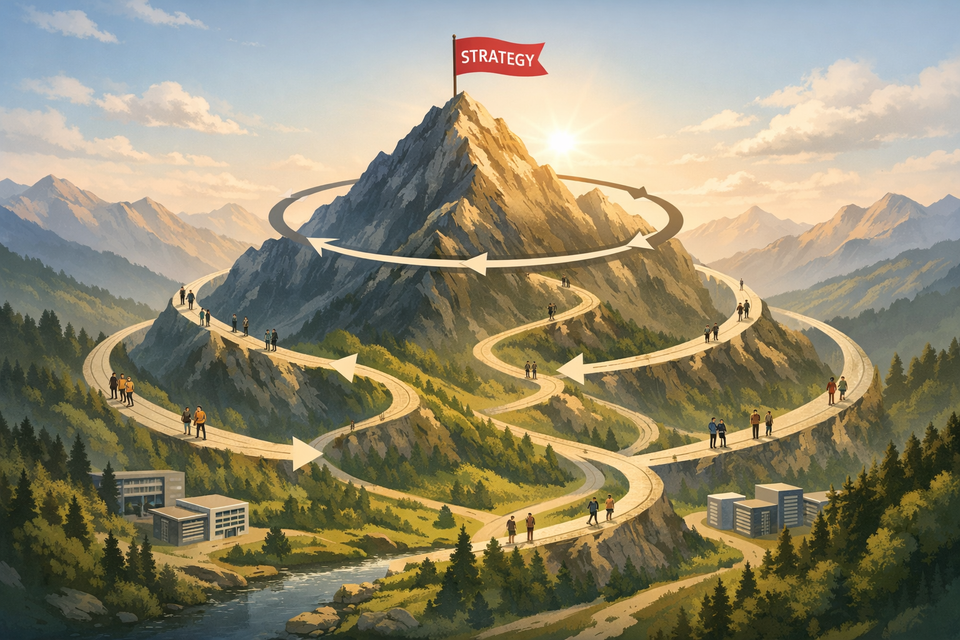
2. Strategy Is Not a Cascade. It Is a Loop.
High‑performing organisations treat strategy differently. Direction still comes from leadership. Organisations need vision and clarity about where they intend to go.
But strong organisations recognise something critical: strategy must evolve through operational feedback.
Execution produces signals. And those signals reshape strategy. Strategy therefore behaves less like a cascade and more like a loop:
Direction → Execution → Feedback → Refinement
Engineering organisations illustrate this particularly well. Engineers see where systems bend and where they break. They understand the hidden costs of architectural decisions. They detect technical friction long before it appears in high‑level reports.
When those insights travel upward, strategy becomes grounded in reality. Not theoretical. Executable.
I once witnessed this dynamic clearly during a discussion about profitability on a SaaS platform.
The CEO explained the importance of understanding the cost of running a single transaction. Instead of remaining an abstract financial metric, engineers immediately connected the conversation to architecture, infrastructure costs, and system efficiency.
Suddenly executives and engineers were speaking the same language:
• cost per transaction
• system behaviour
• operational efficiency
Strategy and execution met in real time. And the loop closed instantly.
This dynamic does not weaken leadership authority. It strengthens it.
Leaders make better strategic decisions when they remain connected to the operational system.
3. Purpose Emerges When Strategy Connects to Work
Another important consequence appears when teams participate in shaping strategic outcomes. People rarely commit deeply to a strategy they simply receive. Engineering teams in particular seek clarity about three questions:
- Why does this matter?
- How does my work contribute?
- What real problem are we trying to solve?
When teams help surface constraints, opportunities, and solutions, strategy stops being a directive.
It becomes a shared direction.
This shared understanding creates something organisations often struggle to build: a genuine sense of purpose.
Purpose does not come from slogans or internal campaigns. It emerges when people understand how their work contributes to meaningful outcomes.
- Participation creates ownership.
- Ownership reinforces commitment.
- Commitment improves execution.
Strategy therefore becomes stronger when it incorporates the intelligence of the system delivering it.
4. A Practical Mechanism: Scale In, Scale Out, Communicate
One practical way to create this connection appears in the framework Scale In, Scale Out, Communicate, described in the book An Evolution for a Revolution, co‑authored with Karol Kasáš .
The framework creates a structural bridge between strategy and execution.
Scale In
Scale In empowers engineering and operational teams to bring forward initiatives aligned with company goals.
By surfacing ideas, constraints, and opportunities early, teams contribute insight directly from the operational system. This helps engineers:
• understand the strategic direction
• anticipate future needs
• connect execution with long‑term intent
Over time engineers involved in this process begin to see themselves differently. They no longer execute isolated tasks. They participate in shaping the organisation's trajectory.
Many also begin projecting themselves into leadership paths, discovering whether they aspire toward deeper technical leadership or broader managerial responsibility.
Scale Out
Scale Out spreads strategic direction across the organisation so teams understand where the company is going and how their work contributes to that direction.
Clarity reduces misalignment and prevents strategy from remaining confined to executive discussions.
Communicate
Communicate closes the loop. Information flows both ways.
Leadership communicates intent. Teams communicate feedback from execution.
And strategy evolves continuously through that exchange.
Instead of a static annual document, strategy becomes a living system capable of learning.
5. Why Executives Should Care: The Economics of the Loop
For executives this approach is not only cultural or organisational. It is also economic: when strategy and execution operate as a loop, several measurable effects appear.
Decision velocity increases.
When engineers, product leaders, and executives share the same operational language, decisions happen faster. Leaders no longer operate with delayed or abstract information. They can act on signals coming directly from the system.
This dramatically reduces what might be called strategic latency: the delay between a signal emerging in the system and leadership acting on it. Organisations that shorten this latency adapt faster, correct mistakes earlier, and move with far greater confidence.
Strategic mistakes become cheaper.
Feedback arrives earlier. Instead of discovering problems months later, organisations adjust direction continuously.
Customer experience improves.
Teams closer to users influence strategic direction earlier. This reduces friction in the product and increases customer loyalty.
Churn decreases while long‑term value increases.
When teams understand the strategic intent behind what they build, they make better decisions locally. Products evolve with greater coherence and stability.
Execution becomes more predictable.
Because constraints surface earlier, organisations avoid the common cycle of ambitious plans followed by emergency re‑prioritisation.
In other words, building a strategic loop is not a philosophical exercise. It is an investment. An investment in faster decisions, better products, and more resilient organisations.
6. Why This Matters Even More When Companies Scale
This dynamic becomes even more critical as companies grow.
In early stage startups, strategy and execution often live close together. Founders speak directly with engineers. Decisions happen quickly because information flows naturally.
As organisations scale, distance appears.
- Layers emerge.
- Processes appear.
- Signals travel more slowly.
Without deliberate mechanisms, strategic latency increases.
This is why many companies move fast during the early stages but slow dramatically after Series A or Series B. The system grows, but the feedback loop between strategy and execution weakens.
Building mechanisms such as Scale In, Scale Out, Communicate helps preserve that loop as the organisation expands.
Instead of strategy drifting away from execution, the system keeps reconnecting both continuously.
For founders and investors alike, this matters enormously. The companies that scale successfully are rarely the ones with the most ambitious plans.
They are the ones capable of continuously aligning strategy with operational reality.
Breaking the Myth
Strategy does not live exclusively at the top of an organisation. Leadership provides direction. And the system delivering that direction constantly reshapes it.
Organisations that ignore this dynamic often struggle with alignment, slow execution, and endless strategic resets.
Those that embrace it build something far more resilient. A system where strategy and execution inform each other continuously. In such organisations strategy stops being a presentation prepared for leadership meetings.
It becomes something far more powerful. A system capable of learning. And when that happens, something important changes. Strategy stops being something written for leadership meetings. It becomes something the system itself helps shape. That is when execution accelerates.
Because the organisation is no longer trying to implement a strategy designed far from reality.
It is building one together.





Member discussion