Monday Myth: Improvement Comes from Adding More
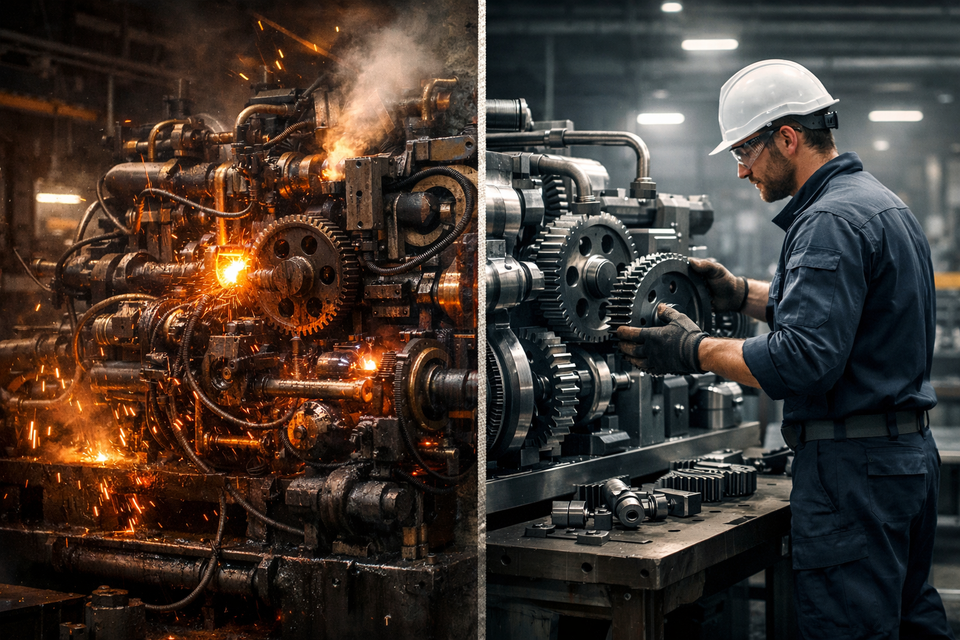
Most organisations chase improvement like a machine spinning faster without producing more output. More processes, more tools, more meetings, more roles. Gears turning everywhere, energy consumed everywhere, yet throughput does not move. It signals action, reassures stakeholders, and creates the impression of control, while making the system heavier, slower, and less efficient.
The Illusion of Progress
Addition feels productive because it is visible, and people experience it as progress. Individuals do more, move more, attend more, yet cannot see why outcomes do not improve. A new process can be documented, a new role announced, a new tool deployed.
Removal is different. It requires judgement and creates discomfort. What is taken away feels like loss, even when it improves the system. This is loss aversion: losses are felt more strongly than equivalent gains. Removal is therefore resisted, even when correct. Evolutionary psychology adds another layer: removal can signal past decisions were unnecessary or wrong, threatening reputation and status. People defend what exists, even when it no longer serves the system.
So organisations keep adding. And complexity grows faster than value.
Where Systems Actually Improve
High-performing systems do not evolve through accumulation. They evolve through selection. They remove what does not contribute to flow, clarity, or outcome.
What slows delivery is rarely a lack of effort. It is the accumulation of friction disguised as necessity. In physics, friction is energy lost to heat, pure waste that reduces useful work. The same applies here: legacy decisions never revisited, temporary fixes that become permanent, safeguards that outlive the risks they address.
Over time, the system becomes heavier. Not because it needs to be, but because nothing is removed. Like in mechanics, friction compounds until the system stalls.
Leverage Comes from Removal
The highest leverage interventions are rarely where activity increases. They are where structure simplifies.
When a stock must stabilise or grow, most people think in terms of inflow, adding more. Yet there are always two levers: increase what comes in, or reduce what leaks out. The second is less intuitive, less visible, and often more effective.
Many organisations get this wrong. They over-invest in inflow and under-invest in leakage control. They chase demand, initiatives, and output while ignoring rework, decision drag, duplication, and misalignment. They try to fill the system faster than it is bleeding energy.
Removing a constraint, shortening a feedback loop, or eliminating an unnecessary dependency changes system behaviour. This is not marginal optimisation. This is structural impact.
What This Looks Like in the Real World
This pattern is not theoretical.
A team adds approvals to reduce risk. Delivery slows and risk barely changes. A platform adds abstraction to be “future-proof”. Integration becomes harder and adoption drops. A product organisation increases intake to show momentum. Teams start more, finish less and context switching explodes. A company adds roles to improve coordination. Decisions slow and ownership blurs.
In each case, intent is valid. Outcome is the same: more activity, less throughput. What is missing is not effort. It is removal.
Named Examples
Some organisations pay the price of not removing. Nokia accumulated layers, preserved legacy decisions, and failed to simplify as the market shifted. Complexity grew while responsiveness declined. The system could not adapt fast enough.
Others build advantage by removing. Toyota’s production system relentlessly eliminates waste. Instead of adding controls, it removes variation, excess inventory, and unnecessary steps. Flow improves because friction is reduced.
The contrast is simple. One protects what exists and adds around it. The other questions everything and removes what does not serve flow. Only one scales.
The Constraint Does Not Care About Your Process
Throughput does not improve when everything moves faster. It improves when non-essential work stops competing with the constraint. Every unnecessary step consumes capacity that should be reserved for what matters.
Most organisations optimise locally. They add layers to manage symptoms instead of addressing causes. They protect structures instead of questioning their relevance.
The Cost of Not Removing
The result is predictable. Decision latency increases, coordination overhead rises, effort expands while outcomes stagnate. Teams stay busy, but the system slows.
The Risk of Removal
Removal is not safe. It is a judgement call, a trade-off, and often a trial-and-error process. Remove the wrong thing, and you can destabilise the system.
This is why many organisations avoid it. Addition feels reversible. Removal feels final. Yet avoiding removal creates a different failure mode: systems become so overloaded that drastic, poorly targeted cuts follow.
Recent waves of layoffs driven by “AI-first” narratives illustrate this. Companies remove capacity blindly, chasing a perceived future state without understanding what sustains their system today.
This is not disciplined removal. This is reactive reduction. The difference matters.
How to Remove Without Breaking the System
Removal is a discipline, not an instinct.
Start with the constraint: remove anything that does not support it. Target leakage first: rework, delays, duplication, misalignment. Remove in small increments and observe behaviour. Make reversibility explicit where possible. Measure impact on flow, not activity.
Removal is not about cutting randomly. It is about protecting what matters by eliminating what does not.
The Hard Question
Improvement does not start with what to add.
It starts with a harder question: what can be removed without degrading the system?
And then: what improves once it is removed?
Closing
Most organisations are not underbuilt. They are overloaded. Until removal becomes a discipline, addition will be mistaken for progress.
If everything looks necessary, you have already lost control of the system.




Member discussion